Council adopts new site‑development rules, adds traffic‑study requirement to code
Summary
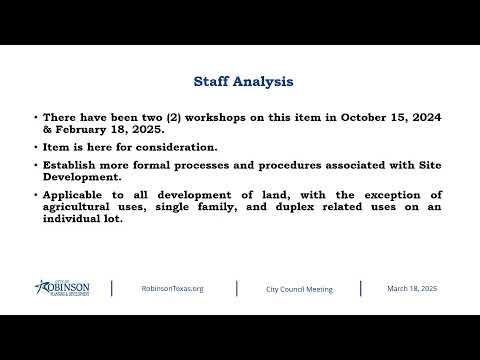
Robinson replaced the site‑plan provisions of Chapter 11 with a new Chapter 22 site development code, formalizing processes and adding traffic‑impact analysis requirements for non‑single‑family projects.
The Robinson City Council voted to delete Appendix A, Zoning Article 11 (site plan approval) and add a new Chapter 22 titled “Site Development,” adopting Ordinance 2025-007.
Planning and development director David Harrow told the council the replacement consolidates and clarifies site development processes, application requirements, pre‑development meeting rules and the materials applicants must submit. The amendment applies to nonresidential site development — commercial, industrial, multi‑family and similar projects — and excludes single‑family lots, duplexes on a lot, and agricultural uses.
Harrow said Chapter 22 also formalizes the use of Traffic Impact Analyses (TIAs) for qualifying developments and establishes scope and review procedures. “We’re also adding traffic impact analysis requirements in as well … just as you looked at tonight as part of this PDD modification process for these items as well,” Harrow said.
The city staff report noted the Planning and Zoning Commission recommended the change unanimously (5–0) in July 2024 and that the draft ordinance spells out the specific submittal materials and review steps staff needs to review and permit nonresidential developments.
Council moved to adopt Ordinance 2025-007 as presented; the motion was seconded and the ordinance passed with recorded “Aye” votes and no oppositions listed in the minutes.
The ordinance replaces the prior site‑plan provisions and is intended to create clearer expectations for applicants and to ensure staff and outside reviewers have consistent scoping and submittal requirements — including when a traffic impact study is required.
AI generated
The text on this page is AI generated. Summaries, highlights, analysis, and video transcripts are all produced from the original source material.
AI can make mistakes, so if you spot one, and we will fix it for everyone.
Note: the source content is unaltered by us. Any content source we link to, be it a video, an audio recording, or a document, is presented exactly as its publisher released it. That publisher is usually a government body, sometimes an individual official or another organisation.