Get AI Briefings, Transcripts & Alerts on Local & National Government Meetings — Forever.
Senate Criminal Justice Committee advances package of bills on child murders, trafficking survivors and victim protections
Loading...
Summary
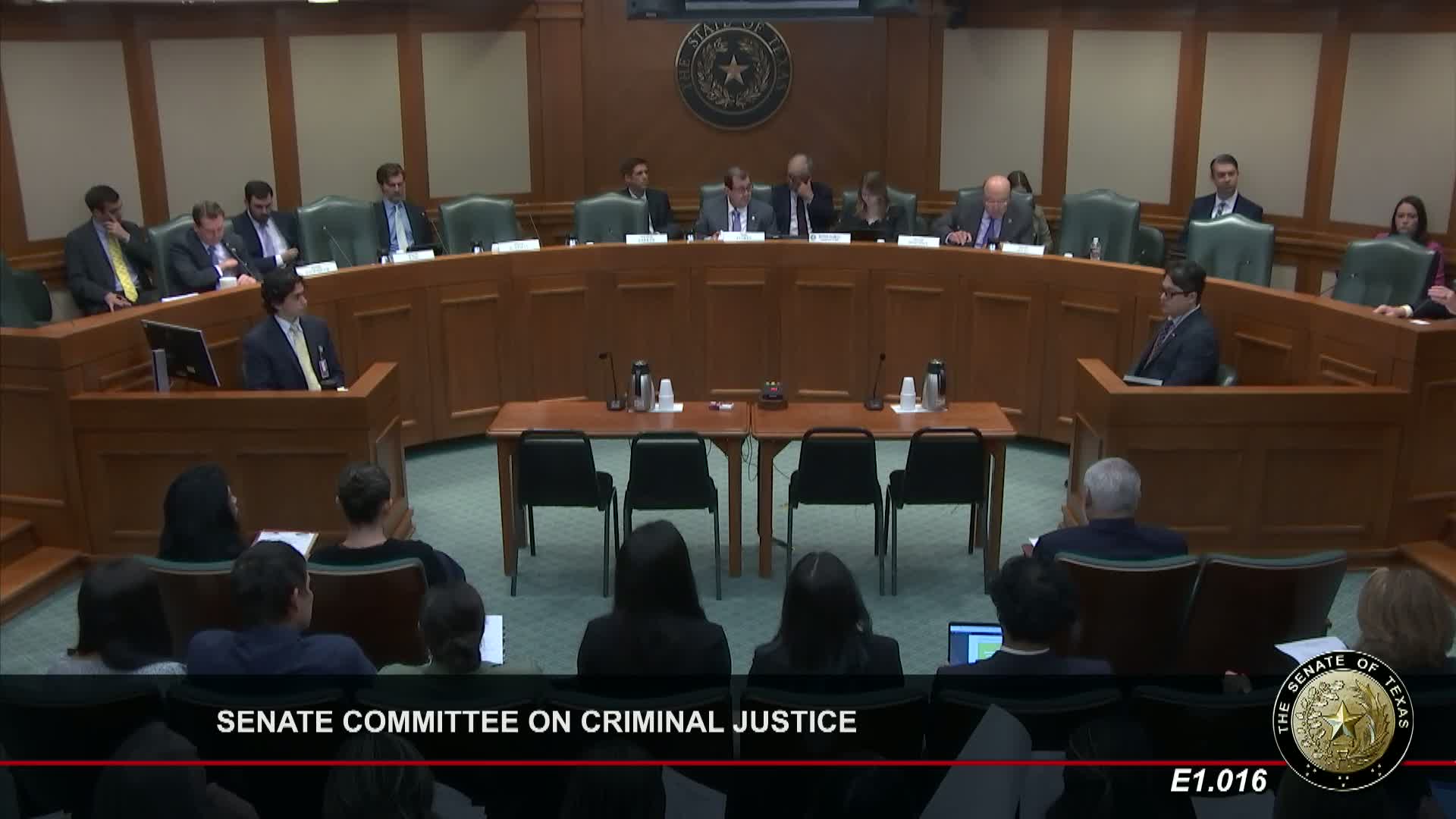
The Senate Committee on Criminal Justice on Oct. 12 advanced a set of bills addressing child murders, human trafficking, victim protections and organized theft, voting to send most measures to the full Senate.
The Senate Committee on Criminal Justice on Oct. 12 advanced a set of bills addressing child murders, human trafficking, victim protections and organized theft, voting to send most measures to the full Senate.
The committee, chaired by Senator John Flores, voted to report favorably measures that would: expand capital‑punishment eligibility in certain child‑murder cases (Senate Bill 990); broaden non‑disclosure and sealing options for survivors of human trafficking (SB 958 committee substitute); expand shield‑law protections for trafficking and child‑specific sexual offenses (committee substitute for SB 535); create a continuous aggravated promotion‑of‑prostitution offense (SB 957); raise penalties for thefts that damage fuel‑pump equipment used to steal large volumes of fuel (SB 988); and require better reporting on overdue sexual‑assault evidence kits (SB 608). The committee also moved forward bills to align juvenile and adult outcry testimony rules (SB 1019), bar community supervision for stalking convictions (SB 1021), add family‑violence victims to expanded conferencing rights (SB 1120), authorize magistrates in Bell County (SB 251), and toughen penalties for traffickers who recruit victims from correctional facilities (SB 955).
Why it matters: the bills target several recurring problems identified by prosecutors and victim advocates — gaps in legal protection for child and trafficking victims, difficulty prosecuting long‑running prostitution enterprises, and law‑enforcement challenges in holding organized theft rings accountable. Supporters said the package will give prosecutors new tools and victims clearer rights; some measures prompted emotional testimony from survivors and family members.
Senate Bill 990 — death‑penalty eligibility for certain child murders
Senator Paul Bettencourt introduced SB 990, citing the 2024 murder of 12‑year‑old Jocelyn Nungari in Harris County as a motivating case. Bettencourt said the current statute excludes some preteens from capital‑murder eligibility and that prosecutors should have discretion to seek the death penalty in some child‑murder cases: "I feel that for the justice of the family, for Jocelyn's mother, who's here with us... this is the 1 time that I'll be signing on to a death penalty bill," Bettencourt told the committee.
Two family members of slain children testified. Alexis Nungari, who identified herself as Jocelyn's mother, described her daughter's death and urged the committee to expand eligibility: "She was strangled to death. She was brutally raped... Left there to rot," she said. April Leguiri, who identified herself as the aunt of Arlene Alvarez and spoke for other families, testified about additional child victims and said investigators often must wait months for forensic confirmation of sexual assault before a capital charge is available.
Victim‑advocacy witnesses and prosecutors also supported the bill. Andy Khan, director of victim services for Crime Stoppers of Houston, said the statutory age gap leaves prosecutors without discretion in cases involving children ages roughly 10–15 and asked the committee to "rectify this glitch in the system."
The committee voted to report SB 990 favorably to the full Senate (tally recorded in committee: 5 ayes, 0 nays).
SB 958 (committee substitute) — nondisclosure for trafficking survivors
Senator Robert Huffman presented a committee substitute to SB 958, which would expand judicial nondisclosure (sealing) options for survivors of trafficking so that misdemeanors commonly committed under coercion (drug possession, forgery of documents, public intoxication and others) can be sealed from public view while preserving law‑enforcement access when needed. Huffman stressed the bill preserves the existing judicial process for obtaining nondisclosure orders and that the change is narrowly tailored to offenses committed "as a result of being a victim of trafficking."
Invited witnesses supporting the substitute included Joseph Scaramucci (director of law enforcement training and operations at SGS Incorporated), Andrea Sparks (co‑founder, Not on Our Watch Texas) and other advocates who described how criminal records created because of coercion hinder survivors' ability to obtain housing, employment and banking.
The committee substitute was adopted and reported favorably (committee tally: 6 ayes, 0 nays). The committee also recommended the measure for the local and uncontested calendar.
SB 535 (committee substitute) — expanding the sexual‑assault shield rule to trafficking and child‑specific offenses
A committee substitute for SB 535 was offered to expand protections in Rule 412 of the Texas Rules of Evidence (the "rape‑shield" rule) beyond sexual assault and aggravated sexual assault to cover trafficking offenses and child‑specific sexual crimes, such as continuous sexual abuse of a young child and indecency with a child. Supporters said the change prevents defense teams from introducing irrelevant past‑sexual‑history material to discredit victims, particularly minors, during long prosecutions.
Victims and prosecutors described the harms when trials are delayed for years and victims' post‑trauma conduct is used to attack credibility. Assistant District Attorney Alicia Byrd, who prosecuted cases in which the existing rule did not apply, testified that the substitute would let victims and prosecutors focus trials on the charged offense rather than on unrelated conduct that occurred after the crime. The committee substitute was adopted and reported favorably (5 ayes, 0 nays).
SB 1019 — aligning outcry‑witness rules between adult and juvenile courts
Senator Huffman laid out SB 1019 to resolve a statutory mismatch: prior sessions raised the age for outcry‑witness admissibility in adult criminal procedure to 18, but the Family Code’s corresponding provision still limited outcry support to victims 12 or younger in juvenile cases. Michael O'Brien, chief juvenile prosecutor in Dallas County, described a pending juvenile trial involving a 15‑year‑old victim that would be denied outcry testimony under the current juvenile rule. The committee reported SB 1019 favorably (5 ayes, 0 nays) and recommended it for local and uncontested calendars.
SB 1021 — ineligibility for community supervision for stalking convictions
SB 1021 would bar judges from placing people convicted of stalking on community supervision. Supporters argued stalking often escalates and short or supervised probation terms have not prevented repeated victimization. Rachel Burris, a felony court chief with decades of prosecutorial experience, described cases where stalking continued for years and escalated to assault. The committee voted to report the bill favorably (5 ayes, 0 nays) and recommended local and uncontested consideration.
SB 761 (committee substitute) and SB 1120 — victims’ notification, advocates and family‑violence rights
Senate Bill 761 (committee substitute) and SB 1120 expand and clarify victims’ rights, notification timeframes and the role of advocates. Testimony included survivors who described being unaware of plea negotiations, lacking advocates during forensic exams, and seeing plea outcomes reduced without prior notice to the victim. SB 761’s committee substitute narrowed some original enforcement provisions after negotiations with prosecutors; the substitute was reported favorably (5 ayes, 0 nays). SB 1120 would extend SB 409 (last session) conferencing rights to family‑violence victims; it was reported favorably (6 ayes, 0 nays).
SB 251 — Bell County criminal‑law magistrates
Senator Flores presented SB 251 to authorize Bell County to establish dedicated criminal‑law magistrates to handle magistration duties and relieve justices of the peace that have seen rising caseloads. Bell County Judge David Blackburn described an interim local solution that funded associate district judges for magistration and said SB 251 would permit a long‑term, county‑funded magistrate court. The committee voted to report SB 251 favorably (6 ayes, 0 nays).
SB 608 — reporting overdue sexual‑assault kit pickups
SB 608 would require sexual‑assault‑response teams and the Department of Public Safety to report the number of forensic kits overdue for transfer to a crime lab in the departments’ routine reports. DPS witnesses explained the statewide tracking system (TrackIt) and said overdue kits represent a small fraction of the more than 56,000 kits tracked, but each overdue kit implicates an individual survivor waiting for testing. The committee reported SB 608 favorably (5 ayes, 0 nays) and placed it on the local calendar.
SB 988 — making tampering with motor‑fuel dispensers a felony
Senator Bettencourt explained SB 988, intended to raise the penalty for damaging or destroying retail motor‑fuel pump equipment used by organized thieves to steal large quantities of fuel. Dallas County prosecutors described organized groups that temporarily disable meters or install devices to divert fuel into tanks, producing five‑ to six‑figure losses at some sites; a replacement pulser costs only a few hundred dollars while the fuel losses can be large. The committee reported the bill favorably (5 ayes, 0 nays) and recommended local and uncontested consideration.
SB 955 and SB 957 — trafficking‑related aggravated offenses
SB 955 would increase the penalty for traffickers who recruit victims from jails or correctional facilities. Joseph Scaramucci and other witnesses detailed recruiters targeting vulnerable populations in shelters, foster care and correctional settings; the committee reported SB 955 favorably (4 ayes, 0 nays).
SB 957 would create a new offense — continuous aggravated promotion of prostitution — for people who operate or manage a prostitution enterprise involving two or more victims over a 30‑day period. Proponents said the statute lets juries view a trafficking enterprise’s full scope rather than a single incident, making it easier to prove the management and financial structure of ongoing exploitation; the committee reported SB 957 favorably (4 ayes, 0 nays).
Votes at a glance (committee actions)
- SB 990 (Bettencourt) — expand capital‑punishment eligibility in some child‑murder cases: reported favorably (committee tally: 5 ayes, 0 nays). - SB 958 (committee substitute) — expand nondisclosure options for trafficking survivors: substitute adopted/reported favorably (6–0); recommended for local & uncontested. - SB 487 (Alvarado) — allow certain victims pseudonyms (add indecent assault and invasive visual recording): reported favorably (6–0); recommended for local & uncontested. - SB 988 (Bettencourt) — elevate tampering with motor‑fuel pump equipment to felony: reported favorably (5–0); recommended for local & uncontested. - SB 535 (committee substitute) — expand shield law protections to trafficking and child‑specific offenses: committee substitute adopted/reported favorably (5–0). - SB 1019 (Huffman) — align outcry‑witness age for juvenile court with adult law: reported favorably (5–0); recommended for local & uncontested. - SB 1021 (Huffman) — make stalking ineligible for community supervision: reported favorably (5–0); recommended for local & uncontested. - SB 761 (committee substitute) — clarify and enforce victims’ rights and notification requirements: committee substitute adopted/reported favorably (5–0); recommended for local & uncontested. - SB 1120 (Hinojosa) — expand family‑violence victims’ rights to confer on dispositions: reported favorably (6–0); recommended for local & uncontested. - SB 251 (Flores) — authorize criminal‑law magistrates in Bell County: reported favorably (6–0); recommended for local & uncontested. - SB 608 (Flores) — require reporting of overdue sexual‑assault kit pickups: reported favorably (5–0); recommended for local & uncontested. - SB 955 (Parker) — increase penalty when traffickers recruit victims from jails/correctional facilities: reported favorably (4–0); recommended for local & uncontested. - SB 957 (Parker) — new continuous aggravated promotion of prostitution offense: reported favorably (4–0); recommended for local & uncontested.
What lawmakers said and next steps
Committee members, advocates and prosecutors framed the package as a response to gaps identified in prosecutions and survivor services: inconsistencies in statutory protections for juvenile victims; barriers to survivors’ reentry caused by trafficking‑related records; and prosecutors’ difficulty showing the scope of an enterprise in long‑running exploitation cases. Several survivors gave emotional testimony about courts and investigative delays and urged lawmakers to close statutory gaps.
All bills advanced in committee will go next to the Senate calendar process where floor consideration and further amendments are possible. The committee recommended many bills for the local and uncontested calendar, a procedural step that can accelerate floor consideration when leadership places them on that calendar.
Ending
The committee recessed after completing its agenda; senators said they would continue work with stakeholders and amend bills on the floor if needed. The bills now await scheduling on the full Senate’s calendar.