Get email alerts on the Stair Pressurization Dampers topic
No spam. Unsubscribe anytime.
State building-code panel tables stair-pressurization petitions and related damper changes for proponent input
Summary
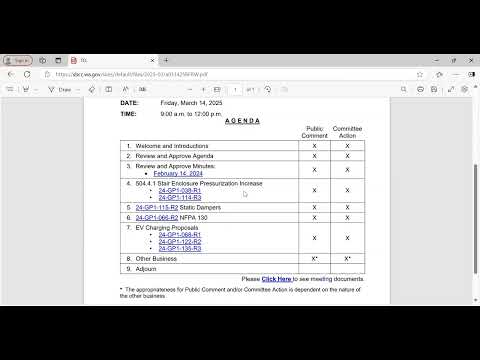
The Building Code Council BRFW Committee delayed action on two petitions to revise IBC 504.4.1 (stair enclosure pressurization) and on a separate proposal about activating static/ceiling radiation dampers, saying proponents and technical clarifications are needed before a recommendation to the full council.
The State Building Code Council BRFW Committee on March 14 tabled two petitions to change stair-enclosure pressurization rules and a related proposal about adding smoke-detection activation to static/ceiling radiation dampers, after members said the proponents were not available to answer technical questions.
Committee members said the two petitions focused on the same IBC provision, IBC section 504.4.1, and were being held so staff and proponents could resolve technical conflicts and supply written amendment language. Dustin (staff member) told the committee both petitions — GP1038 (rev. 1) and GP114 (rev. 3) — addressed the stair-pressurization text and had been kept alive so one could succeed if the other failed.
The committee raised several outstanding technical questions. Ken Burlette of the Seattle Fire Department asked whether the state’s adoption of the 2023 National Electrical Code affected one proposal’s reliance on NEC standby-power “option C,” saying: “Did the state amend the 2023 NEC and remove c? That’s what I’m trying — I don’t know. That’s what I’m asking.” Members said they lacked a definitive answer and wanted the proponent or a code specialist on the call before advancing the language.
A separate petition, discussed later in the meeting, would add additional smoke-detection actuation pathways for ceiling radiation dampers (sometimes called static dampers). Chris (committee member) urged caution: “This is adding a bunch of smoke detection to activate it like it was a smoke damper, which it’s not,” and suggested adding an exception for a water-flow switch so buildings with sprinkler systems would not be forced to add extra smoke detectors.
Committee members repeatedly said they were not ready to vote on amendment language without the proponents and recommended written revisions. Multiple motions to table were moved and seconded; the committee voted by voice to table the stair-pressurization petitions and later voted to table the damper/detection petition until the proponents could appear or submit specific code text.
The committee asked staff to publish any written amendment language submitted by proponents and for those changes to be circulated at least a week before the next BRFW meeting so committee members would have time to review. The committee also encouraged interested stakeholders to send written comments to the SBCC inbox so staff could post and make them available ahead of the next meeting.
The tabling preserves the petitions for continued public process, rather than denying them, and gives the committee more time to reconcile cross-code references (for example, to NFPA 70/NEC) and to receive specific amendment text from proponents.
Ending: The petitions on stair-enclosure pressurization and the related damper-detection proposal were formally tabled for the BRFW Committee’s next meeting; the committee requested proponents submit written amendment language and any supporting technical materials in advance so staff can publish them for review.
AI generated
The text on this page is AI generated. Summaries, highlights, analysis, and video transcripts are all produced from the original source material.
AI can make mistakes, so if you spot one, and we will fix it for everyone.
Note: the source content is unaltered by us. Any content source we link to, be it a video, an audio recording, or a document, is presented exactly as its publisher released it. That publisher is usually a government body, sometimes an individual official or another organisation.