Get Full Government Meeting Transcripts, Videos, & Alerts Forever!
Get email alerts on the Major Development topic
No spam. Unsubscribe anytime.
Land Use Commission withholds recommendation for 605 Davis Street tower after lengthy hearing on ownership, parking, wind and environmental impacts
Summary
After a multi‑hour hearing and extensive public comment, the Evanston Land Use Commission voted 4–3 to send a negative recommendation to City Council on a proposed high‑rise plan development at 605 Davis Street, citing unresolved questions about scale, traffic, and legal mechanisms for transferring floor‑area rights.
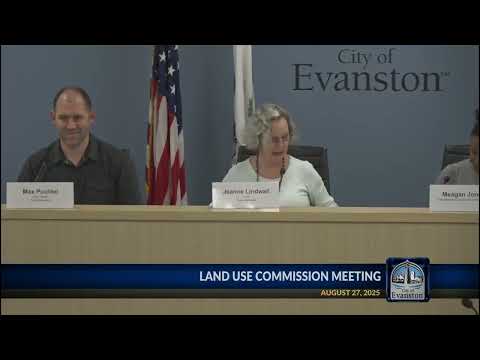
The Evanston Land Use Commission voted 4–3 Aug. 27 to send a negative recommendation to City Council on the proposed plan development for 605 Davis Street, a multi‑tower, mixed‑use project that would add hundreds of dwelling units to downtown Evanston.
The hearing — continued from July and reopened for a series of invited continuance speakers — drew hours of testimony from nearby residents, traffic and parking consultants, attorneys, and the applicant team. Objections focused on four principal areas: (1) the legal structure and the developer’s proposed transfer of floor‑area ratio (FAR) from an adjacent parcel (the “university building”) that opponents said was not a proper transfer under the planned‑development rules; (2) traffic, parking and the project’s proposed approach to on‑site and off‑site parking; (3) wind effects and shadow/comfort impacts on Fountain Square and a neighboring daycare rooftop playground; and (4) overall scale relative to the block’s context.
Ownership and FAR transfer: Attorney Jeff Smith and neighborhood attorney Steven Miskowitz argued that the application relied on a novel “zoning control agreement” and a transfer of FAR from an adjacent property that, they said, did not satisfy the zoning code’s single‑ownership or single‑control requirement for planned developments (Evanston Zoning Ordinance §6‑3‑6‑4). The city’s law department advised the commission the proposal could be treated as a single zoning lot under the submitted zoning control agreement; staff and the law department therefore concluded the application was properly before the commission. The legal dispute over whether that mechanism is permissible was a central focus of public testimony and counsel argument.
Traffic and parking: Multiple speakers presented alternative parking estimates. The developer’s parking and traffic consultant (TYLin) said its survey of comparable downtown and transit‑oriented buildings supported a lower parking demand (about 0.46 vehicles per dwelling unit), and staff noted available capacity in nearby municipal garages. Neighbors and independent reviewers argued the study undercounts peak overnight demand and package delivery, and presented higher estimates (one analysis calculated an 85th‑percentile demand of roughly 314 in‑building spaces rather than the roughly 80 spaces proposed on site). Residents emphasized the constrained curbspace on Davis and the nearby alley (used for Bright Horizons daycare drop‑off), delivery truck staging and a high projected number of deliveries (one speaker prorated current package counts and estimated over 50,000 packages per year for the project). Several commissioners said they were not convinced the proposed two lay‑by/drop‑off spaces adequately addressed the operational load and directed staff and applicant to explore increasing those spaces.
Wind, environmental and design concerns: An environmental and engineering expert and other residents argued that tall, concrete towers carry higher 'embodied carbon' and can increase local greenhouse‑gas emissions per square foot compared with low‑ and mid‑rise alternatives; they urged limits on height and stronger materials and envelope standards. The project team’s wind consultant, Hanqing (RWDI), presented computational wind analysis and told the commission that side‑by‑side modeling of existing and future conditions showed the proposed tower would not materially worsen wind comfort at Fountain Square and in some places could improve it; he said increases would be within typical pedestrian‑way standards. The applicant’s team also said the building would be all‑electric and aimed at a strong LEED rating, and the developer highlighted public‑realm commitments including alley reconstruction, streetscape work and funding for city alley repair.
Affordable housing and public benefits: The developer proposed a higher inclusionary housing yield under state/local incentive programs and said the project would deliver dozens of below‑market units; supporters argued the project would add foot traffic and retail customers downtown. Opponents disputed whether the number and configuration of affordable units met local family housing needs and whether the tax incentives the project seeks were the best use of public subsidy.
Deliberations and vote: After extended deliberation, the commission split along concerns over scale, unresolved technical questions and legal uncertainty about FAR transfers. The roll call on the final motion to forward a positive recommendation was: Berlin — yes; Harris Ferri — yes; Johnson — no; Mahbadi — no; Mangum — no; Puktel — yes; Chair Cheryl Lindwall — no. The commission therefore recorded a negative recommendation to City Council (3 yes, 4 no). The applicant may still pursue City Council review; staff, applicant and municipal counsel indicated several technical issues raised in testimony would be clarified in the council record.
What happens next: The Land Use Commission’s negative recommendation will be included in the City Council packet; City Council will hold the final hearing and may approve, modify or deny the plan development and any requested zoning relief. The developer indicated willingness to work with staff on additional conditions (including sustainability benchmarks, transit‑information kiosks and expanded lay‑by/drop‑off arrangements) and the commission requested further study of parking and curb‑management options.