Get email alerts on the Land Development Services topic
No spam. Unsubscribe anytime.
County hears Land Development Services update on aging code, permit volumes and staffing changes
Summary
At its Sept. 3 committee meeting, the Columbia County Board of Commissioners received a multi-part Land Development Services update on a 1984 zoning code, permit volumes, building‑plan changes, staffing certifications and long‑range projects including a DLCD technical assistance grant and housing-related zoning work.
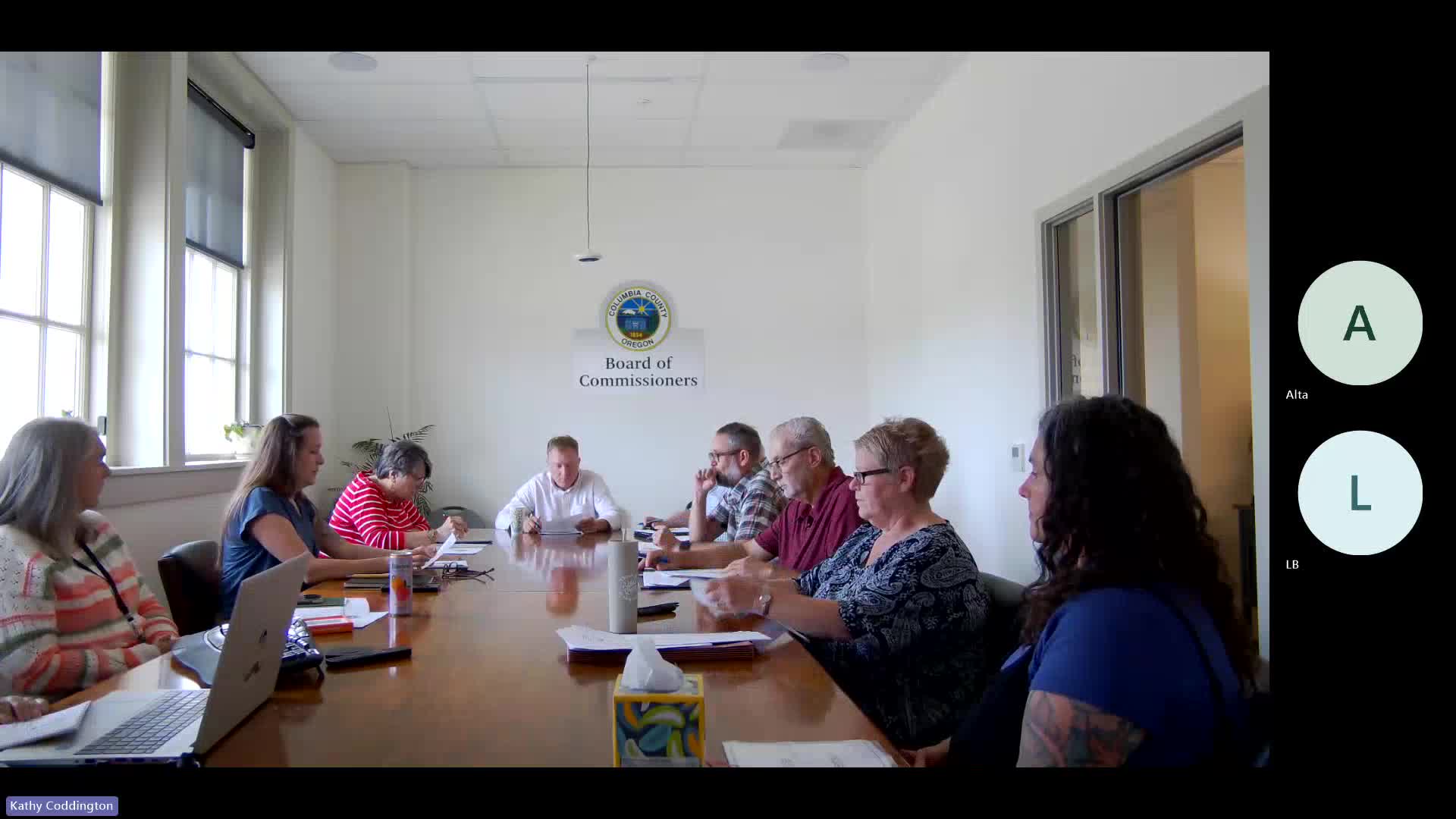
At a Sept. 3 Columbia County Board of Commissioners committee meeting, Land Development Services staff provided a consolidated department update covering planning and building activity, staffing and ongoing long‑range projects.
“ I gave you a little packet,” Land Development Services staff said, introducing four years of permit and application data compiled for the board. The staff briefing noted that the county’s zoning code dates to 1984 and that application of that code to contemporary development is a recurring challenge.
The presentation outlined several immediate and near‑term items: updating the zoning and subdivision/partition ordinances, modernizing outdated application forms (including making some forms fillable online), and continuing long‑range planning work tied to housing strategies. Staff said they intend to seek a technical assistance grant from the Department of Land Conservation and Development (DLCD) to support housekeeping updates to the county zoning ordinance and to compile a housing land inventory across the county’s cities.
On building operations, staff described changes from the State of Oregon Building Codes Division, which is releasing “state ready” plans stamped to current codes that can shorten local building plan reviews for simple projects (decks, shops, single‑family components). Staff also reported recent inspector certifications: one inspector earned special electrical inspector (SEI) credentials for small commercial projects and fire/life‑safety plan‑review qualifications; another gained residential electrical certification. The department said four staff now hold fire life‑safety and commercial plan‑review credentials.
Staff also described an operational change implemented in late May: a four‑day work week for building inspectors intended to consolidate site visits and reduce vehicle and complaint costs. “They love it. The contractors love it. The homeowners love it,” staff said, adding the schedule has reduced complaints and improved grouping of inspections.
Permit and application numbers were presented in multi‑year view: the building division issued 1,390 permits across the four‑year packet; planning applications this year were reported as 21 (compared with 215 in FY 2021–22, when a change in state rules prompted a surge in applications). Staff cautioned that counts vary by report type and that statutory timelines mean some active applications will be recorded in later fiscal summaries.
Staff also described procedural items in their work plan: updating intergovernmental agreements (IGAs) with the cities of Scappoose and St. Helens, renewing a contract with Rogers Engineering for third‑party review services, continuing work on the county energy resilience plan, pursuing FEMA BIOC training for staff, and evaluating department fees against a 2018 fee study. The briefing noted continuing work on departmental forms, policies and procedures and a prospective departmental name change and consolidation of CPACs (citizen planning advisory committees) into a planning commission recommendation process.
Why it matters: staff emphasized that an antiquated code affects predictability and workload for applicants and reviewers; proposed housekeeping and code updates are presented as a way to reduce friction for housing‑related development and to align county practice with state standards.
Sources: remarks and slides from Land Development Services staff at the Sept. 3 committee meeting. No formal board action was taken on the code or grant items during this presentation.
AI generated
The text on this page is AI generated. Summaries, highlights, analysis, and video transcripts are all produced from the original source material.
AI can make mistakes, so if you spot one, and we will fix it for everyone.
Note: the source content is unaltered by us. Any content source we link to, be it a video, an audio recording, or a document, is presented exactly as its publisher released it. That publisher is usually a government body, sometimes an individual official or another organisation.