Lifetime Citizen Portal Access — AI Briefings, Alerts & Unlimited Follows
HCAI launches Medi‑Cal Behavioral Health Residency Training Program; $14 million available in first cycle
Loading...
Summary
The Department of Health Care Access and Information (HCAI) on July 15 opened the Medi‑Cal Behavioral Health Residency Training Program and detailed eligibility, funding, the student loan repayment tie‑in, and application deadlines during a webinar.
The Department of Health Care Access and Information (HCAI) opened the Medi‑Cal Behavioral Health Residency Training Program grant on July 15 and held a webinar to explain eligibility, award amounts and how the award links to a special Medi‑Cal behavioral health student loan repayment cycle. HCAI said about $14,000,000 is available for cycle 1 and applicants must submit full applications by Aug. 15 at 3 p.m.
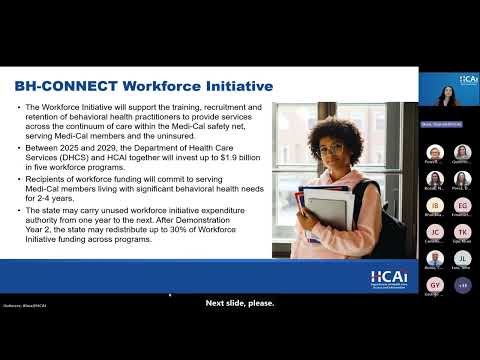
HCAI framed the program as part of its larger BH Connect workforce initiative, which the department said will invest up to $1.9 billion from 2025 to 2029 across five workforce programs to expand behavioral‑health services in Medi‑Cal safety‑net settings. "Behavioral health challenges affect people from all walks of life and the need for skilled, compassionate professionals in this field has never been more urgent," Dr. Sharmila Shaw, behavioral health and policy branch chief for health workforce development, said in opening remarks. She said the residency program aims "to increase the availability of the psychiatrists practicing in Medi Cal safety net settings that serve our communities, children and youth, and those with addiction challenges."
Officials described how the residency program and a special student loan repayment cycle (SLRP) will work together. Lindsay Bradshaw, project manager with HCAI, said programs awarded MBHRTP funds must commit to filling grant‑funded slots with trainees who have been prequalified for HCAI's special SLRP cycle. "They'll have a 4 year service obligation period where they need to, pre or be employed in a medical safety net setting," Bradshaw said, describing the service requirement for individuals who accept SLRP support. HCAI said the SLRP offers up to $240,000 per individual and the residency award calculation is up to $250,000 per year adjusted for the percentage of time a trainee spends in qualifying Medi‑Cal safety‑net settings.
Eligibility and program rules: HCAI listed the core eligibility and program conditions on the webinar. Applicants must be ACGME‑accredited psychiatry residency or specified fellowship programs (child and adolescent psychiatry, addiction psychiatry, and addiction medicine) and must provide ACGME approval or proof of request for new positions as part of the application. Trainees in positions funded by the grant must spend at least 75% of rotation time in qualifying medical safety‑net settings; award amounts will be adjusted to reflect the percentage of qualifying rotation time. HCAI also said funds must supplement, not supplant, existing training funds and that costs for faculty salaries and benefits, capital infrastructure and indirect costs are not eligible.
Timeline and reporting: HCAI opened the MBHRTP application July 15 and set an application deadline of Aug. 15 at 3 p.m. The department said it expects to announce awardees in October and begin grant agreements in December 2025. HCAI also said it will pay awards prospectively on an annual basis (the grant guide initially said payments would be in arrears and HCAI said it will issue an addendum revising that language). Annual reporting will include both expense reconciliation and prospective budgets for subsequent academic years; HCAI described an initial report due July 31, 2026 for the first academic year projections.
How the loan repayment tie‑in works: HCAI will administer the special SLRP cycle and prequalify individuals for loan repayment; program applicants are responsible for encouraging prospective trainees to apply for prequalification during interviews but are not responsible for individually verifying eligibility. HCAI said it will notify awardees which interviewees have been prequalified so programs can consider them when making match decisions. For cycle 1 HCAI said it intends to open the special SLRP cycle Oct. 1 and keep it open through a window that will permit programs to receive prequalification results before rank order and match deadlines (HCAI repeatedly urged programs to contact staff if timelines for fellowships or matches require adjustments).
Program scope and qualifying sites: HCAI provided a broad list of qualifying medical safety‑net settings, including federally qualified health centers (FQHCs), community mental health centers, rural health clinics, hospitals with at least 40% Medi‑Cal or uninsured payer mix (30% for rural hospitals), school‑based and other community behavioral‑health settings, crisis stabilization units, outpatient clinics, mental health rehabilitation centers and independent licensed practitioners contracted with behavioral‑health plans. HCAI said a full list is available in the grant guide and slide deck.
Application mechanics and scoring: The application has 12 sections including program profiles, rotation sites and time‑spent calculations, budget and sustainability documentation, and assurances. Applicants must upload a sustainability letter and either an ACGME approval letter for new positions or proof of a request for ACGME approval; if an approval letter is not available at submission, HCAI will require it before issuing an award. Scoring will consider rotation sites in HCAI‑identified shortage areas, language capacity, prior program cohort size, strategies to encourage practice in Medi‑Cal safety‑net settings and plans to integrate culturally responsive care into curricula.
Questions HCAI highlighted during the webinar included how the program treats previously unfunded first‑year slots (HCAI said unfunded slots may be eligible but asked programs to contact staff to discuss specifics and provide ACGME correspondence), and the department advised programs to consider creating separate NRMP match tracks for grant‑funded slots to avoid match‑rule concerns and to ensure trainees prequalified for the SLRP can be selected for those slots.
HCAI closed the webinar by directing applicants to the grant guide, a forthcoming addendum and technical assistance resources on its website, and reminding applicants to email mbhrtp@hcai.ca.gov with technical or timeline questions. "The application period closes on August 15 at 3PM, so don't wait to get those applications in," Lead Communications Analyst Chris Rowena said in closing remarks.
The grant guide and the webinar recording will be posted on HCAI's website; HCAI said it will post award notifications and a recording within about five business days.