Lifetime Citizen Portal Access — AI Briefings, Alerts & Unlimited Follows
California agency details Medi‑Cal Behavioral Health Scholarship: $96.9 million pool, applications open Feb. 2
Loading...
Summary
The Department of Health Care Access and Information described a Medi‑Cal Behavioral Health Scholarship cycle with up to $96.9 million available, awards targeted to tuition and fees only, service obligations that typically last 2–4 years, and an application window from Feb. 2 to March 16, 2026.
The Department of Health Care Access and Information (HCAI) outlined details and answered questions about the Medi‑Cal Behavioral Health Scholarship Program at a public webinar, saying the program will open applications on Feb. 2, 2026, and that the first cycle includes up to $96,900,000 to support students and trainees in behavioral‑health professions.
"We have up to $96,900,000 available," said Andres Gonzalez, health program specialist and policy lead for the scholarship program. Gonzalez said individual awards "may be as high as $240,000 depending on the profession," and emphasized that program rules come from the BH Connect special terms and conditions agreed with federal partners.
The scholarship is restricted to education‑related costs only. Gonzalez said payments may cover tuition, mandatory fees, textbooks and supplies required by the program; the funds cannot be used for living expenses, child care, transportation or distributed directly to individual participants. Instead, HCAI will pay institutions and colleges will distribute funds to students per the contract terms.
Applicants may include a broad set of behavioral‑health roles. Gonzalez listed eligible professions that range from alcohol and other drug counselors, peer support specialists and community health workers up to licensed clinical social workers, professional clinical counselors, clinical psychologists, marriage and family therapists, nurse practitioners and physician assistants. HCAI described award tiers: some prescribing and licensed roles are eligible for higher award ceilings, licensed and allied professions have a mid tier, and counselor/peer/CHW roles are in a lower award tier.
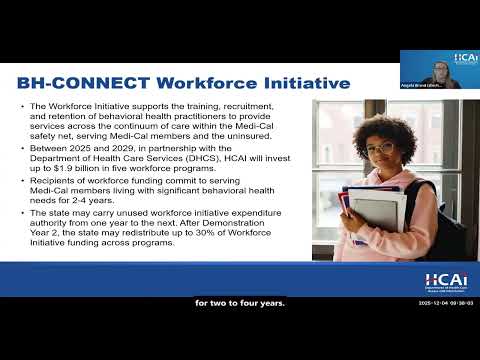
Service obligations apply. Gonzalez said licensed and prescribing practitioners and associate‑level pre‑licensure practitioners will carry a four‑year service obligation. For nonprescribing practitioners the obligation scales by grant amount: awards of $20,000 or more require four years of service; awards between $10,000 and $20,000 require three years; awards under $10,000 require two years. All service must be completed in a qualifying Medi‑Cal safety‑net setting (examples HCAI gave include federally qualified health centers, community mental health centers, rural health clinics, and hospitals that meet specified Medi‑Cal payer‑mix thresholds).
HCAI gave examples of payer‑mix thresholds it will use when determining eligible settings: hospitals with a 40% or higher Medicaid/uninsured patient mix and certain rural hospitals with a 30% threshold. The agency said a complete list of eligible setting types and exact thresholds will appear in the grant guide.
Timing and application process. HCAI said the grant guide and online application open Feb. 2, 2026 and close March 16, 2026 at 3 p.m. Award notifications are expected between June and July 2026, with an anticipated program start in August 2026. Gonzalez said applicants apply individually (not via their school), but HCAI will work with a third‑party vendor and with colleges to route funds directly to institutions for distribution to students.
Other clarifications from the webinar: current associate‑level social workers working toward licensure may apply as long as they are progressing toward licensure and will work in eligible settings; international students may apply if they meet grant guide requirements; community colleges and private universities are eligible; and doctoral routes (for example, PhD clinical psychologist programs) may be eligible depending on profession and program accreditation. HCAI said generally it will accept currently accredited programs and will publish a detailed eligible program list in the grant guide.
On equity concerns, an attendee said limiting funds to tuition could disadvantage students who need living‑expense support. Gonzalez acknowledged the concern but said HCAI is bound by the federal STCs governing allowable uses. Christian (HCAI staff) added that the funds derive from a federal contract and that HCAI has not been told those funds are at risk, while noting that federal approvals govern future funding. HCAI also said students are not held to a service obligation for funds they never actually received under the contract terms.
Next steps and contact. HCAI plans multiple scholarship cycles through 2029; the webinar team said the full grant guide and slide deck will be posted on HCAI’s website within 7–10 business days after the recording is processed. HCAI provided a program contact email (mbhsp@hcai.ca.gov) and a BH Connect helpline (916‑326‑3899) for follow‑up questions.
The grant guide and application open Feb. 2, 2026 and close March 16, 2026 at 3 p.m.; applicants should consult the guide for the full list of eligible programs, exact award amounts by profession, detailed verification and reporting requirements, and timelines for postgraduation employment and licensure verification.