Get Full Government Meeting Transcripts, Videos, & Alerts Forever!
Get email alerts on the On Site Wastewater Permitting topic
No spam. Unsubscribe anytime.
Coconino County outlines permitting, soil-testing rules for on-site wastewater systems in Valley
Summary
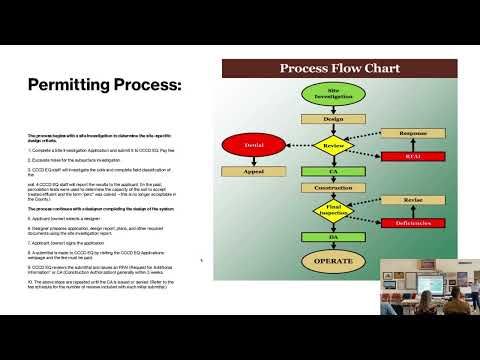
At a community presentation in Valley, Coconino County environmental quality specialist Zachary Burf explained the county's two-part permitting process, required site investigations (minimum three test holes), and why shallow soils restrict conventional septic systems in the area.
Zachary Burf, an environmental quality specialist for Coconino County, told Valley residents that on-site wastewater systems require a two-part county permit and a separate site investigation before construction can begin. He said Coconino County is delegated by the Arizona Department of Environmental Quality (ADEQ) to review and issue Aquifer Protection Program permits and that the county issues a Construction Authorization to allow installation and a Discharge Authorization (DA) to permit use once a system passes final inspection. Burf said county staff require a minimum of three test holes for a site investigation, with two placed in the proposed primary disposal area and a third reserved area for future expansion. He described how site investigators record soil horizons, texture (by ASTM standard "texture by feel" tests), rock content and total test-hole depth; those data determine a soil absorption rate used to size disposal fields for a given design flow. "What we're looking for is soil characterization," Burf said, adding that investigators stop digging when they hit refusal (bedrock). Why it matters: county and state rules require minimum vertical separation between disposal works and limiting layers. Burf explained that conventional systems require about 48 inches of native soil below the disposal media; where Valley parcels have shallower soils over bedrock, designers rely on pre-treatment or alternate systems to meet the rule's separation requirements. More detail: Burf described typical field practice: test holes spaced roughly 50 to 60 feet apart, with each test hole supporting a 30-foot radius of "tested soil" for siting. He said smaller hand-dug holes are acceptable when bedrock is shallow, but excavator buckets of at least 2 to 3 feet are preferred so the inspector can view sidewalls. He said as-built drawings are required if components are changed in the field, and that county final inspections occur before a Discharge Authorization is granted. "Once your house is there, you guys got your wastewater system, everything's good. I'll close the permit out," Burf said. Discussion vs. direction vs. decision: the presentation was an informational discussion; Burf invited residents to submit a brief anonymous survey about household water use to inform a possible pilot project, and he distributed business cards and county resource lists for designers and installers. Background and takeaways: Burf noted that rules are state-originated and that county staff must apply ADEQ's standards. He encouraged residents to contact the county with questions and to use the county's posted designer/installer resource list. Nina, a county staff member present at the meeting, also noted the county's ongoing comprehensive plan public review and invited comments. Ending: Burf said staff are available to answer follow-up questions and recommended that property owners provide designers with detailed household water-use information so designs reflect local behavior and conserve limited soil resources.