Get Full Government Meeting Transcripts, Videos, & Alerts Forever!
Get email alerts on the Science And Technology topic
No spam. Unsubscribe anytime.
Fermilab deputy director outlines DUNE, PIP‑II upgrades, quantum research and local outreach
Summary
Greg Stevens, deputy director and COO of Fermilab, briefed the Geneva City Council on major projects — including the $3 billion LBNF/DUNE experiment, PIP‑II accelerator construction, quantum research facilities and local education outreach — and described timelines, staffing and recent infrastructure investments.
Greg Stevens, deputy director and chief operating officer at Fermilab, told the Geneva City Council on Monday evening that Fermilab’s work ranges from large-scale neutrino experiments to quantum materials research and local education programs. "Fermilab is more than 2,000 employees — about 2,200 as of yesterday," Stevens said, and he described several projects now underway or planned.
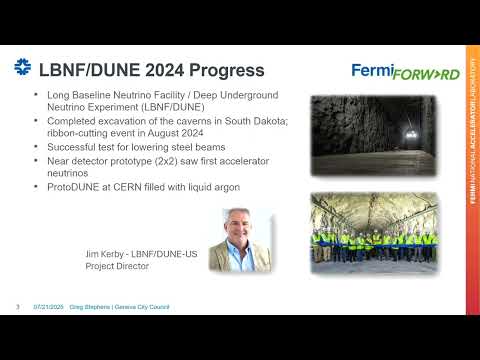
The Long Baseline Neutrino Facility and Deep Underground Neutrino Experiment (LBNF/DUNE) is one of the lab’s largest undertakings, Stevens said. "LBNF DUNE ... is about a $3,000,000,000 project" that has been underway for years and is expected to have facilities ready to take beam in the 2030–2032 time frame. Stevens described the South Dakota caverns that will house the detectors as “roughly 2 football fields wide and about 3 football fields long and 9 stories tall.” He said each detector will hold about 90,000 tons of liquid argon.
Why it matters: LBNF/DUNE is a long‑term, high‑cost federal research project that involves construction across multiple states and that will occupy Fermilab operations and contractor resources for years. The lab’s construction and operations affect local employment, regional supply chains and public engagement opportunities.
Stevens also described the Proton Improvement Project (PIP‑II), an accelerator upgrade he called the engine for the neutrino program. He said the new superconducting accelerator will produce more than double the beam intensity available today while using less than half the electrical power. "When it's completed, the beam intensity will be more than twice what the beam intensity is available today ... and it will use less than half of the electrical power that we use to power the accelerator today," Stevens said; he added that running the current accelerator costs the lab about "a million dollars a month" in electricity. Stevens said components such as a large cold box used to cool the superconducting cavities were donated and transported from Europe and India earlier this year.
Stevens summarized other laboratory highlights: Fermilab’s astrophysics instruments and CCD camera technology for the Dark Energy Survey; final results narrowing error bars in the muon g‑2 experiment; a short‑baseline neutrino detector on site that began seeing neutrinos in 2024; work in superconducting quantum materials (SQMS) and an underground quiet lab (QIAT) about 100 meters below grade for low‑noise quantum testing; and education and outreach, including thousands of visitors, teacher programs and hundreds of summer interns.
On management and leadership, Stevens described the lab’s recently awarded management and operations (M&O) contract and said the University of Chicago and Universities Research Association retained member status while integrated subcontractors Omentum and Longenecker and Associates joined the team. He said the permanent laboratory director search is underway with a target to select a director in the fourth calendar quarter and place the new director between Thanksgiving and Christmas. Stevens also acknowledged interim lab director Dr. Young‑Ki Kim and several project directors and partners he named.
Council questions and public outreach: Alderman Paschke asked whether Fermilab would resume public lecture and music series; Stevens said arts programs have been reintroduced and a public lecture series will return later this year but that security posture changes require modifications. Stevens invited residents to visit the lab’s Visitor Center, described plans for a new Pine Street badge office expected to open around November, and noted bison on site and outreach that reaches thousands of students annually.
Ending: Stevens closed by inviting residents to visit Fermilab exhibits and public programs. The council did not take any action; the presentation was informational.