Lifetime Citizen Portal Access — AI Briefings, Alerts & Unlimited Follows
CECC Hearing: Witnesses Say PRC Uses 'Political Warfare' and Transnational Repression Against Taiwan and Diaspora
Loading...
Summary
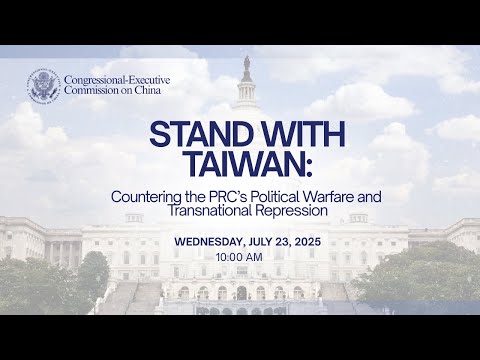
Chairman Senator Sullivan convened the Congressional‑Executive Commission on China hearing to examine what witnesses called a broad, coordinated campaign of political warfare and transnational repression by the People’s Republic of China (PRC) against Taiwan and members of the Taiwanese diaspora.
Chairman Senator Sullivan convened the Congressional‑Executive Commission on China hearing to examine what witnesses called a broad, coordinated campaign of political warfare and transnational repression by the People’s Republic of China (PRC) against Taiwan and members of the Taiwanese diaspora.
Why it matters: Witnesses said those tactics—ranging from disinformation and legal coercion to doxxing, overseas surveillance and the cultivation of local political actors—threaten Taiwan’s democracy, imperil Taiwanese and Chinese‑origin residents abroad and complicate U.S. and allied policymaking.
At the hearing, MP Fan, a member of the legislature of Taiwan (Democratic Progressive Party), described the lived consequences in Taipei and abroad: “This is the reality we live with, constantly being silenced by the PRC,” she said, recounting reported increases in espionage indictments and large‑scale disinformation campaigns.
Retired Rear Admiral Mike Studeman, a former director of intelligence at INDOPACOM, characterized Beijing’s campaign as comprehensive. “Beijing’s political warfare efforts are relentless, pervasive, and all encompassing,” he told the commission, and outlined what he described as white (overt diplomatic and economic pressure), gray (maritime coercion, junkets, influence on media and academia) and black (covert espionage, recruitment and criminal proxies) elements used to weaken Taiwan’s resistance and international position.
Dr. Audrey Wong, a fellow at a Washington think tank and academic, described how PRC‑linked united‑front networks operate in the United States. “Transnational repression and political influence activities consist of multi‑pronged, community and political mobilization,” she said, and testified that the PRC both pressures critics directly and mobilizes sympathetic local groups to change public discourse.
Peter Mattis, president of the Jamestown Foundation and former CECC staff director, and other witnesses told the commission that the PRC’s approach combines long‑term cultivation of local interlocutors, efforts to place or influence officials and political aides, and support for pro‑Beijing candidates and organizations at municipal and state levels.
Witnesses and members cited specific patterns and examples discussed in testimony: Czech intelligence uncovered a planned kinetic intimidation operation against then‑vice president‑elect Lai (B. Kim) during a visit to the Czech Republic; Taiwan’s National Security Bureau reported an increase in spy activity indictments from 16 in 2021 to 64 in 2024; and Taiwanese authorities and researchers reported disinformation volumes rising from roughly 1,300,000 messages in 2023 to 2,200,000 in 2024. Testimony also referenced instances in the United States reported in open sources—such as so‑called overseas police stations and organized demonstrations coordinated with consular elements—as evidence of extraterritorial pressure.
Members of the commission pressed witnesses on U.S. readiness. Witnesses said current capabilities are uneven, law enforcement and intelligence resources are limited, and public awareness low. Panelists urged a combination of approaches: more federal‑state coordination, resources for prosecutors and local law enforcement to investigate transnational coercion, expanded public education on foreign influence tactics, support for independent community organizations that can serve as alternative voices, and more robust interagency and allied cooperation on counter‑disinformation and counter‑influence measures.
The hearing included repeated calls for transparency and selective declassification where possible to “expose” malign influence while protecting sources and methods; witnesses argued that targeted public disclosure can reduce space for covert influence without violating classified protections.
Chairman Sullivan closed by asking the witnesses to submit additional, specific examples of intimidation or PRC influence operations on U.S. soil for the record; the commission kept the hearing record open for seven business days for members to submit questions and witnesses to revise and extend testimony.
The hearing did not produce formal legislative action; members discussed pending bills mentioned at the hearing, including the Stand With Taiwan Act and the Transnational Repression Policy Act, and urged bipartisan follow‑through.
Looking ahead: Witnesses and members emphasized that confronting PRC political warfare will require sustained, cross‑sector effort—education and public awareness, targeted law enforcement capacity at the state and local level, better interagency coordination, and allied information‑sharing and posture‑building with partners that have confronted similar tactics.