Get Full Government Meeting Transcripts, Videos, & Alerts Forever!
Get email alerts on the Fund Estimate topic
No spam. Unsubscribe anytime.
California Transportation Commission hears draft 2026 STIP fund estimate showing reduced near-term capacity; August adoption planned
Summary
Caltrans staff and CTC staff presented a draft fund estimate for the 2026 State Transportation Improvement Program showing lower near‑term capacity, a negative starting balance in fiscal 2025–26, and reduced STIP/SHOP targets versus the 2024 cycle. The commission plans to consider adoption at its August meeting.
A draft 2026 State Transportation Improvement Program (STIP) fund estimate presented at a California Transportation Commission workshop detailed falling gasoline consumption, a reduced near‑term cash balance and lower programming capacity compared with the 2024 cycle. Caltrans staff said the commission will consider the fund estimate for adoption at its August meeting.
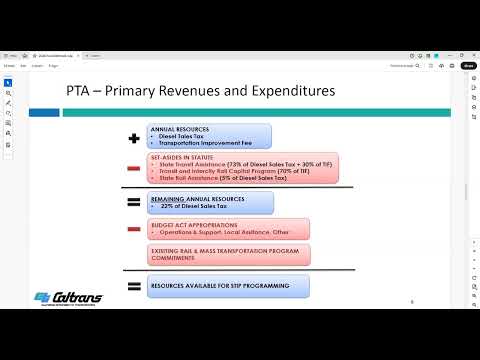
The fund estimate is “a five‑year projection of available resources required by the state,” Anthony Espino, Caltrans fund estimate manager, said during the July workshop. He explained the cash‑flow method starts with the beginning cash balance, adds anticipated revenues, subtracts non‑program commitments and maintenance and then removes existing program commitments to calculate resources available for programming.
Caltrans and CTC staff pointed to three revenue drivers: gross gasoline excise revenues (which are affected by declining consumption and annual inflationary adjustments to the excise rate), the incremental excise tax created by SB 1, and diesel sales tax revenue directed to the Public Transportation Account. Garrett Franklin, Office Chief over Capital and Finance at Caltrans, said draft targets show a decline in STIP and SHOP capacities from the 2024 cycle.
Why it matters: staff and attendees repeatedly stressed that lower near‑term capacity and a negative starting cash position limit what regions can program in the early years of the STIP and increase the likelihood that agencies will need to rely on local or other funds or seek amendments later. Casey Gutierrez, STIP program manager at the CTC, warned regions to prioritize local funding and be mindful of cost increases when requesting state funds.
Key numbers and comparisons published by Caltrans staff at the workshop include: a draft total STIP/SHOP capacity presented in the slides as roughly $3.3 billion over a six‑year view, a STIP five‑year target described later as about $2.7 billion (about $155 million less than the 2024 cycle), and a draft total available capacity of roughly $952 million over the six‑year table that includes the current fiscal year. Staff reported a starting‑year (fiscal 2025–26) shortfall of about $133 million in the combined accounts, which is deducted from the multi‑year programming picture. Caltrans staff also reported new capacity for STIP of about $1.0 billion over the six‑year span and that SHOP capacity showed a larger reduction compared with 2024.
Caltrans staff emphasized that consumption of gasoline is projected to decline over the fund‑estimate period (Anthony Espino noted a 2.9% decline over five years in staff projections), while the annual inflation adjustment on the excise tax keeps gross gasoline tax revenue relatively flat.
Schedule and next steps: Garrett Franklin said the proposed fund estimate would be presented to the commission for adoption at the August meeting (staff identified the dates as the 14th or 15th). Caltrans staff also gave statutory and internal milestones: Caltrans will identify state highway needs by Sept. 15, release the draft ITIP Oct. 15, hold ITIP hearings (north and south) Oct. 30 and Nov. 7, and submit final ITIP/RTIPs to the commission by Dec. 15; the CTC’s planned STIP adoption meeting is March 19–20, 2026. Casey Gutierrez told participants she will post updated tables and circulate revised draft materials after the workshop.
Discussion versus decision: the workshop was informational; no formal vote occurred. Staff repeated that the fund estimate could change between the draft and the final adoption because of (1) the actual beginning fiscal balance, (2) any budget actions (including trailer bills) enacted before the August meeting, and (3) adjustments to interest calculations or other technical items.
What stakeholders said: attendees asked whether and how the draft would change before August and how extensions and advances on previously programmed projects affect the fund estimate. Caltrans staff said draft tables will be posted and that the final fund estimate will reflect reconciled commitments and any early allocations or legislative actions.
Bottom line: the draft fund estimate presented in the July workshop shows reduced early‑year capacity and a negative starting balance that CTC staff said will constrain programming in the first years of the 2026 STIP; staff plan to present a final fund estimate and proposed guidelines for commission adoption in August.