Lifetime Citizen Portal Access — AI Briefings, Alerts & Unlimited Follows
Marshfield reviews $9.7 million borrowing target in draft 2026–2030 CIP; council asks for more detail before Aug. approval
Loading...
Summary
Marshfield city officials presented a draft 2026–2030 Capital Improvement Plan on July 17 that anticipates about $9.7 million in borrowing in 2026 — including roughly $5 million for a police renovation — while later years contain multiple unfunded projects.
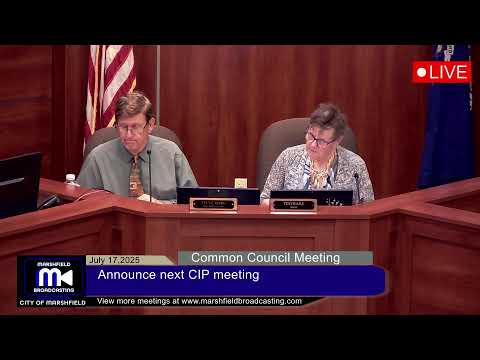
Marshfield city officials presented a draft 2026–2030 Capital Improvement Plan (CIP) during a special council session on July 17, warning that the plan anticipates roughly $9.7 million in borrowing in 2026 — including about $5 million earmarked for a police department renovation at Wildwood Plaza — and that later years in the five‑year schedule contain multiple unfunded projects.
City administrator Steve Barr told the council the CIP is “a five‑year blueprint revised every year,” and described new categories the draft uses to show projects that have been scheduled but lack identified funding. He said the first two years of the financial plan are roughly balanced but the remaining years show shortfalls that staff and the council must address before final adoption in August.
Why it matters: the CIP frames when and how the city pays for streets, buildings, vehicles and major equipment. Large, state‑led reconstruction projects carry fixed timetables and outside funding and can lock the city into schedules and borrowing that limit local flexibility, Barr said.
Key fiscal signals and process - Staff and the city’s financial adviser estimate about $9.7 million in borrowing in 2026, followed by roughly $4.5 million per year in subsequent years under current assumptions. Barr said the 2026 total includes roughly $5.0 million for the police renovation. He also said the plan shows a roughly $900,000 shortfall across the four mid‑years (2027–2029) versus the adviser’s target if no changes are made. - The CIP uses a $10,000 cost and a five‑year minimum useful life as the threshold for capital classification. Projects without a funding source were placed in an “unfunded” category so the council can consider trade‑offs. - Barr and staff emphasized that four reconstruction projects in the five‑year window are state projects funded on roughly an 80% state / 20% city split; those schedules are largely set by the state and hard to move.
Department highlights (selected) - UW‑Stevens Point at Marshfield: Tony Andrews said the campus occupies a 60‑year‑old building and requested work across several years, including a new fieldhouse roof and rooftop HVAC unit, repairs to theater and lobby finishes, replacement of boilers in the Felker Building and upgrades to building controls. Andrews told councilors he has requested moving tennis‑court repairs earlier because local high school teams are using the courts.
- Administration: Finance staff proposed a property revaluation budgeted roughly $100,000 in 2027 and $75,000 in 2028, noting state rules require action if assessment ratios fall below thresholds. The packet also lists $48,000 in 2026 for six ballot counting machines; staff said the county estimate is about $8,000 per machine pending Wisconsin Elections Commission certification. The city’s shared taxi fleet replacement model was shown with a typical city share of 20% and grant support of about 80%.
- Airport: Jeff Geier outlined a long list of airport projects the airport committee has petitioned the Wisconsin Bureau of Aeronautics to add to the state/federal program. He said most airport capital projects are funded either 80% state/20% city or 90% federal/5% state/5% city, and the airport anticipates about $700,000 in city share costs across its CIP items in the five‑year window. Major items described included snow‑removal equipment and building, medium‑intensity approach lighting, relocation of visual guidance systems, runway 16 reconstruction (the main runway, 5,000 feet by 100 feet) and a runway extension/parallel taxiway study. Geier noted that accepting federal funding typically imposes a 25‑year maintenance obligation.
- Emergency Medical Services: EMS staff listed ambulance replacement schedule items and life‑safety gear including power‑load cot systems and Lucas mechanical CPR devices. Staff confirmed Ambulance 99 is slated for replacement in 2026 and explained the sector‑wide manufacturing lead times have lengthened — creating longer delivery delays — which is why the department is retaining an older ambulance as a reserve. EMS staff and several councilors asked for a follow‑up report with utilization and maintenance data; Alderman Tompkins asked specifically for counts of how often multiple ambulances were out simultaneously and for maintenance downtime statistics.
- Engineering and streets: Public works staff described a long slate of reconstruction and paving projects, including Fifth Street (complete reconstruction), Vine Avenue reconstruction segments and multi‑year asphalt paving programs. Several of these are slated for WISDOT or state grant funding (an 80% grant share in some cases); staff noted that when state grants apply, the local schedule is constrained by the state program and grant requirements such as temporary easements.
- Fairgrounds and parks: The Fairgrounds Commission presented unfunded needs including grandstand roof and wall repairs, entrance/parking lighting and several access improvements; staff said some work is eligible for cost sharing with the county but the CIP currently lists them as unfunded. Parks staff highlighted that a community fundraising campaign for a large Greasy Park playground has raised roughly $750,000 toward an estimated $1.5 million project and moved that work earlier in the plan; Braine Park parking and pavilion/restroom needs were shown in later years and listed as unfunded or under discussion for phasing.
- Fire and related public safety capital: Fire staff requested replacement of two outdoor warning sirens around 2027–2028, funding for training‑site improvements (a $50/50 match previously scoped), and noted a new fire engine purchased in 2024 may not be delivered until 2028 because of factory lead times. Fire also proposed a staffing study (budgeted about $35,000) and equipment such as a UTV; the department said it has raised about $15,000 to date for UTV acquisition, including a $10,000 donation from a local bank.
- Police: Police capital shows ongoing vehicle rotation and equipment funding and a $5.0 million figure tied to the renovation of Wildwood Plaza space for the department. Staff advised the council the full plan will be returned for adoption after the council’s review and any changes.
Council requests, direction and next steps Councilors pressed staff for additional detail and follow‑up analysis before final CIP approval. Alderman Tompkins asked for ambulance utilization and maintenance downtime data and for a plan or prioritized list from the Fairgrounds Commission for the commission’s unfunded building needs. Steve Barr said staff (including Josh Morris, Jennifer Salinski and the affected department heads) will bring additional information and possible rebalancing options to the council’s next CIP meeting.
The council scheduled a follow‑up special CIP meeting on Thursday, July 31, 2025, at 6:00 p.m. to continue the review. A motion to adjourn the July 17 session, moved by Alderman Douglas and seconded by Alderman Coran, passed at the meeting’s close.
Quotes from the meeting (selected) “The CIP is more of a fluid document. It’s a five‑year blueprint revised every year,” Steve Barr, city administrator, said as he opened the discussion. “We have a 60‑year‑old building, which I continue to upgrade,” Tony Andrews, representing UW‑Stevens Point at Marshfield, told the council when summarizing campus needs. “Most of our projects are either a state project that are 80% state funded, 20% city funded, or they’re a federal project where they are 90% federal funded, 5% state funded, and 5% city funded,” Jeff Geier, representing the airport, said when explaining airport funding mixes. “We’re really just retaining that ambulance for another three years,” Chief Miller said when explaining the department’s decision to keep an older ambulance as a reserve because loaner units are unavailable.
Ending: Staff will return to the July 31 special CIP meeting with additional detail on borrowing options, ambulance utilization and maintenance data, and prioritized proposals for unfunded fairgrounds and park items so the council can consider adjustments prior to a regular council meeting in August when the CIP is tentatively scheduled for final action.