Get Full Government Meeting Transcripts, Videos, & Alerts Forever!
Get email alerts on the Jail Levy Oversight topic
No spam. Unsubscribe anytime.
Columbia County interviews applicants for jail-levy oversight committee; medical care and reentry services raised
Summary
Commissioners interviewed applicants for the Jail Operating Citizens Advisory Committee, discussed the committee’s limited oversight role over a 2014 jail levy and heard an applicant call for better jail medical and reentry services including continuity of Oregon Health Plan coverage and medication-assisted treatment.
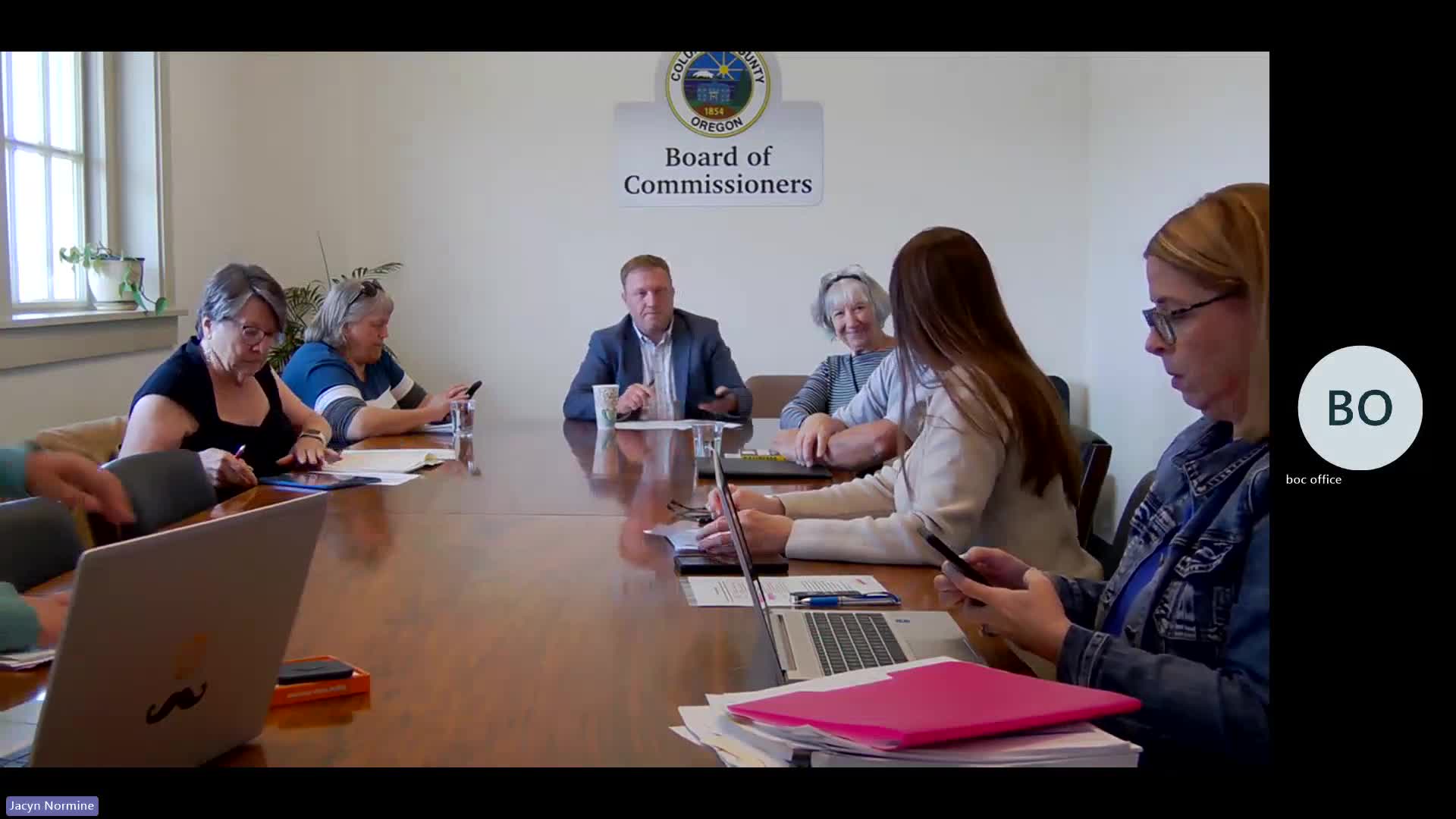
Columbia County commissioners on a June 2005 agenda interviewed applicants for the Jail Operating Citizens Advisory Committee (JOCAC), focusing discussion on the committee’s narrow role overseeing 2014 jail levy funds and on gaps in jail medical care and reentry services.
The committee was created after the county’s jail levy passed in 2014, the board said, to verify that levy revenues are spent for jail operations rather than other county purposes. “The citizen operating committee was established after the initial levy was passed in 2014 to the idea that the committee would review the expenditures made with the levy funds and verify that they were used for jail operations,” the meeting chair said.
Two applicants who spoke were Paul Carroll and Michelle Comrath. Paul Carroll, applying for a seat, described a long law-enforcement career: “My name is Paul Carroll. . . . I’ve got a 31 year background in law enforcement,” and said he supports oversight to ensure levy dollars are not diverted. Carroll said his experience includes work in larger departments and interest in county jail operations and budgets.
Nurse and applicant Michelle Comrath urged the board to consider health and reentry issues as part of oversight. “Most of the inmates who come into the jail are low education, unemployed, lots of drug addiction issues,” Comrath said. She told commissioners that many people lose Oregon Health Plan coverage when booked and must reapply after release, and that that gap can lead to withdrawal, emergency care and rapid return to custody. “When they leave the jail, it doesn’t automatically stop. They have to go up to DHS and reapply for it,” she said. Comrath also described cases involving methadone and medication-assisted treatment, and said outside partners, including a local provider she identified as CCMH, have offered support for in-jail programs.
Commissioners and applicants debated the proper scope of JOCAC. Some expressed concern that a citizen committee should remain narrowly focused on verifying levy expenditures for jail operations rather than making broader operational or policy recommendations. Others said the committee provides public assurance and a forum for community perspectives; the board noted the county also plans a separate audit of levy funds. Commissioners said the committee could be dissolved if it proved unnecessary but that political distrust in some parts of the community partly motivated its creation.
Administrative details discussed at the meeting included that the county had five open seats on the committee and that the next related meeting for applicants would be June 28 at 1:00 p.m.; staff said they would follow up with applicants before that date. No formal appointments were made during the public portion of the meeting.
The board signaled it may route some health and reentry policy matters to an alcohol-and-drug commission committee rather than to JOCAC’s fiscal oversight role. Commissioners emphasized that JOCAC’s stated mission is limited auditing and verification of levy spending for jail operations.