Get AI Briefings, Transcripts & Alerts on Local & National Government Meetings — Forever.
Committee hears broad support for Marketable Record Title Act changes aimed at preserving older restrictions
Loading...
Summary
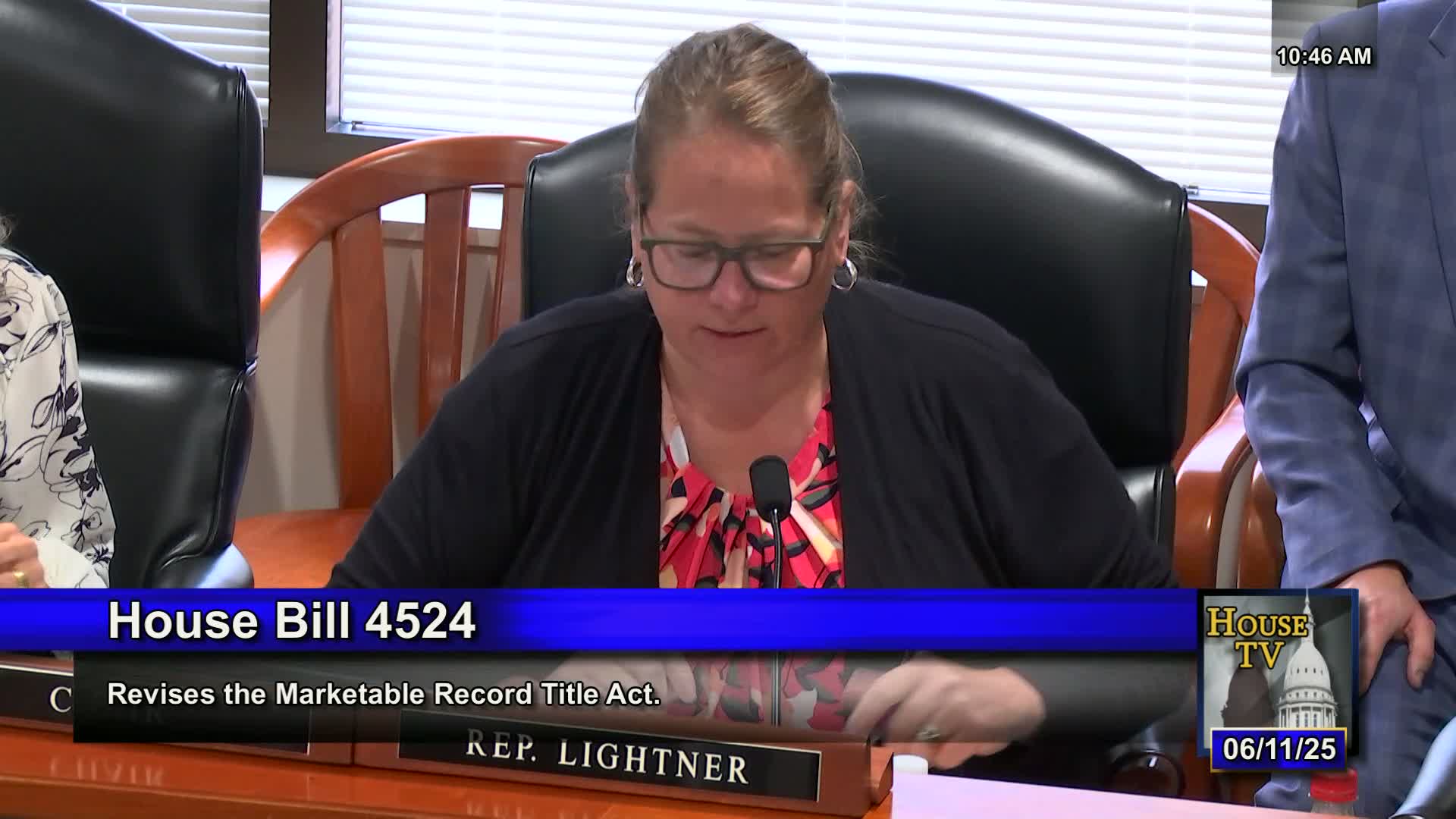
The Michigan House Judiciary Committee heard testimony on House Bill 45 24, a measure clarifying how the Marketable Record Title Act treats old restrictions and easements; supporters say the change prevents older subdivision restrictions and commercial easements from disappearing unintentionally.
Representative Juan Wozniak sponsored House Bill 45 24 and introduced David Pearson of the Real Property Law Section to explain changes to the Marketable Record Title Act. Pearson told the committee the bill is intended to restore the practical operation of the law after the 2018 amendments narrowed what older recorded restrictions remain effective.
Lede: "This bill preserves recorded restrictions and easements recorded up to 75 years old and clarifies how the Marketable Record Title Act treats older instruments," Pearson said, describing a consensus among title industry stakeholders, realtors, condominium and homeowners associations and utility companies.
Nut graf: Supporters said the 2018 amendment — which required explicit recording references to preserve older restrictions — had the unintended effect of placing decades‑old subdivision restrictions, condominium declarations and commercial easements at risk. The legislation before the committee would exempt certain recorded restrictions dated back to Jan. 1, 1950, and clarify treatment of older easements.
What witnesses said
Pearson, speaking for the Real Property Law Section, said the Marketable Record Title Act (originally enacted in 1945) was intended to simplify title searches by cutting off claims after a 40‑year window. The 2018 changes, he said, caused a wave of uncertainty because many instruments had generic provisos that unintentionally revived older encumbrances. The bill on the table would exempt recorded restrictions and easements recorded through 1950 and otherwise clarify the law so long‑standing subdivision controls, condominium covenants and commercial easements are preserved "as a practical matter," Pearson said.
Emily Dagnostini (appearing by Zoom) and representatives of the real property bar, Michigan Realtors, the Real Property Law Section and the Community Associations Institute testified in support or had filed cards indicating support. Dagnostini said stakeholders have been working on fixes since the December 2018 amendment and that the new draft addresses the concerns of most parties.
Committee action and timing
No vote was taken on House Bill 45 24 during the hearing. Sponsors said the bill reflects a broad stakeholder process and that they expect a final technical change may be filed in the coming days; the committee indicated it would schedule further consideration in an upcoming meeting.
Context
Witnesses said the 2018 amendment to the Marketable Record Title Act included a two‑year grace period for filing notices of claim but had the inadvertent effect of extinguishing many interests that parties believed to be intact. Supporters told the committee the current bill is intended to restore the law to how practitioners understood it before 2018 while preserving certainty for title searches.
Ending
Committee members did not take final action. Sponsors asked the committee to move the measure forward once a technical amendment is filed and to avoid another short-term extension of the 2018 amendment’s effective date.