Get Full Government Meeting Transcripts, Videos, & Alerts Forever!
Get email alerts on the Banking Bde Expansion topic
No spam. Unsubscribe anytime.
House commission hears competing arguments over bill to expand Banco de Desarrollo lending to mortgages, credit cards and consumer loans
Summary
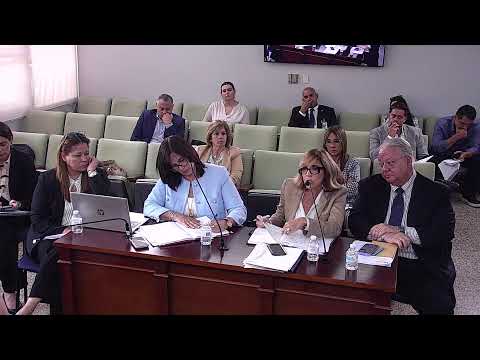
At a June 16 hearing, the House Commission on Banking, Insurance and Commerce heard testimony for and against House Bill 701, which would amend Law 22 (Ley del Banco de Desarrollo Económico para Puerto Rico) to allow the Banco de Desarrollo Económico (BDE) to offer residential mortgages, consumer loans and credit cards; no vote was taken.
Members of the House of Representatives' Commission on Banking, Insurance and Commerce on June 16 heard competing testimony on House Bill 701, which would amend Articles 2 and 3 of Law No. 22 (the enabling statute for the Banco de Desarrollo Económico para Puerto Rico) to expand the bank’s lending powers to include residential mortgages, consumer loans, credit cards and other financing products; the committee held a public hearing but did not take a final vote.
Why it matters: supporters say the change would expand access to credit for groups they say are underserved—including young people and small businesses—while opponents warned the shift would push a development bank into direct competition with private banks and cooperatives and expose the government to fiscal and operational risk.
The hearing began with an opening from the Asociación de Bancos de Puerto Rico, represented by its president Mea Álvarez Rubio, who argued the proposal would “alejar al Banco de Desarrollo Económico peligrosamente de su rol fundamental” and stressed the lack of empirical data in the bill’s expositional material to justify expanding the BDE into consumer and mortgage markets. The association asked the committee for a careful review of constitutionality and title clarity; Álvarez cited a rule in the constitution (reported in the hearing as section 17, article 3) that limits a law’s subject matter to what is expressed in its title.
Financial-advisory testimony accompanied the association’s presentation. Francisco Rodríguez Castro, president and CEO of Berlín CapitalAdvisors, presented an analysis he described as identifying “enormes riesgos fiscales, operativos y estructurales” if the bank were to add mortgages, personal loans and credit cards. Rodríguez gave scenario projections (as presented to the commission) that estimated sizable capital and provisioning needs under a range of participation assumptions and described the lack of recent audited financial information for the BDE as a material concern.
Banco de Desarrollo President Carmen Vega told the committee the bank supports PC701 as a tool to broaden financial access. Vega said the bank already has 92 employees, available liquidity and systems she described as capable of supporting mortgage and card products. Vega stated the bank has set aside roughly $40 million for an initial mortgage pilot and cited $160 million for commercial lending (figures provided to the committee by the bank at the hearing). She also described arrangements with card networks and partners intended to provide operational capacity, and said mortgage pricing would be approximately 6–6.5 percent while proposed credit-card rates would be about 13.95 percent and initial card limits would be small (the bank cited $500 limits for an initial student-focused card product).
Committee members pressed both sides on readiness and safeguards. Opponents emphasized that the BDE allegedly has not been fully examined by the Office of the Commissioner of Financial Institutions (OCIF) in more than a decade (as stated by the association), and argued the bill lacks an operational business plan and an audited fiscal impact study the association and its advisor said is required under the law referenced in the hearing as “la ley PROMESA.” Supporters, including Vega, said the bank is coordinating with OCIF and federal technical partners and described planned training, new external auditors and phased implementation (cards first, then mortgages) to limit sudden fiscal exposure.
Committee chair Representative Jorge Navarro Suárez called for written materials and updates. During the hearing the chair directed staff to request updated liquidity and allocation details from the Banco de Desarrollo within five business days (the request was made on the record). Several members asked the bank to provide documented, current audited financial statements, details on sources of funds, and a concrete plan for independent supervision before approving any statutory expansion.
What was not decided: the committee did not adopt or reject PC701 at the hearing. No final vote or formal motion on the bill was recorded during the session. The hearing record contains multiple requests for additional data and regulatory reviews but no committee-level action to change or advance the bill was announced.
Outlook: The debate at the hearing makes clear the committee will likely seek more documentation—current audited financials for the BDE, an OCIF review or conditions linking implementation to supervisory approvals, and a fiscal-impact analysis—before moving forward. Proponents framed PC701 as a policy tool to extend credit to underserved groups; opponents framed it as a fiscal and operational risk absent strong safeguards and a clear funding plan.