Get AI Briefings, Transcripts & Alerts on Local & National Government Meetings — Forever.
City of Orange hearings on ban for game rooms end with P&Z approval but no council vote
Loading...
Summary
The Planning and Zoning Commission recommended an ordinance banning amusement redemption machines and game rooms in all zoning districts; the City Council did not take action after public comments urged delay and legal concerns were raised.
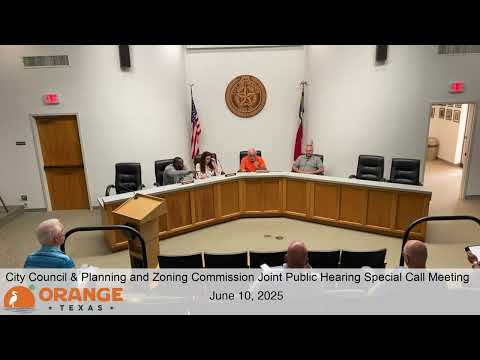
The Planning and Zoning Commission for the City of Orange held a public hearing on a proposed ordinance to ban “amusement redemption machines” and game rooms in every zoning district and voted to recommend approval, while the City Council did not take action on the measure after public testimony and discussion.
The proposed ordinance would add definitions for “amusement redemption machines,” “gambling devices” and “game rooms” to Chapter 12 (Planning and Zoning) of the City of Orange Code of Ordinances and would amend the land-use matrix to prohibit those uses in all districts. The draft also references prior local ordinances (2016-15, 2022-14, 2022-15, 2023-20), contains a severability and penalty clause, and, as drafted, sets an effective date that would give business owners 90 days to remove machines if the ordinance were adopted with a September 23, 2025 effective date.
Why it matters: the measure directly affects businesses that operate gaming or “8-liner” style machines, local revenue streams and residents who described the game rooms as a community recreation option. Supporters of the ban told the commission and council they believe the machines cause harm; opponents warned of legal risk and economic hardship.
During the Planning and Zoning meeting, commissioners moved to pass the proposed ordinance. The commission recorded a 4–0 recommendation in favor of the ordinance, and a motion to pass the proposed ordinance banning game rooms and amusement redemption machines was approved at the Planning and Zoning meeting with the chair calling “Aye” and “Motion passes.”
At the City Council meeting, several members of the public spoke against an immediate ban. Business owner Fahim Hussain Kwaja said the Fort Worth court decision cited by proponents is not binding on Orange and that the Texas Supreme Court denied review without reaching the merits. Kwaja said, “In no way, in no way, in no circumstances, that ruling is binding here in Orange on us,” and added that “we have been given the licenses, the permits from the state department.” He asked council to delay action so cities and the legislature could clarify the law and avoid costly litigation.
Residents Leticia McDonald and Tiffany Green urged council to preserve the game rooms for community recreation. McDonald said the rooms provide “a place for us to just go enjoy sitting around, meet friends, and talk,” and Green said, “We just go there and have a good time. There's no fights, no harm, nothing positive.”
Council members discussed uncertainty over enforcement and state-level authority. A city official reported the Texas Comptroller’s Office issues permits and collects fees but that enforcement of state law would fall to another agency. A council member noted that when the Fort Worth litigation reached the Texas Supreme Court the city had paused enforcement and applications until the court declined to hear the appeal; the council must now decide whether to proceed or wait for additional guidance.
Because no council member moved to adopt the ordinance at that meeting, the reading for item 9a “died for lack of motion.” Council discussion indicated the item would be placed on a future agenda so the full council could consider it; staff warned that delaying action would require re-advertising and another public hearing if the council later pursues the same effective date and 90-day compliance window.
What happened next: the Planning and Zoning Commission’s formal recommendation (4–0 in favor) was transmitted to the council. The council did not adopt the ordinance at the meeting; no adoption vote or effective-date action was recorded. Council members indicated the item will return to a future meeting when more members are present.
The record shows a split between local business owners who cited state-issued permits and potential revenue (a figure of about $100,000 per year was raised by commenters as potential municipal tax revenue under prior regulation) and residents and elected officials who expressed concern about public safety and neighborhood impacts. The city attorney and staff referenced prior local ordinances and the need to follow state administrative processes if the council decides to move forward.
Votes at a glance: - Planning and Zoning Commission — Recommendation to approve ordinance banning amusement redemption machines/game rooms: 4–0 in favor (motion passed at the Planning and Zoning meeting). - City Council — Consideration of ordinance: no motion, reading for item 9a “died for lack of motion”; no adoption vote recorded.
Next steps: Council members said the item will be placed on a future agenda so the full council can consider whether to adopt the ordinance, table it, or pursue other options pending state action or further legal guidance.