Get Full Government Meeting Transcripts, Videos, & Alerts Forever!
Get email alerts on the Rural Housing Policy topic
No spam. Unsubscribe anytime.
House subcommittee hears bipartisan proposals to shore up rural housing supply and preserve USDA-backed rentals
Summary
Witnesses and members at a House Financial Services subcommittee hearing described higher per‑unit construction costs, thin private capital, and administrative barriers as central to rural housing shortages and urged targeted reforms to USDA Rural Housing Service programs, tax credits and permitting to preserve and build homes in smaller towns.
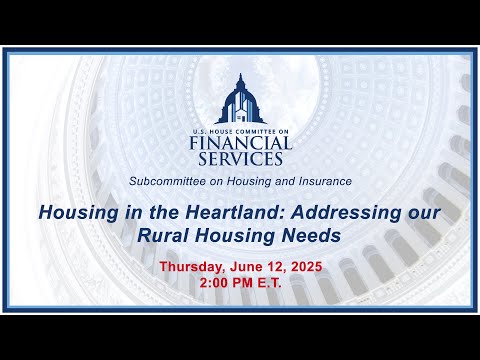
The House Financial Services Committee’s Subcommittee on Housing and Insurance held a hearing titled "Housing in the Heartland: Addressing Our Rural Housing Needs" where members and witnesses described a pattern of higher construction costs, limited contractor and lender capacity, and regulatory burdens that together shrink housing supply in rural communities.
The hearing’s chair, Chairman Flood, opened the session by framing four federal requirements he called the “four horsemen of the housing apocalypse”: lengthy environmental reviews, Build America, Buy America procurement rules, Davis‑Bacon prevailing‑wage and reporting requirements, and Section 3 hiring preferences. He said those federal requirements, while well intentioned, “significantly drive up costs of projects using federal dollars.”
Why it matters: Rural communities house about one in five Americans and face a confluence of problems—aging housing stock, higher per‑unit delivery costs for materials and labor, limited access to private capital, and thin public‑sector administrative capacity—that threaten existing affordable housing and make new production more expensive.
Witnesses from the banking, advocacy and nonprofit housing sectors described overlapping solutions. Richard Beyer, president and CEO of the Nebraska Bankers Association, detailed Nebraska’s state workforce housing matching grant program, which has directed about $59 million in state grants matched by roughly $36 million in local funds and produced 331 owner‑occupied units, 655 rental units, and 670 units under construction. Beyer told the subcommittee that Nebraska caps unit construction costs in the program ($325,000 for single‑family, $250,000 per multifamily unit) and that program rules intentionally avoid ongoing tenant income verification to reduce administrative costs.
David Garcia, policy director at Up for Growth, and David Lipsitz, president and CEO of the Housing Assistance Council, emphasized scale, capacity building, and program modernization. Garcia noted an estimated national shortfall of 3,790,000 homes and said rural home prices and rents have risen rapidly in recent years; he and other witnesses recommended targeted basis boosts for LIHTC projects serving rural areas and technical assistance grants so small local governments can update zoning and speed permitting.
Ian Mote, director of development at Buckeye Community Hope Foundation testifying for the Council for Affordable and Rural Housing (CAR), focused on preservation of USDA multifamily properties. He and other witnesses urged permanent authority to “decouple” USDA rental assistance from Section 515 mortgages so properties do not lose rental subsidy when mortgages mature, and they cited an existing demonstration (standalone rental assistance) as proof of concept.
Manufactured housing and off‑site construction drew sustained attention. Several members and witnesses said removing a HUD requirement that manufactured homes be built on a permanent steel chassis would reduce costs and speed production. Witnesses also described 3‑D printing and modular construction pilots and proposed removing regulatory barriers that prevent siting and financing of modern manufactured units in many rural communities.
Members pressed witnesses on tradeoffs between program goals and cost. In an extended exchange, Chairman Flood and Richard Beyer discussed how wage reporting, domestic procurement mandates, and local hiring quotas can increase project costs and administrative burdens; Beyer said adding Davis‑Bacon reporting, Buy America constraints or strict local hiring quotas to Nebraska’s state grant program “would add significant cost” and administrative strain for small contractors.
Multiple members highlighted permitting, inspections and local approval capacity as a non‑financial bottleneck. Witnesses recommended federal technical assistance and best‑practice toolkits for streamlined permitting, and proposed wider use of post‑pandemic practices such as tele‑inspections and virtual plan reviews to cut travel time and uncertainty.
Several members raised climate and disaster resilience concerns, including rising insurance costs in mountain and wildfire‑prone areas and the need to preserve housing after weather events. Witnesses urged funding for resilience, modernization of existing multifamily stock, and maintenance of programs that provide capital for small and rural projects.
What was not decided: The hearing was a fact‑finding and legislative discussion forum. Members and witnesses discussed draft bills and policy proposals (including language to expand LIHTC basis boosts, permanent decoupling authority for USDA rental assistance, and reforms to Section 502 loans) but no votes or formal committee actions were taken at the hearing. Witnesses were asked to submit additional materials and to respond to post‑hearing questions by 2025‑07‑17.
Ending: Lawmakers and witnesses expressed bipartisan support for targeted changes to make federal programs easier to use in small towns—simpler administrative rules, capacity building, targeted funding boosts for rural projects, and regulatory updates to allow modern manufactured and modular construction. Several speakers warned that without legislative or administrative changes, a wave of USDA property maturities and ongoing cost increases could erode existing rural affordable housing over the next decade.