Get Full Government Meeting Transcripts, Videos, & Alerts Forever!
Get email alerts on the Housing Affordable topic
No spam. Unsubscribe anytime.
San Juan County details housing gains and funding plans as state law will change how homelessness is counted
Summary
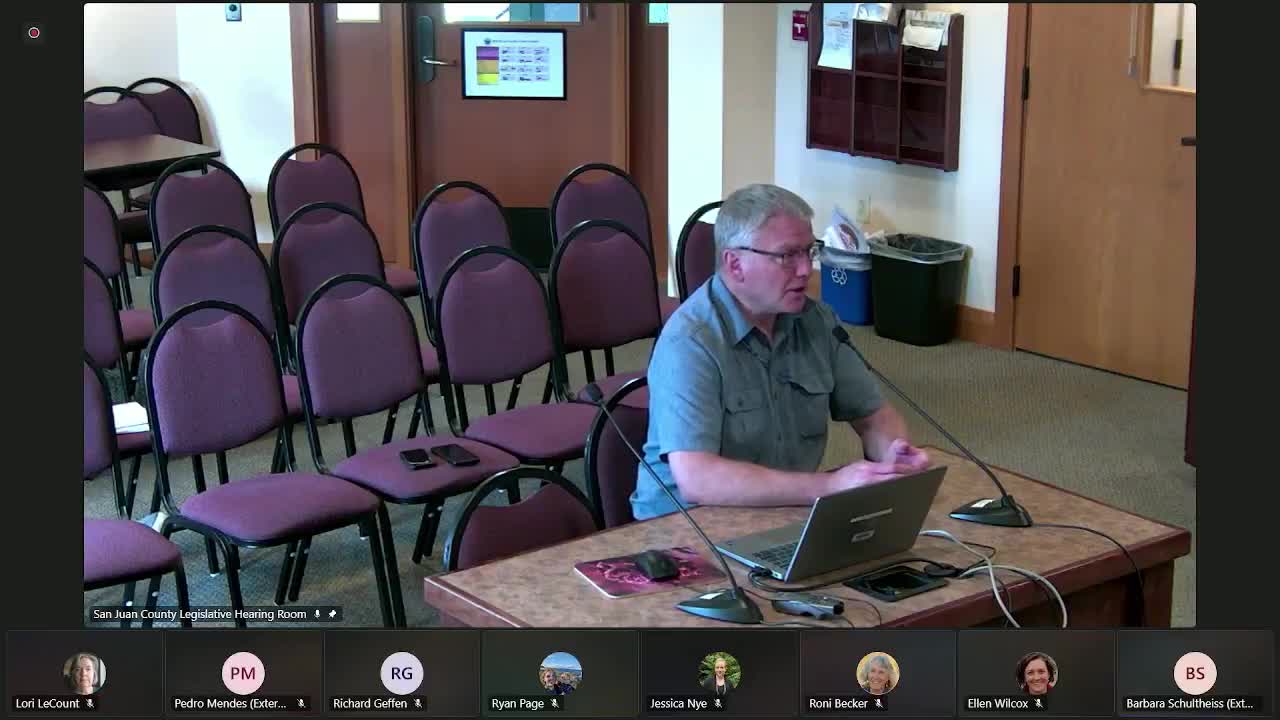
SAN JUAN COUNTY, Wash. — At the San Juan County Board of Health meeting on May 21, Housing Program Coordinator Ryan Page described recent affordable-housing developments, how county housing dollars have been used, and an upcoming legal change that will transfer responsibility for the “point‑in‑time” homelessness census to the Washington Department of Commerce.
SAN JUAN COUNTY, Wash. — At the San Juan County Board of Health meeting on May 21, Housing Program Coordinator Ryan Page described recent affordable-housing developments, how county housing dollars have been used, and an upcoming legal change that will transfer responsibility for the “point‑in‑time” homelessness census to the Washington Department of Commerce.
Page told the board that the county’s HOME and related housing funds have supported 196 housing units either completed or in development and that the county has committed roughly $13 million to 13 projects so far. He also summarized rental‑assistance programs and warned that a new state law will change how the county measures homelessness.
The changes matter because local planning, service delivery and funding rounds rely on the count and on the county’s current funding pipeline, Page said. “The 2025 point‑in‑time count we were able to identify a 124 individuals that were either considered homeless or at risk of homelessness,” he told the board, and then flagged Substitute House Bill 1899 as the driver of a new state approach to the survey.
Page outlined immediate program details first. He said the county’s senior and disabled rental‑subsidy program currently supports 22 clients across four apartment complexes. Page described an emergency rental‑assistance pilot begun in 2024 that “served over 75 individuals … averaging less than $600 per subsidy,” and he said the county budgeted $105,000 for rental assistance in the current year.
On capital and program funds, Page said the county has generated more than $15 million into its housing funds and has committed about $13 million to projects that together leverage roughly $80 million in total development costs. He said $2.7 million is available in the 2025 HOME fund round, which opens for applications on June 2, and that the county has $2.2 million in uncommitted refunding for that round.
Page described several projects funded or in development: Lopez Village North (a 15‑unit modular project), Oyster Catcher on Lopez, Kitter Way and a “Forest House” single‑family unit donated on Lopez, plus predevelopment work on OPAL’s Pea Patch and the Argyle projects. He said the Pea Patch project recently secured $3 million in state capital funds for site work and a separate $2 million allocation for a food‑bank resource center site improvement.
Page also reviewed state grant interactions. He said the county has received more than $960,000 in Connecting Housing to Infrastructure Program (CHIP) grants and that the Housing Trust Fund and Consolidated Homeless Grant were funded at similar levels in the most recent state budget cycle.
On the statewide counting change, Page said Substitute House Bill 1899 will shift a primary role to the Department of Commerce and likely move the state away from annual counts. “At a minimum, the count will no longer be conducted annually in the state, but most likely biannually every other year,” Page said. He added that Commerce will likely rely on administrative data sources and modeling to produce estimates and that the county is discussing whether to continue a local count or a local survey to preserve useful local information.
Page and board members also described planning work under way: the county’s five‑year homeless plan refresh (due for adoption by December 2025) and a host‑homes pilot to match youth with vetted local host households. The host‑homes work group — involving the Joyce L. Sobel Family Resource Center, Superior Court services and county health and community services — is drafting program design, policies and fiscal estimates so the county will be ready to apply for grants if funding opportunities appear.
Board members asked for more local detail on how programs are funded. Page explained that the county uses multiple restricted funds: the 1% affordable‑housing sales tax (HOME fund), an “o4” affordable and supportive housing fund used for rental assistance pilots, a specialty “o5” fund, and some document‑recording fee revenue. He said the county has spent about $190,000 in HOME‑fund administrative costs to date (about 1.2% of revenues) and that private philanthropy and local partners have been essential to several projects’ feasibility.
The board did not take formal votes related to housing at this meeting because no quorum was present. Page and staff said they will bring more detail to upcoming council and board meetings as the June funding round starts and as the five‑year plan advances through task‑force review, the Housing Advisory Committee and the county council.
Ending note: Page told the board he expects a competitive application round and asked board members to watch for further briefings on how the state’s point‑in‑time change and proposed federal budget developments could affect local eligibility and program demand.