Get email alerts on the Education Instruction topic
No spam. Unsubscribe anytime.
Lansing middle school outlines professional learning communities, data-driven common assessments
Summary
Lansing Middle School administrators described their Professional Learning Community model to the board, explaining how common formative assessments, SMART goals and shared outcomes drive instruction and reteaching across grade-level teams.
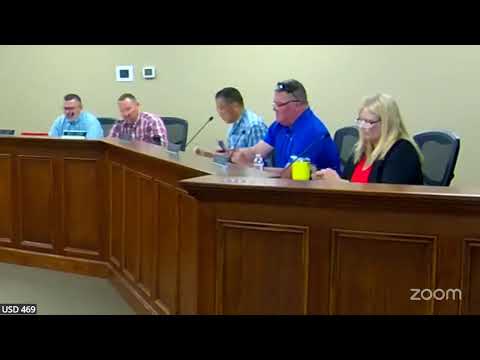
Brooks, a Lansing Middle School administrator, told the Lansing Board of Education on Monday that the school is using professional learning communities (PLCs) to align instruction, track student learning and plan reteaching based on short, common formative assessments.
The presentation laid out how PLC teams set SMART goals, agree on essential outcomes and give shared common formative assessments (CFAs) to measure mastery, then use the CFA data to reteach or enrich students. The district presented a recent example in science where a PLC set a goal to raise performance from 77.5% to 80%.
Brooks said PLCs are “a collaborative process with two end goals: to improve instruction in the classroom and then also student learning at the same time.” He described the PLC cycle: teams identify essential outcomes tied to Kansas standards or NGSS, build short CFAs tied to those outcomes, administer those CFAs on a common schedule, and then use the results to adjust instruction. “An assessment becomes formative when the idea is to take those results and to use it to drive further instruction,” Brooks said.
At Lansing Middle School PLCs are organized by grade and content (for example, three grade-level language arts teams and three grade-level math teams). Teachers are asked to give roughly four CFAs per year (about one per quarter) and to track both the mean student score and the percent of students at “mastery,” defined by the school as 80% or higher. Brooks walked the board through sample PLC data showing variation in mean scores between teachers, and then a student-by-student look that flagged which students needed reteaching on particular outcomes.
Brooks and other staff explained how PLC work informs instructional planning and curriculum decisions: consistent essential outcomes and shared CFAs (“tight”) combined with teacher-level instructional choices (“loose”) let teachers compare results while preserving classroom flexibility. He said PLCs also inform curriculum review: CFA and PLC data can show whether a purchased curricular resource produces the expected learning gains.
Board members asked about vertical alignment across grades and how PLC data integrates with the district’s scope-and-sequence (the GVC). Brooks said PLC groups at Lansing are primarily horizontal (same grade and content), but the district tracks trends as cohorts move through grades and embeds CFAs in the district’s GVC so teachers can revise question banks and outcomes over time.
The presentation emphasized that PLCs are ongoing and collective: Brooks called them “a continuous improvement process” and said PLC work is intended to be a shared responsibility among teachers to improve student outcomes.
The board did not take action on the presentation; administrators said PLC data will continue to be used in curriculum review, teacher planning and future reports to the board.
AI generated
The text on this page is AI generated. Summaries, highlights, analysis, and video transcripts are all produced from the original source material.
AI can make mistakes, so if you spot one, and we will fix it for everyone.
Note: the source content is unaltered by us. Any content source we link to, be it a video, an audio recording, or a document, is presented exactly as its publisher released it. That publisher is usually a government body, sometimes an individual official or another organisation.