Get email alerts on the Priority Hire Criteria Change topic
No spam. Unsubscribe anytime.
Committee backs change to Priority Hire ZIP-code methodology; staff exploring census-tract outreach
Summary
The committee recommended approval of an ordinance to change how King County's Priority Hire program defines economically distressed areas (changing ZIP-code methodology), and staff said they are studying options to reach eligible residents who live in high-need census tracts inside wealthier ZIP codes.
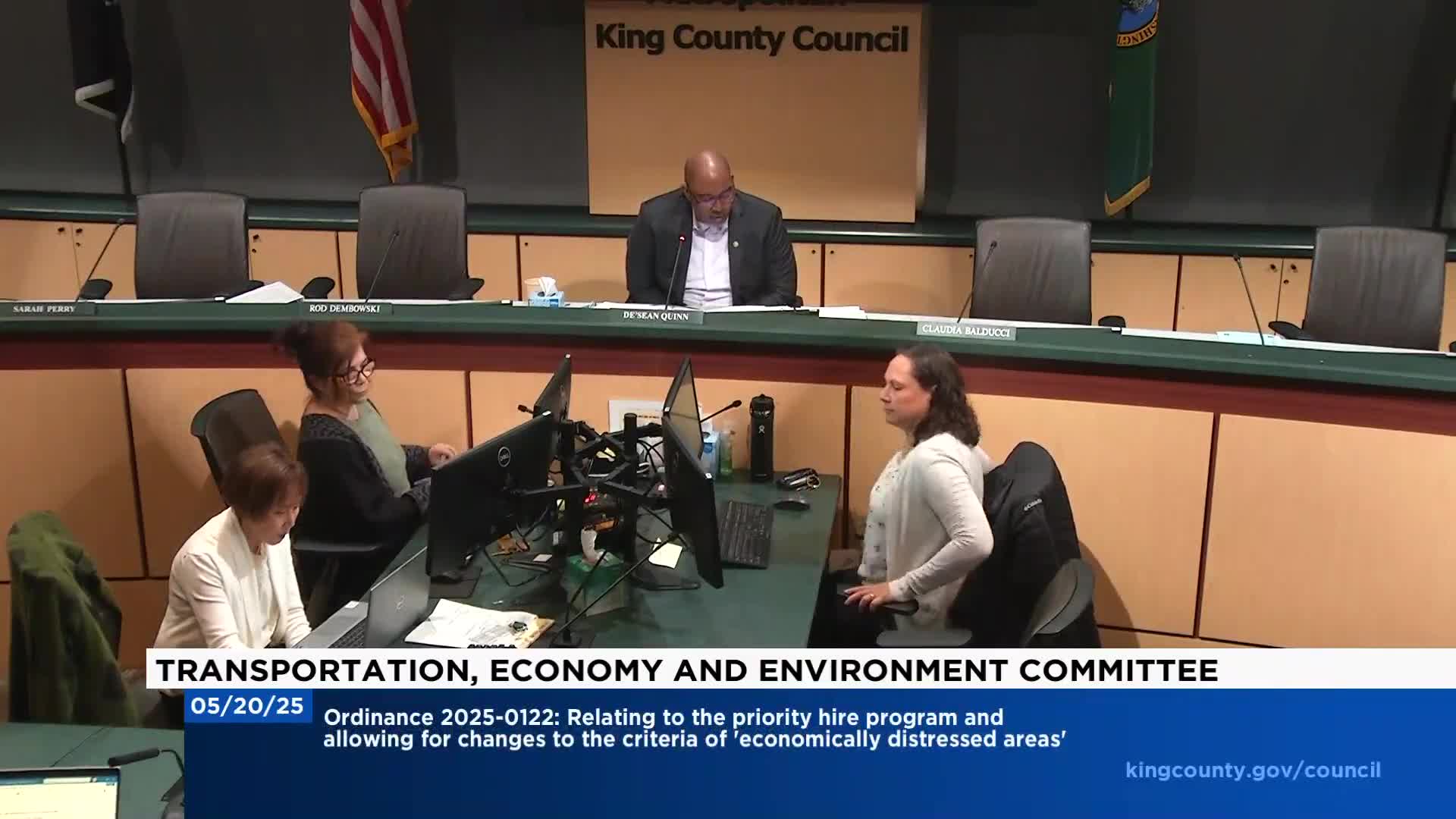
The Transportation, Economy and Environment Committee on May 20 recommended approval of an ordinance that would change how King County defines "economically distressed areas" for the Priority Hire program, and staff said they are exploring additional outreach to reach eligible workers who live in high-need census tracts.
Leah Kreckleszapi of Council Central Staff summarized proposed ordinance 2025-0122 and said the change would alter the methodology for which ZIP codes qualify as economically distressed for Priority Hire. The current definition targets the top 30 percent of ZIP codes by concentration; the proposal would instead select ZIP codes that together include at least 60 percent of the county's population of residents who meet Priority Hire criteria (household income at or below 200% of the federal poverty level, unemployed, or with less than a bachelor's degree), allowing selection by absolute counts, percentage or density.
Ken Guy, Director of Finance and Business Operations (F. Bod), told the committee that the change is intended to reflect shifting demographics and to align King County's approach with the City of Seattle's Priority Hire methodology. He said a consultant analysis found the proposed method would reach about 72 percent of residents meeting the program criteria versus 45 percent under the current method and would increase the number of Priority Hire ZIP codes from 44 to 55.
"This is something we're currently taking a look at," Guy said, describing a feasibility assessment to reach people who are economically eligible but live in non-priority ZIP codes. He noted a census tract in Bellevue as an example of an area with concentrated need inside a wealthier ZIP code and said the county is assessing how community organizations could identify and connect such residents to pre-apprenticeship and Priority Hire placements.
Committee members raised equity concerns about using ZIP codes as the sole geographic basis. Councilmember Balducci said she has raised the ZIP-code limitation before and urged more time to review the technical changes; Councilmember Perry urged attention to census-tract outreach to reach pockets of need.
The Priority Hire program was created in 2018 and is administered by the Finance and Business Operations Division. Central staff said the program has resulted in approximately $35 million in wages paid to local workers since inception and applies to county public work projects with estimated construction costs of $5,000,000 or more. The proposed ordinance also makes a minor wording change in the program criteria from "without a college degree" to "with less than a bachelor's degree."
The committee moved a due-pass recommendation for proposed ordinance 2025-0122. The clerk recorded four ayes, no nays; one councilmember was excused on that vote. Staff reiterated that work is ongoing to complete a feasibility assessment and to consult relevant executive-branch offices before implementation.
AI generated
The text on this page is AI generated. Summaries, highlights, analysis, and video transcripts are all produced from the original source material.
AI can make mistakes, so if you spot one, and we will fix it for everyone.
Note: the source content is unaltered by us. Any content source we link to, be it a video, an audio recording, or a document, is presented exactly as its publisher released it. That publisher is usually a government body, sometimes an individual official or another organisation.