Get Full Government Meeting Transcripts, Videos, & Alerts Forever!
Get email alerts on the Design Review Board topic
No spam. Unsubscribe anytime.
Naples council directs staff to remove DRB development‑order language, asks single DRB hearing with re‑review trigger
Summary
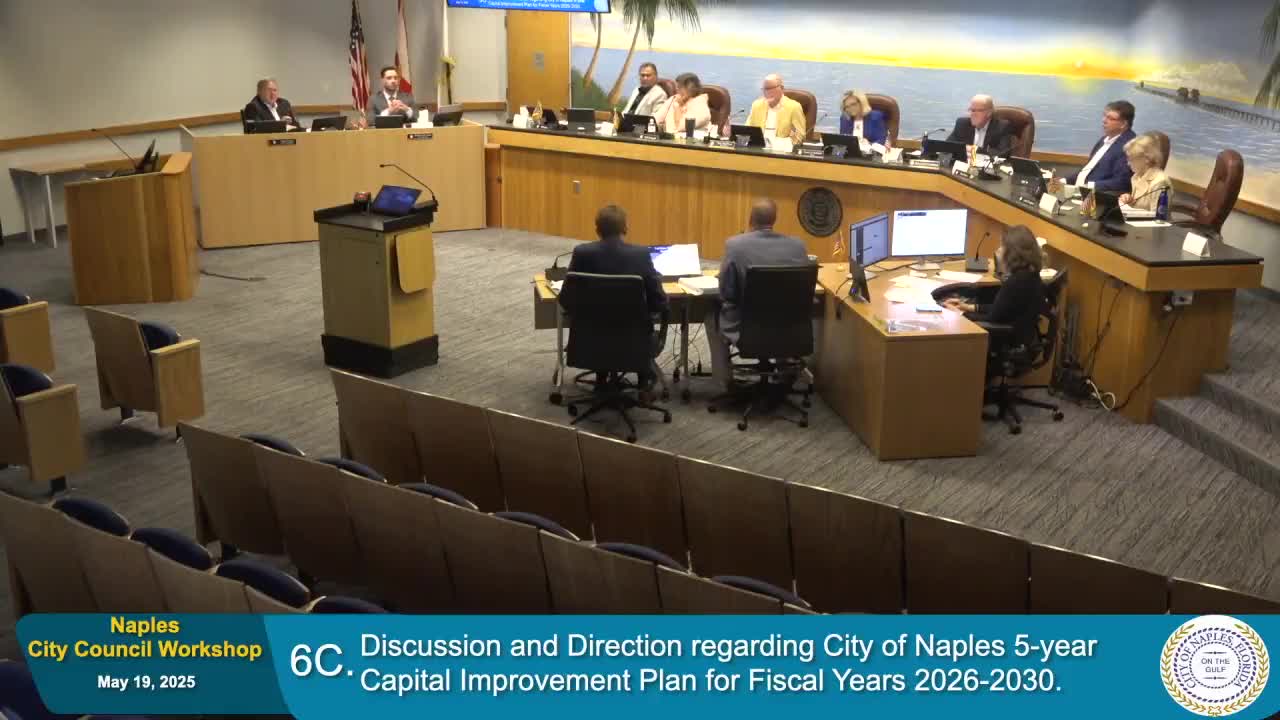
Naples City Council instructed staff to prepare ordinance language clarifying that Design Review Board (DRB) approvals do not constitute development orders and to bring a companion Planning Advisory Board ordinance to the June 4 reading.
Naples City Council instructed staff to prepare ordinance language clarifying that Design Review Board (DRB) approvals do not constitute development orders and to bring a companion Planning Advisory Board (PAB) ordinance to the June 4 reading, after an extended workshop discussion about who should make final land‑use and design decisions.
The move follows months of council, staff and board debate over whether DRB decisions function as de facto development orders and whether the public has enough opportunities to comment on projects that affect traffic, stormwater and neighborhood character. City Attorney Matthew McConnell told council an April 3, 2024 ordinance already states DRB approvals “shall in no way provide a petitioner or property owner a vested property interest or development order,” but staff and several council members said inconsistent language remains elsewhere in the municipal code and DRB guidance materials.
Why this matters: council members said the process has created confusion for applicants and residents. Projects that meet code now commonly proceed through an early DRB review, administrative site‑plan review by staff and then a final DRB step; council directed staff to remove overlapping references so the record is clear that DRB recommendations do not substitute for required staff or council entitlements.
What council asked staff to do: prepare ordinance text that (1) removes or harmonizes any code or handbook language implying DRB approvals create development orders, (2) preserves a single DRB public design review early in the review process so the public can see proposed design outcomes, and (3) inserts a clear, objective trigger that requires a project to return to DRB if later staff review or project revisions produce “substantial” design changes. Council member Ray Christman and others requested that the trigger include a clear metric or examples (for staff to draft) so staff can consistently decide when re‑review is required.
How the change will work in practice: for code‑compliant projects council accepted a streamlined path (one DRB hearing, concurrent administrative site‑plan review). For projects that require council entitlements (rezoning, comprehensive plan amendment, planned development, conditional use, variance or other discretionary action), the required public hearings for those entitlements will remain (PAB and/or council as required by statute) and the DRB design review will be the public design hearing; if subsequent technical reviews change the design substantially, the project will be referred back to DRB for reconsideration. The city manager and city attorney will return a draft ordinance implementing the changes; council agreed the PAB ordinance already scheduled for June 4 should proceed while the DRB language and the “substantial change” trigger are finalized.
Nut graf: Council members said they want a predictable, auditable process that preserves a public design review opportunity while preventing confusion about who issues development approvals. The immediate direction to staff is legal and redrafting work to remove conflicting language across the municipal code, the DRB handbook and related documents and to present the PAB ordinance at the June 4 reading so changes can be adopted in a timely way.
Process note: the PAB previously heard a related revision and recommended denial; council ordered staff to prepare the ordinance language and return it for reading and debate. Council directed staff to prepare clear guidance for applicants on the application materials required at each step (e.g., aerial/orthophoto, schematic 3‑D massing, elevations, stormwater and traffic summary) so the public and staff review the same baseline information.
Next steps: staff will draft ordinance language and a recommended “substantial change” definition for council review and will circulate materials prior to the June 4 reading. If enacted, the revisions will be codified by ordinance (two readings required); the DRB handbook will be harmonized with the new code language. The council did not vote on an ordinance in the workshop; it gave direction for ordinance text and a timetable for readings.
Ending: Councilmembers said they expect the changes to reduce confusion for applicants and residents, and to improve coordination among DRB, PAB and staff reviews while protecting statutory land‑use obligations.