Get AI Briefings, Transcripts & Alerts on Local & National Government Meetings — Forever.
Baltimore Convention Center presents $29.6 million FY26 budget as deferred maintenance nears $130 million
Summary
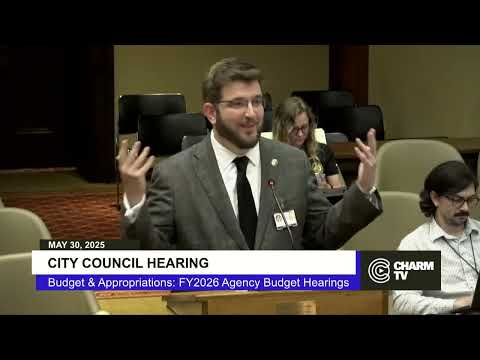
Matt Campbell, executive director of the Baltimore Convention Center, told the Baltimore City Finance Committee that the center’s proposed FY26 operating budget is $29,600,000 and — after earned revenue and a state deficit subsidy — will cost Baltimore about $6,600,000.
Matt Campbell, executive director of the Baltimore Convention Center, told the Baltimore City Finance Committee that the center’s proposed FY26 operating budget is $29,600,000 and — after earned revenue and a state deficit subsidy — will cost Baltimore about $6,600,000.
"The mission of the convention center is to generate positive economic impact to the city and state, create jobs, and serve our community," Campbell said, noting the facility draws roughly 450,000 visitors and supports about 194,000 hotel nights annually.
The convention center’s economic footprint, Campbell said, included about $5,700,000 in city tax revenue and $15,100,000 in state tax revenue in FY24 and roughly $273,000,000 in direct and indirect spending. He told the committee the center supports about 1,900 jobs, most filled by city residents.
Why it matters: the building’s aging core infrastructure — much of it dating to the center’s 1979 opening — has created what Campbell described as "close to $130,000,000 deferred maintenance backlog," driving the push for sustained capital funding and governance changes. Campbell said the mayor’s legislative agenda and the Operating Authority Task Force (House Bill 1016) are intended to "facilitate change in funding and governance mechanisms to better align the convention center with our national peers." He added the city and state will provide more than $30,000,000 in capital starting this summer to begin addressing the backlog.
Campbell described several near-term projects: upgraded fire/life-safety systems, renovated restrooms, a rehabilitated pedestrian bridge to a major hotel, and a planned RFP for a digital-signage management contract. The digital-signage partner would build interior and exterior infrastructure to enable paid sponsorships and show branding; Campbell said the program could generate "millions of dollars of top line revenue" annually once scaled and that the center would receive a substantial percentage of commissions.
Campbell said the center has increased its FY26 request for repairs, maintenance and supplies by more than $600,000 to align with prior-year actuals and to address ongoing building failures the in-house maintenance team has managed without large-scale outsourcing.
Federal policy and booking recovery: Campbell warned that recent federal travel restrictions and executive actions affecting diversity, equity and inclusion programs have reduced attendance at events that historically anchored the schedule. He cited the Black Engineer of the Year Awards, where branches of the military reduced participation after executive orders, and said some military groups outright canceled events because of DOD travel restrictions. "A banquet for 1,600 with the full joint chief of staff ... ended up being 400," he said, outlining cascading losses to labor, service providers and restaurants.
Governance and the task force: Council President Cohen pressed Campbell on the stalled effort to create an independent authority to support downtown and the convention center; Cohen said hoteliers have "signaled that they will not invest in themselves until something is done about the convention center." Campbell said the recent session amended the bill to extend the Operating Authority Task Force’s work rather than immediately creating the authority, and that the task force will develop bylaws, funding mechanisms and governance details before the authority is activated. Campbell added that the task force’s work will address employment protections for the center’s roughly 56 city employees.
Community programming and partnerships: Campbell highlighted placemaking efforts — murals from the Brush Mural Festival, interior window clings, and local food and beverage partnerships — as part of a strategy to make the center a gateway to Baltimore neighborhoods, not just a destination. He credited partnerships with Visit Baltimore and said the center is leveraging recently allocated ARPA funds for Visit Baltimore to help incentivize events that maximize community impact.
Parking, transportation and customer experience: Council members raised parking and access concerns. Vice President Middleton said parking delays hurt revenue; Campbell said the center is exploring options including a modest on-site parking increase, shuttle services, and partnerships with nearby garages (including capacity returning as the collapsed 1 East Pratt/PNC garage is rebuilt). He said the center is working more proactively — not merely brokering conversations — with the stadium authority and other providers to offer optional shuttle services and other customer-focused solutions.
Other operational notes: Campbell pointed to Visit Baltimore as a sales and marketing partner that distributes "know before you go" information, including transit options such as the Circulator. He said the center is working with industry associations, benchmarking other cities, and intends to pursue procurement for rideshare or parking incentives if a viable, equitable model can be procured.
Next steps: Campbell said he hopes to see digital-signage revenue in FY26 if procurement moves quickly and that the task force’s next phase will produce the bylaws, funding models and recommendations needed to pursue larger capital work. Staff and council members pressed for clear, concise funding and governance proposals when the task force returns to legislative action.
Ending: Campbell closed by reiterating the center’s role in downtown revitalization and its commitment to building a stronger sales pipeline and new revenue streams to reduce the city’s operating burden while modernizing the facility.