Wayne County panel approves $1.02 million grant application, outlines program funding and staffing limits
Summary
Wayne County Community Corrections Advisory Board approved its fiscal year 2026 grant application totaling $1,017,899.76 and accepted the fiscal year 2025 second-quarter report, citing utilization improvements and partnerships while noting gaps in education/employment funding.
The Wayne County Community Corrections Advisory Board on Thursday voted to approve a fiscal year 2026 grant application requesting $1,017,899.76 and also approved the board's fiscal year 2025 second-quarter report.
The approvals, made during the board's regular meeting, advance the county's request for state Community Corrections funding from the Michigan Department of Corrections and formalize the quarterly financial snapshot from Jan. 1 to March 31, 2025.
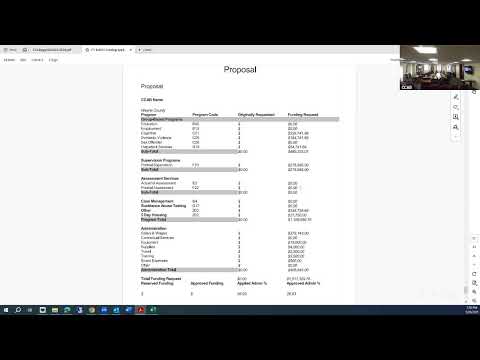
Board Administrator Lester Thomas, who chaired the meeting, said the FY26 application breaks funding into program lines including jail-based services, domestic-violence community programming, a fugitive apprehension line, short-term (five-day) housing and a violence-prevention contract that remains pending board-level contract approval. "As you know, we cannot exceed 30% for salaries; that $379,000 keeps us at 26.93, which is under the threshold," Thomas said during the funding overview.
Thomas said the application lists a proposed allotment for a violence-prevention curriculum operated by a vendor identified as Real Solutions that is still awaiting full-commission contract approval; if approved at the commission's next meeting, staff expect to begin implementing the violence-prevention program in June. The application also designates roughly $379,000 for salaries, with the remaining funds for contracts, supplies, training and board expenses.
Board discussion and questions focused on utilization rates across existing programs and on why the application does not request separate funding for education and employment services. Thomas presented the FY25 quarter-two utilization figures and said most subprograms were at or near 50% utilization through March 31 — figures the board is tracking closely because MDOC funding depends on demonstrated use of allocated services.
Ebony McCann, transition services division director, told the board the department previously ran a "wrap" vocational-education program at the Detroit Reentry Center but discontinued it after reviewing outcome statistics and because the facility closed. McCann said the violence-prevention curriculum in the FY26 application includes an education-and-employment component, and the county plans to leverage community providers such as Goodwill Industries and Detroit at Work for education and employment referrals. "We did in the past have the wrap program ... it did not appear that it was effective to have that curriculum in that particular facility," McCann said. She added the board could discuss adding a specific curriculum for registered offenders if members want to fund one directly.
On program line items Thomas cited during the overview, the application lists: a jail-based program at $50,000; a community domestic-violence program at $125,000; a drunk-driving (DUI) program at $45,000; Black Family Development trauma services at $75,000; fugitive apprehension at $50,000; five-day housing at $21,000; and a Real Solutions violence-prevention line listed at $250,000. Thomas also cited a Lakeridge Village cognitive behavioral therapy line at approximately $140,500. Board members asked for clarification about a consolidated "other" line in the application; Thomas and McCann said the application groups several smaller program lines under that subcategory.
The board also heard administrative items: Vice chair (name not specified) announced two vacant advisory-board seats — one for media and one for workforce development — and said interviews are underway. The board approved the March 12, 2025, meeting minutes by voice vote earlier in the meeting.
Formal motions to approve the FY25 quarter-two report and the FY26 grant application were made and seconded; each passed on voice vote. Thomas said staff would submit the approved FY26 application to the Michigan Department of Corrections and keep board members updated on grant processing and any contract approvals needed for vendor-led programs.
The meeting closed with no public comments and the board adjourned.
AI generated
The text on this page is AI generated. Summaries, highlights, analysis, and video transcripts are all produced from the original source material.
AI can make mistakes, so if you spot one, and we will fix it for everyone.
Note: the source content is unaltered by us. Any content source we link to, be it a video, an audio recording, or a document, is presented exactly as its publisher released it. That publisher is usually a government body, sometimes an individual official or another organisation.