Get AI Briefings, Transcripts & Alerts on Local & National Government Meetings — Forever.
Senate backs temporary restriction on TCEQ class‑5 permits for Austin ASR project after stakeholder concern
Loading...
Summary
Lawmakers approved a committee substitute that pauses TCEQ authorization of a class‑5 injection well for an aquifer storage and recovery project until community studies are complete; Austin officials warned the pause risks project feasibility while local governments and groundwater districts said more study and stakeholder engagement were needed.
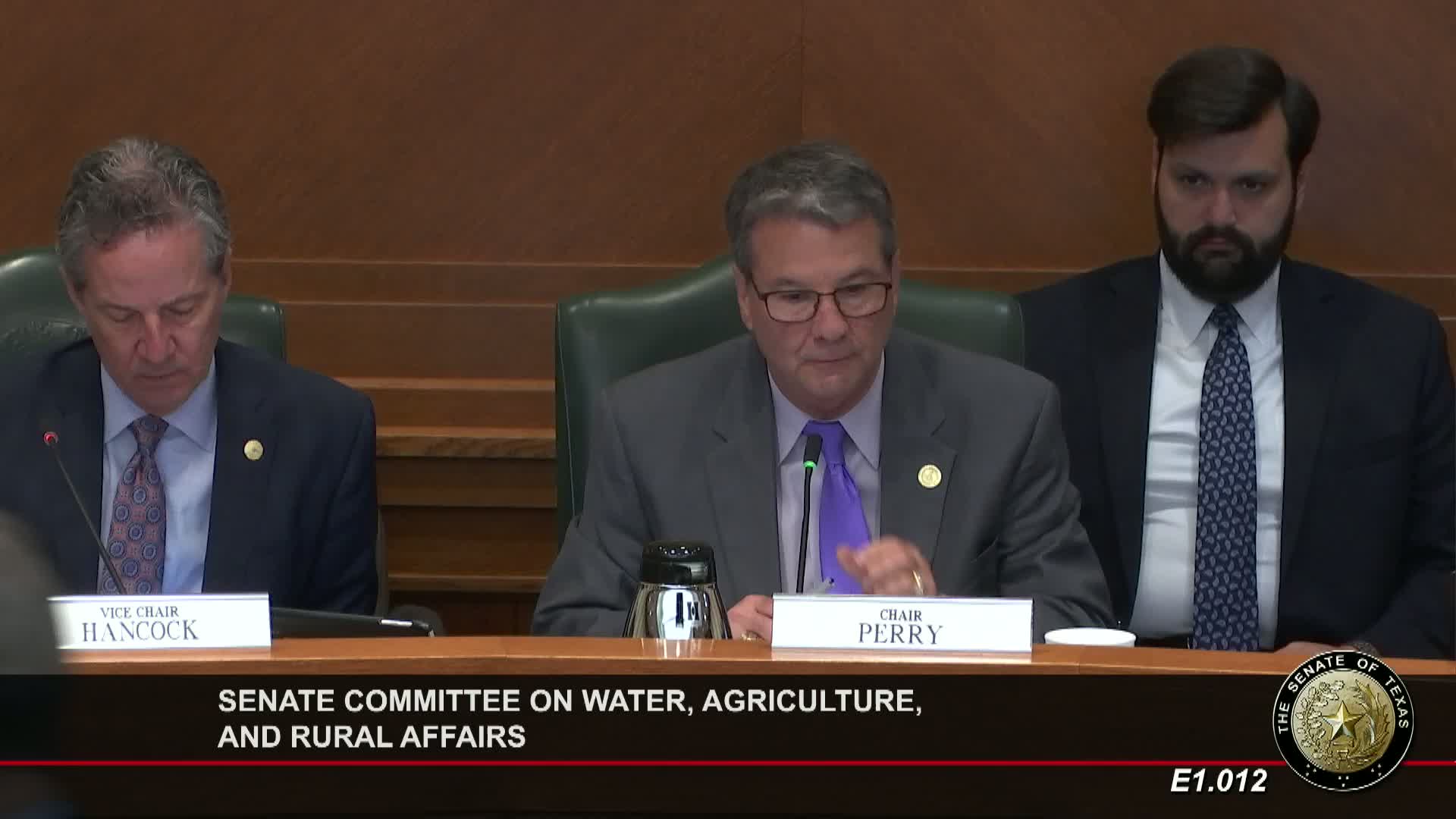
The Senate Committee on Water, Agriculture & Rural Affairs adopted a committee substitute for House Bill 15,23 that temporarily prohibits the Texas Commission on Environmental Quality from authorizing or issuing a class‑5 injection well permit for an aquifer storage and recovery project proposed by the City of Austin in areas affecting the Lost Pines region, sponsors said.
Sponsor Senator Pete Schwartner (appearing in committee as sponsor) said the substitute prohibits moving forward on the permit until the studies proposed by the city’s phase‑1 and phase‑2 plans are completed, with the prohibition lasting through Dec. 27, 2027. The motion to adopt the committee substitute passed in committee and the substitute was reported favorably to the full Senate.
The hearing drew detailed technical and local testimony. Ed McCarthy, an attorney who said he worked on Texas’ first ASR legislation and permitting, argued against an additional moratorium: “Any restriction on ASR above what is currently in statute I believe … is unnecessary,” he told the committee, noting successful ASR projects have helped communities survive drought.
Greg Ellis, representing the Lost Pines Groundwater Conservation District, said the district supports the committee substitute because local stakeholders had not received adequate answers from the city before the bill’s filing and had since engaged in multiple stakeholder meetings; Ellis said the substitute “assures that [the stakeholder process] will continue through December 2027.”
Austin Water’s director, Shay Roulson, testified against the committee substitute. “The ASR project prohibited by this bill is a cornerstone of our 100‑year water plan, and it’s key to improving drought resiliency across Central Texas,” she said, and warned that the uncertainty added by the substitute could render the project infeasible by jeopardizing required preliminary testing and financial commitments.
Local elected officials from Bastrop voiced support for the substitute. John Kirkland, acting mayor pro tem of Bastrop, asked how injection and recovery rates would be controlled and said Bastrop was concerned about the risk that its municipal supply could be harmed if recharge and recovery rates are mismatched.
TCEQ staff described the permitting pathway in place today. Ashley Forbes of the TCEQ’s Radioactive Materials Division explained that TCEQ processes authorizations that include technical chemistry and withdrawal‑rate conditions and that the agency “has the ability to make it a permit with a public participation process that is in our toolbox,” but said most ASR authorizations implemented so far had followed the authorization pathway rather than the permit pathway.
Committee members emphasized that ASR is a useful tool but that projects should be built with robust stakeholder engagement and scientific review. The committee adopted the substitute and voted to report it favorably to the full Senate by roll call.