Get Full Government Meeting Transcripts, Videos, & Alerts Forever!
Get email alerts on the County Budget topic
No spam. Unsubscribe anytime.
Sweetwater County commissioners face roughly $8.5 million shortfall; staff and commissioners weigh cuts, reserve use and capital deferrals
Summary
At a May 20 budget workshop commissioners discussed an estimated $8–8.6 million fiscal gap driven by falling valuations and state property tax relief. Staff and commissioners debated cuts to outside agencies, delaying capital projects, using reserves and ARPA/PILT funds, and pausing certain FTE commitments.
Sweetwater County commissioners spent much of a May 20 workshop confronting a projected multi‑million‑dollar shortfall for fiscal 2026 and weighing options that included significant reductions to outside agencies, deferring capital projects, and limited use of county reserves and other restricted funds.
Rebecca Merrell (accounting specialist) presented updated budget numbers that showed a decrease in projected revenues and changes in planned expenditures and carryover. Commissioners and staff described a roughly $8.1–$8.5 million gap compared with currently proposed spending levels; participants emphasized that the figure could change as final valuation and revenue numbers arrive and as specific capital encumbrances are reconciled. Commissioners noted the shortfall reflects lower property valuations, changes to state property tax relief and other one-time/ongoing revenue shifts discussed during the legislature’s recent session.
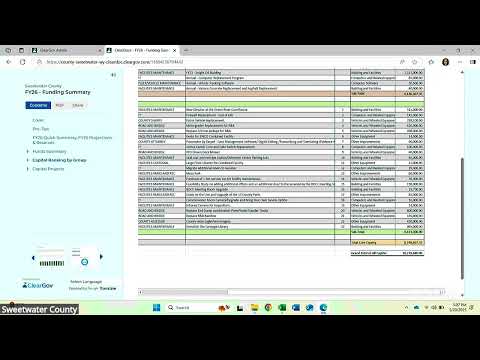
Options discussed at length included: - Reducing or phasing out funding for nonstatutory outside agencies and nonprofits. Commissioners debated whether to cut organizations entirely or reduce them by fixed percentages (examples raised: 10–50% reductions, with some commissioners proposing complete defunding of a few small agencies). Several agencies mentioned in the discussion: Boys & Girls Club, Climb Wyoming, Family Resource Center, VIRS, Golden Hour senior center, Young at Heart senior center, Star Transit, youth home, conservation district and others. Commissioners noted some agencies have reserve balances while others provide essential services to vulnerable residents. - Deferring or canceling capital projects. Commissioners reviewed the capital ranking prepared by a capital committee. Proposed deferrals included lower‑priority county capital items and some component-unit projects (museum façade, event‑complex projects). Multiple commissioners suggested more aggressive capital reductions are the fastest way to reduce the gap. - Using restricted or special funds. Commissioners discussed using targeted reserves: an Impact Assistance fund (roughly $2.5 million), ARPA PILT (public lands) funds received under the American Rescue Plan, and existing carryover for one-time projects. One commissioner proposed funding a previously promised hospital lab project from reserves (rather than operating funds), which would reduce the operating gap substantially but would draw on reserve balances. - Reassessing personnel/FTE funding for positions that remain vacant. Commissioners reviewed carryover and unfilled positions in departments (sheriff/detention and county attorney’s offices in particular) and considered delaying or pausing automatic budgeted funding for vacant positions until hiring prospects are clearer.
Commissioners described a multi-step plan: (1) ask outside agencies to submit revised requests and searches for alternative funding, (2) prioritize county core and component capital using the capital committee ranking, and (3) consider limited use of specific reserve/capital funds for one-time obligations rather than recurring operating costs. Several commissioners favored a mix of actions rather than relying solely on reserves.
Next steps and schedule: the board agreed to hold one more dedicated budget workshop (proposed afternoon of June 3) so staff can produce revised numbers, and to meet the legal deadlines for the required public notices and hearings in mid‑June. Commissioners directed staff to follow up with outside agencies promptly so those organizations can plan for revised funding levels.
Why it matters: the decisions will determine which programs county government can continue funding, whether capital projects will be deferred, and how many vacant positions are not filled during a difficult budget year. The board prioritized preserving statutory services but acknowledged that choices will be required on discretionary and community grants.