Get Full Government Meeting Transcripts, Videos, & Alerts Forever!
Get email alerts on the Housing topic
No spam. Unsubscribe anytime.
Seattle public hearing on HB 11‑10 interim code draws hundreds; advocates clash over housing density and tree protections
Summary
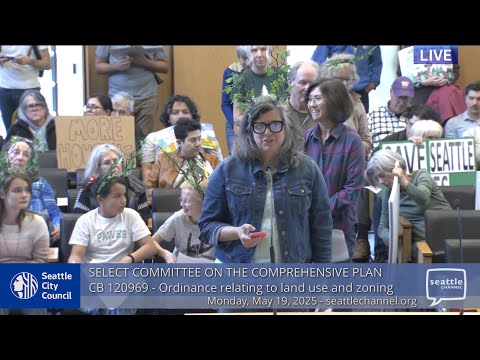
Seattle — Hundreds of residents filled Council chambers on May 20 for the second in‑person session of a public hearing on interim rules to implement state House Bill 11‑10, the measure that requires cities to allow “middle housing.”
Seattle — Hundreds of residents filled Council chambers on May 20 for the second in-person session of a public hearing on interim rules to implement state House Bill 11‑10, the measure that requires cities to allow “middle housing.” The Select Committee on the Comprehensive Plan heard comments urging both swift approval of denser housing types and stronger protections for large trees and front‑yard setbacks.
The meeting, chaired by Select Committee Chair Joy Hollingsworth, opened the in‑person session after a morning remote session. Hollingsworth explained logistics and said the committee had prioritized speakers who signed up for an earlier February 5 hearing that was disrupted by weather.
Why it matters: The interim ordinance is meant to bring Seattle into compliance with state law and set short‑term zoning rules ahead of the city’s full “1 Seattle” comprehensive plan update. Speakers said the interim rules will shape development patterns — and tree canopy — for years.
Supporters of rapid up‑zoning pressed the committee to pass the interim ordinance without setback increases or other amendments they said would block construction. Ryan Donahue, chief advocacy officer for Habitat for Humanity Seattle‑King‑Kittitas Counties, told the committee that the city should “treat this as a floor, not a ceiling,” and highlighted recently completed stacked‑flat projects that produced homeownership opportunities. Donahue said those projects created “over 31 families now have a place to call home in the heart of Seattle.”
Other housing advocates urged removing minimum lot sizes and unit‑size minimums so stacked flats and six‑plexes become economically feasible. Ryan Haight, a speaker who said stacked flats are among the most affordable middle‑housing types, asked the committee to “remove the minimum unit size and minimum lot size for stacked flats,” calling them the most affordable forms of housing the city can build.
Speakers representing business and worker interests echoed those points. Lily Hayward, representing the Seattle Metro Chamber of Commerce and the Complete Communities Coalition, said polling shows a majority of residents believe increasing housing supply will slow price increases and that the city should “pass this interim legislation with haste and then get to the comprehensive plan.” Phil Lewis, co‑chair of the Human Rights Commission, framed housing access as an equity and human‑rights issue and urged passage.
At the same time, many residents, neighborhood groups and environmental advocates urged preservation of the city’s tree canopy and retention of 20‑foot front setbacks. “The current interim plan is bad for trees,” Martha (last name not provided) told the committee, saying the draft could hardscape 95% of some lots and “pave over” space needed for mature trees. Several speakers pointed to recent removals of large heritage trees and said current enforcement and permitting by the Seattle Department of Construction and Inspections (SDCI) permit too much tree loss.
Rachel Shaver and Jeff Callahan, who said the developer cut a co‑owned boundary cedar in North Broadview, described confrontations and a loss of a large, historic tree. “When I go home today and I see the absence of the tree, I die inside,” Callahan said.
Children and school representatives also testified. Students from McDonald International School described the emotional impact of losing a large sequoia named “Grace.” A 7‑year‑old speaker, Angus Oak, told the committee, “Please protect the trees for the children of the city and for the future.”
Specific policy points raised
- Setbacks and amendment 8: Several speakers and groups repeatedly asked the committee to adopt what they identified as “amendment 8,” which would retain a 20‑foot front‑yard setback and protective measures the speakers said are necessary for trees and neighborhood character. Tree advocates argued reduced setbacks in the interim code would concentrate development and lead developers to remove large trees.
- Lot coverage, FAR and minimum lot sizes: Housing advocates urged removing a proposed 6,000‑square‑foot minimum lot size for some housing types and increasing permissible floor‑area ratios (FAR) to make stacked flats affordable. Ryan Turner cited a city middle‑housing study he said estimated stacked flats would be the most affordable typology (he quoted a median price of roughly $500,000 per unit). Opponents said other proposed changes to lot coverage would encourage larger, more expensive homes rather than affordable units.
- Vesting and enforcement: Tree advocates warned that developers can vest projects under older codes and that interim changes could create incentives to clear lots before stronger protections are adopted. Several speakers called for stronger SDCI enforcement, replacement standards for removed trees, and a city tree fund.
- Equity and displacement: Housing proponents framed more supply as a remedy to displacement and rising rents. Multiple speakers said delaying or weakening the interim rules would deny housing to workers, students and people on fixed incomes; others warned that lax tree protections disproportionately harm neighborhoods with lower canopy coverage.
Quotes and attributions (selected)
- “If we build more housing across our city, we will have new neighbors and citizens that will work to improve our city,” said Evan Riley, a nurse who spoke on behalf of himself and his wife, who works in youth homeless services.
- “This interim code is a disaster for the city. It is not well thought out yet will have enduring impacts forever,” said Rick Bridal (as transcribed), urging the council to adopt an interim code that “meets but does not exceed House Bill 11‑10.”
- “The idea that we are benefiting the climate by paving our entire city is ridiculous,” said Julia (last name not provided), arguing that allowing development to hardscape most of a lot would exacerbate urban heat islands and flood risks.
Actions requested and committee next steps
Speakers repeatedly asked the committee to either: 1) pass the interim ordinance promptly and keep it narrow (housing advocates), or 2) adopt the interim ordinance only with amendments to retain larger setbacks, stronger tree protections, and guaranteed replacement standards (tree advocates). Chair Hollingsworth closed the hearing by reminding attendees the committee will meet May 21 to take up HB 11‑10 legislation and amendments.
Context and background
HB 11‑10 is a state law requiring cities to allow middle housing. The interim ordinance under consideration would set short‑term zoning standards before the city adopts a full comprehensive plan (the “1 Seattle” plan). The hearing demonstrated strong cross‑cutting public interest: both housing advocates and tree‑protection advocates said they want a livable, equitable Seattle but disagreed on which interim rules will best achieve those goals.
What’s next
The committee scheduled a meeting for May 21 to consider the interim ordinance and proposed amendments, and Chair Hollingsworth invited written public comment on the bill before that meeting.