Lifetime Citizen Portal Access — AI Briefings, Alerts & Unlimited Follows
Mayor’s FY26 budget funds CHIME program office, adds youth-safety and housing staff
Loading...
Summary
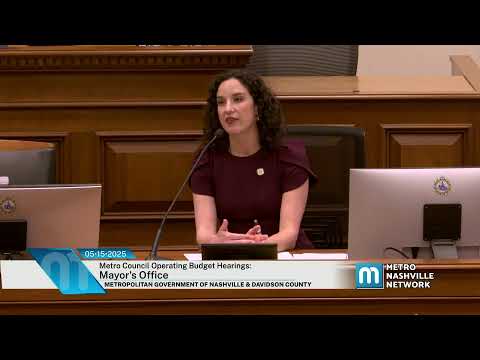
Marjorie Pomeroy Wallace, chief of staff for Mayor Freddie O’Connell, told the Budget & Finance Committee that the mayor’s recommended fiscal year 2026 operating budget creates a six‑person program management office to implement the voter‑approved Choose How You Move transportation improvement program and funds new mayor’s‑office staff for youth safety, violence prevention and housing coordination.
Marjorie Pomeroy Wallace, chief of staff for Mayor Freddie O’Connell, told the Budget & Finance Committee that the mayor’s recommended fiscal year 2026 operating budget creates a six‑person program management office to implement the voter‑approved Choose How You Move transportation improvement program (CHIME) and funds new mayor’s‑office staff for youth safety, violence prevention and housing coordination.
The CHIME program — approved by voters in November 2024 and funded by a dedicated half‑penny surcharge — is reflected in the FY26 operating budget, Wallace said, and the recommended mayor’s‑office team will provide centralized oversight and interdepartmental coordination. “We call that CHIME,” Wallace said during the committee hearing.
Kendra Abkowitz, acting program director for Choose How You Move, told the committee that CHIME received “60.6 percent of Nashvillians” support in the referendum and that the city has already taken procurement and staffing steps to stand up the program, including appointment of a chief program officer and issuance of a program‑management RFP. “Absent a central decision making and program management structure, the city runs the risk of inefficiencies or uncoordinated work across the city, which could lead to project implementation delays, cost overruns, and unnecessary disruptions to our residents,” Abkowitz said.
Budget details presented to the committee include a FY26 personnel cost for the program management office of just over $1.2 million and non‑personnel costs just over $2.4 million; the office will rely on a vendor partner for additional program‑ and project‑management capacity while the six FTEs establish governance, sequencing and templates for a 15‑year, roughly $3.1 billion capital program. Abkowitz said the mayor’s office is negotiating with HNTB to serve as a long‑term implementation partner and described HDR’s short‑term work drafting memoranda of agreement, sequencing processes and financial models.
Committee members pressed for clarity on funding flows and responsibilities. Abkowitz said the $3.3 million item shown in the mayor’s office budget is “actually coming directly from those sales tax revenues, but … we are still including them in the operating budget because they’re operating expenditures.” The presentation also noted a prior Metro Council approval of a $59 million supplemental budget to fund the first 11 CHIME projects.
The FY26 requests include funding across multiple departments to deliver CHIME: WeGo service expansions (expanded Sunday service, improved frequency, three WeGo Link zones, added weekend service for WeGo Access and a low‑income fare program), ITS positions for network and security work, planning and NDOT resources for corridor and transit‑center planning, and increased transit‑system safety and security measures including contracted security, a transit ambassador program and additional MNPD presence. Abkowitz said the Jefferson Street corridor study — funded through CHIME and covering Rosa Parks Boulevard to Ed Temple Boulevard and 20 Eighth Avenue North — kicked off an advisory group this week.
Council members asked about permanence and future governance. Abkowitz said the mayor’s proposed centralized office is intended to “help get everything started” and that institutionalization decisions will be made later; she described a proposed steering committee to set project prioritization, informed by the CHIME advisory committee, with the mayor making final approvals. Abkowitz said the advisory committee work begins June 2 and that a first CHIME advisory board meeting is planned in June.
Other mayor’s‑office staffing in the request includes the Office of Youth Safety (moving into the mayor’s office for its first full year of operation), a director for an Office of Violence Prevention and Reduction to work alongside the youth‑safety director, a housing manager to coordinate the unified housing strategy across departments and public‑private partners, an Imagine Nashville project manager, a workforce development coordinator, a chief strategy officer and a deputy chief of operations. Wallace said the additions aim to improve cross‑department coordination across Metro’s 55 departments.
Looking ahead, Abkowitz told the committee the city hopes to launch the low‑income fare program “later this fall,” subject to program design workshops with social‑service and administrative partners. Negotiations with HNTB and the establishment of program management structures, advisory committees and vendor support remain active next steps.
For now the committee received the presentation and entered into the next scheduled hearing on WeGo and departmental budgets.