Get email alerts on the Land Use Zoning topic
No spam. Unsubscribe anytime.
Planning director outlines rezoning request and zoning code text changes to ease housing development
Summary
A property owner requested rezoning of a 4.5‑acre frontage from Residential‑3 to Rural Mixed Use; planning staff also proposed zoning text amendments to lot size tables, site‑plan standards and site/building development standards to encourage infill and reduce regulatory duplication.
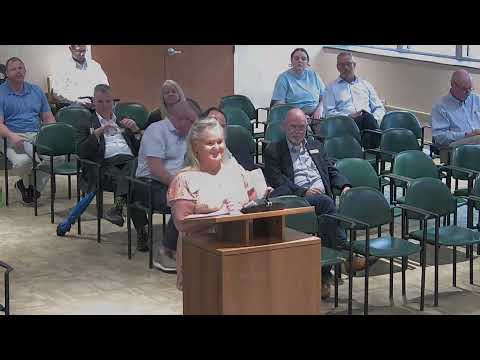
Burke County planning staff presented two related zoning items: a map amendment request by property owners Brian and Robin Smith to rezone about 4.5 acres of frontage on U.S. 64 from Residential‑3 to Rural Mixed Use, and a text amendment aimed at simplifying the county’s zoning code and easing housing production.
Alan Glines, the county planning director, said the Smith parcel is a portion of a roughly 23‑acre tract and that the front 4.5 acres is adjacent to mixed commercial uses along the highway. Glines said the Smiths have used an existing outbuilding to support their custom‑home building business and that rezoning to Rural Mixed Use would formalize the property’s mixed use and allow repair and equipment uses the owner already performs. He said the Morganton Township site is on the county’s future land‑use map as housing infill but that nearby Rural Mixed Use would provide flexibility for the owner.
Separately, Glines outlined a first‑phase zoning text amendment (ZTA‑2025‑01) that would adjust minimum lot sizes to reflect utility availability (well/septic versus public water versus public sewer), consolidate repeated site‑plan requirements into a single table, and reorganize Article 6 into discrete site and building development and design standards (access/parking, landscaping, site utilities, cluster development). Glines said the changes are intended to make the ordinance easier to use for builders and developers and identified future topics for additional phases, including subdivision rules and end‑of‑life provisions for solar farms.
Glines also noted the planning board recommended unanimous approval (6‑0) for the Smith rezoning and that one neighbor spoke in favor at the planning board hearing. Commissioners had no substantive objections and the items were left on the agenda for the upcoming public hearing and for further consideration.
Why it matters: Proposed text changes and rezonings affect allowable densities, site design requirements and the county’s approach to promoting infill housing where utilities exist; changes could shorten review times and lower costs for builders.
Discussion versus action: Planning staff described requested changes and the rezoning case; the board did not adopt zoning changes at pre‑agenda and scheduled the map amendment for a public hearing at the next meeting.
AI generated
The text on this page is AI generated. Summaries, highlights, analysis, and video transcripts are all produced from the original source material.
AI can make mistakes, so if you spot one, and we will fix it for everyone.
Note: the source content is unaltered by us. Any content source we link to, be it a video, an audio recording, or a document, is presented exactly as its publisher released it. That publisher is usually a government body, sometimes an individual official or another organisation.