Get Full Government Meeting Transcripts, Videos, & Alerts Forever!
Get email alerts on the Traditional Medicine topic
No spam. Unsubscribe anytime.
Acupuncturist Gavin McClure gives public lecture on Dao, qi, yin-yang and five elements
Summary
Gavin McClure, an acupuncturist at Good Medicine Clinic, led a community lecture explaining core concepts of Chinese medicine—including the Dao/Tao, yin-yang, qi, the three treasures, the five elements and meridian theory—and announced a follow-up practical session and a book-club sign-up.
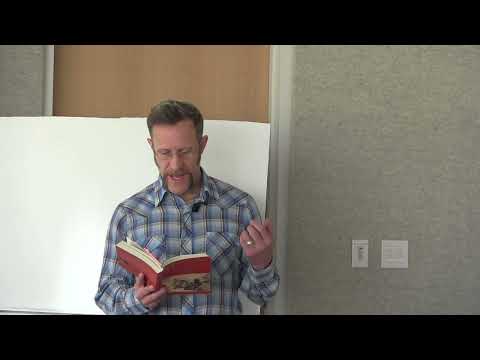
Gavin McClure, an acupuncturist at Good Medicine Clinic, opened a community lecture on Chinese medicine theory, saying, “I am an acupuncturist,” and telling the audience the session would cover the theories that underlie Chinese medicine.
McClure said the talk framed the Dao (Tao) as a generative process from which distinctions arise: “The Tao that can be or the path that can be walked is not the true path,” he read from the Tao Te Ching while explaining that the Dao continually gives rise to being and nonbeing. He then stepped through classical categories used in Chinese medicine—yin and yang, the three treasures (jing, qi, shen), the four seasons and directions, the five elements, and the six phases—to show how practitioners relate cosmology to diagnosis and treatment.
The lecture matters to people seeking or curious about traditional East Asian medicine because McClure connected abstract ideas to clinical signs and to everyday health practices. He explained how yin-yang balance maps to symptoms—an excess of yang manifests as fever or inflammation, a deficiency of yin can appear as hot flashes—and how qi subtypes (for example, nutritive ying qi and defensive wei qi) are used in clinical reasoning. He also outlined practical offerings tied to the series: a follow-up practice class at Good Medicine Clinic, a paid registration option, and a potential monthly book club.
McClure described the Dao as “the undifferentiated whole” that gives rise to polarity and cited the Tao Te Ching and I Ching as foundational texts. He summarized yin and yang’s interdependence and transformation—“yin and yang change into one another”—and used seasonal cycles to illustrate those movements. Audience member Edge added cultural context: “For us Westerners, we see movement, right or wrong, as a scale,” and stressed the Daoist view of continuous balance rather than binary judgment.
On the three treasures, McClure explained the terms and usages he attributes to jing (essence), qi (vital energy), and shen (spirit or animated consciousness). He distinguished prenatal jing (constitutional) from postnatal jing (derived from food, breath and practices) and noted that jing is stored in the kidneys in Chinese medical theory. He also sketched several named kinds of qi—yuan qi (source qi), gu qi (derived from food), ying qi (nutritive), and wei qi (defensive)—and connected them to functions such as immunity and circulation.
Moving toward clinical application, McClure described the five-element system—wood, fire, earth, metal and water—its generation and control cycles, and common organ correlations used in practice (for example, liver–wood, heart–fire, spleen–earth as the digestive system, lung–metal, kidney–water). He said meridians are channels where qi flows and identified common clinical tools: acupuncture needling, moxibustion, gua sha and qigong breath/movement practice. He noted that classical texts and modern textbooks inform these interpretations and listed several authors and translations as sources for further reading.
Practical announcements at the end of the lecture included a Tuesday practice session at Good Medicine Clinic from 6 to 7:30 p.m. (registration required), a $20 fee for that practice session, and promotional cards offering either 10% off a first massage or $25 off a first acupuncture appointment. McClure said the practice session would include demonstrations of needling, moxibustion, gua sha and brief qigong, and that two acupuncturists from Good Medicine—Rosemary Bridal and Amy Smith—would assist. He also invited attendees to sign an email list and to indicate interest in a possible monthly book club covering texts such as the Tao Te Ching and the Neijing.
The lecture was educational and expository rather than deliberative: there were no motions, votes or policy decisions. Questions from the audience focused on clarification (examples, season-to-symptom mapping, how meridians are palpated) and on participation logistics (book-club format, class registration, what would be demonstrated). McClure said palpation can include feeling a field or density where qi is experienced, and he described historical and textual references used to teach students.
Those interested were asked to register with Good Medicine Clinic so organizers could plan seating and materials. McClure closed by listing recommended readings and inviting further questions at the upcoming practice session.