Clark County Planning Commission reviews wide-ranging biannual code amendments including ADU, forest-practices and impact-fee changes
Summary
Clark County Planning Commission Chairman Carl Johnson called the commission’s April 17 work session to order to review the county’s packet of biannual code amendments to Title 40, the county development code.
Clark County Planning Commission Chairman Carl Johnson called the commission’s April 17 work session to order to review the county’s packet of biannual code amendments to Title 40, the county development code. Land Use Review Manager Brent Davis and staff detailed proposed edits ranging from accessory dwelling unit rules to forest-practices procedures and impact-fee timelines.
The package bundles corrections, clarifications and a few minor policy changes that county staff said are intended to align the county code with recent state statutes and to fix unclear language in existing standards. Brent Davis, Land Use Review Manager in the Department of Community Development, said the county filed a 60-day notice with the Washington State Department of Commerce and plans a public hearing May 15 and a Clark County Council hearing July 1.
Why it matters: The amendments would change how the county handles development review timekeeping, where accessory dwelling units (ADUs) are allowed, how long public agencies have to spend impact-fee revenue, and how small forest-harvest permits are processed inside the county. Those changes affect builders, landowners, school districts that collect school-impact fees, and county environmental protections.
Major items discussed
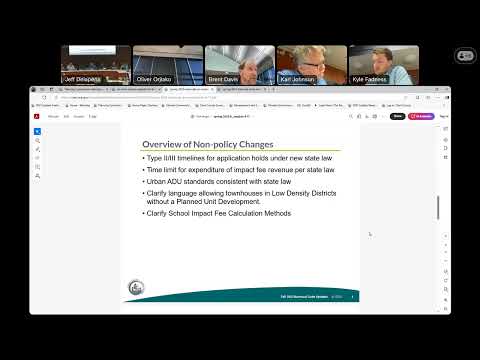
Permit-review timelines: Davis told commissioners county code currently allows staff to add 14 days to the review clock after an applicant submits additional information so staff can verify the response. A recently enacted state statute requires the county to restart the clock as soon as the applicant submits new information. Staff proposes removing the county provision that adds 14 days so the county’s procedure matches the state rule.
Impact fees and spending horizon: County code currently requires expenditure of certain impact-fee revenues (primarily traffic/road impact fees) within six years. Davis said state statute was changed in 2011 to allow a 10-year spending period, and the county proposes extending its timeframe to 10 years to give Public Works more time to plan and deliver projects. Davis noted project delivery timelines—including planning and permitting—often exceed six years; Oliver Jack, Community Planning Director, said school and transportation capital plans use a six-year capital facilities plan and the county staggers review cycles for the county’s nine school districts.
Accessory dwelling units (ADUs): Staff proposes multiple edits to align with state law. Changes include: allowing ADUs for any single-family housing type (not limiting ADUs to detached single-family homes), allowing up to two ADUs per lot where statute requires them, and adding ADUs to use tables for residential and office-residential zones so existing single-family residences in those zones may have ADUs. Davis said the county will remove ADU design and setback rules that are not also required of the primary residence because state law prohibits imposing different setback or design standards on ADUs than on the primary dwelling. Commissioner questions prompted staff to confirm base zoning setbacks still apply; county staff emphasized the change removes ADU‑specific extra setbacks, not all setback requirements.
Townhome limit clarification: The draft clarifies an ambiguity in low-density districts about how many attached townhome units are allowed in a single structure without needing a planned-unit development (PUD). Davis said the intent is that up to four attached units per structure are allowed without a PUD; a building with five attached units would require a PUD.
School-impact-fee methodology and review frequency: The code change would allow the county’s responsible official to approve alternate student-generation methodologies (the “student factor”) used in school-impact-fee calculations so districts can account for atypical housing mixes (for example, senior housing that produces fewer school-age children). The draft also removes a requirement that districts recalculate the student factor annually. Staff and Oliver Jack explained county practice is to coordinate fee updates with school districts’ six-year capital facilities plans; the county’s current code calls for updates at least every four years and staff said the four-year interval remains in practice.
Temporary-hardship provision: The draft would allow an existing dwelling on a property to serve as a temporary hardship dwelling in some cases where a new home is being built elsewhere on the lot. The accommodation would require recording a covenant that commits the owner to decommission the second dwelling (for example, demolition or conversion to a non-dwelling) when the hardship ends.
Pedestrian safety and guest parking: Davis described changes tied to middle-housing guest-parking rules. When guest parking is head-in and adjacent to the public right-of-way, proposed language would require sidewalks to “wrap” around parked cars to maintain a continuous, safe pedestrian path rather than placing sidewalks immediately behind head-in spaces where pedestrians and vehicles could conflict.
Rural lighting and glare: At council request, the draft adds simple standards for lighting and glare in rural districts to prevent new development from directing bright lights outward from a site and into neighboring properties. April Firth, Director of Community Development, said the language was adapted from a neighboring jurisdiction. Commissioners asked for clearer terminology (for example, “shielded” lighting and specific references to motion or flood lights) to avoid enforcement ambiguity; Firth and commissioners discussed forcing language that prevents lights from shining directly into neighbor bedroom windows while allowing crime-prevention motion lighting.
Forest-practices code updates (substantial change): County Public Works staff presented the largest single change in the package: updates to the county’s forest-practices code to make it consistent with state forest-practices law and to fill gaps in the county code for small (Class 1 non‑exempt) permits. Kevin Tyler, Public Works staff, and Hunter Decker, County Forester, said they reviewed the county code for consistency with the Revised Code of Washington (RCW) Chapter 76.09 and the Washington Administrative Code (WAC) chapter 222 and with the county’s critical-areas ordinances.
Key clarifications include: defining and providing process rules for Class 1 non‑exempt forest-practice permits (typically small harvests on parcels two acres or less, or certain personal-use harvest amounts); creating a clear exemption list; and clarifying jurisdictional boundaries between state and county forest-practice permitting (the state issues most Class 2 and 3 permits outside urban growth areas; the county issues certain permits inside the urban growth area and for conversions). Public Works staff described a recurring problem they call “backdoor conversions,” where landowners obtain state forest-harvest permits that allow harvests near streams at narrower buffers than county critical-area rules allow, then seek to develop the site without county conversion review. Staff said the edits aim to close that loophole by clarifying when conversion review and county protections apply.
Replanting and moratoriums: Staff discussed replanting requirements and moratoria tied to harvests; they said state replanting rules generally require about 190 trees per acre on the west side of the Cascades while the county’s critical-area requirements have used a higher density (about 300 trees per acre) in some areas. Conversion reviews (Class 4 general) that change forest land to another use will continue to trigger a more substantial county Type 2 land‑use process (which can include SEPA and archaeological review).
Process, schedule and next steps
Davis said staff will send the draft ordinance to county legal counsel for review, prepare the required SEPA documents, and return to the Planning Commission for the May 15 public hearing. The council hearing is scheduled for July 1 after the 60‑day notice period with the Washington State Department of Commerce. No formal votes were taken at the work session; this was a staff briefing and question-and-answer session.
Who spoke (selected): Commission Chairman Carl Johnson; Brent Davis, Land Use Review Manager, Department of Community Development; Kevin Tyler, Clark County Public Works staff; Hunter Decker, County Forester, Clark County Public Works; April Firth, Director of Community Development; Oliver Jack, Community Planning Director; and Commissioners Alvin, Haroun and Baker.
Ending: Staff asked commissioners to identify any items needing clarification before the hearing. Commissioners requested follow-up information on impact‑fee inflationary effects and school-fee methodology; Davis and Oliver Jack said staff would provide additional detail before the May 15 hearing.
AI generated
The text on this page is AI generated. Summaries, highlights, analysis, and video transcripts are all produced from the original source material.
AI can make mistakes, so if you spot one, and we will fix it for everyone.
Note: the source content is unaltered by us. Any content source we link to, be it a video, an audio recording, or a document, is presented exactly as its publisher released it. That publisher is usually a government body, sometimes an individual official or another organisation.