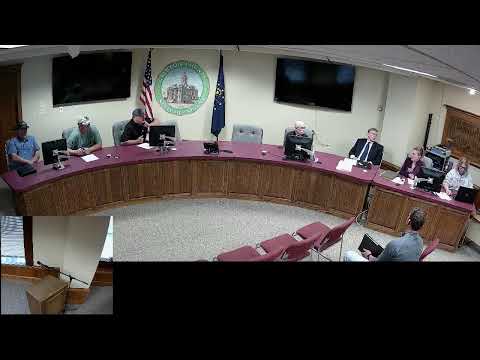
Plan commission recommends primary approval for Creekside Estates subdivision, requires building-envelope changes
Summary
The Clinton County Area Plan Commission voted 4-0 May 6 to recommend primary approval of a one‑lot minor subdivision called Creekside Estates, but required the developer to move the building envelope off mapped floodway/floodplain and to finalize restrictive covenants to the county attorney's satisfaction before secondary approval.
The Clinton County Area Plan Commission on May 6 recommended primary approval of Creekside Estates, a one‑lot minor subdivision, contingent on moving the proposed building envelope off mapped floodway/floodplain and on final legal approval of restrictive covenants. The motion passed 4‑0.
Staff said the application covers a 9.89‑acre parcel that is a first split from a 60.92‑acre parent tract on the east side of North 680 West between State Road 26 and the Carroll County line in Section 22 of Ross Township. Liz Stitzel, planning staff, told commissioners, “This is the application of Caleb and Bethany Hopper. And it's a request as stated for primary approval, 1 lot minor subdivision called Creekside Acre or Creekside Estates.”
The staff report said most of the northern half of the site is floodplain and that the parcel scored four points under the county's point system, primarily because the proposed lot size is between three and 20 acres. Two confined‑feeding operations lie within one mile of the site; staff said those distances lowered the score but did not create setback variances that would block a house on the southern half of the lot. The report also noted the site received a special‑exception approval from the Board of Zoning Appeals on Jan. 7, 2025, for a variance related to confined feeding setbacks.
Commission discussion focused on soils and the location of the building envelope. Stitzel and others explained the originally submitted building envelope included mapped floodway and floodplain soils, which county standards prohibit for primary structures. Stitzel said staff had missed the inclusion when reviewing earlier materials and recommended that the building envelope be adjusted so development is sited on permitted soils outside the floodway. Wyatt Johnson, a surveyor representing the applicants, said, “We can work with Liz and Jay to add that building envelope,” and indicated the applicants would cooperate in locating a permitted home site.
Additional technical approvals noted in the record included Drainage Board approval on April 15, 2025; the county health department’s determination that the lot is suitable for a septic system (with a required permanent drainage outlet shown on the plat); and no objection from County Highway to driveway access. County counsel Jay Moore reviewed restrictive covenants and, per staff, found them legally prepared; the commission conditioned final approval on covenants meeting counsel’s satisfaction at secondary.
A commissioner moved to recommend granting primary approval contingent on adjusting the building envelope to remove floodplain/floodway areas and on final covenant review; the motion was seconded by Commissioner Chad Colby. Roll call votes recorded Grama Mueller: yes; Walt Minnick: yes; Andy Bailey: yes; Chad Colby: yes. The commission approved the recommendation 4‑0.
Discussion versus decision: commissioners and staff discussed soils, floodplain extent, and engineering implications (discussion). The formal action was the motion to recommend primary approval with conditions; staff was directed to verify the building envelope change and to confirm that covenants meet county counsel’s standards before secondary approval (direction/condition). The primary approval recommendation is not a final plat — secondary approval will be required before recording or building permits.
Clarifying details captured from the hearing include: the parcel area (9.89 acres), parent tract size (60.92 acres), scoring result (4 points under the county point system), the Board of Zoning Appeals special‑exception approval date (Jan. 7, 2025), Drainage Board approval (April 15, 2025), and the health department’s septic suitability finding. Staff noted that only about 15% of the site contains the county’s preferred soil map unit (MTB) and that other mapped units on the lot included floodplain soils (GN, LA) and hazardous slope soils (HEF) and that CBA soils are considered buildable with engineered foundations (special‑exception soils).
Potential impacts and next steps: the commission’s action clears the application to proceed to secondary plat review provided the building envelope is moved off the floodway/floodplain, drainage and covenant items are resolved, and county counsel signs off. Nearby landowners within a quarter mile are eligible under the covenants’ enforcement clause to initiate enforcement if needed.
The commission’s next regular meeting is scheduled for June 3, 2025; secondary plat review will be scheduled only after the applicant files the revised building envelope and final covenants for staff and counsel review.
AI generated
The text on this page is AI generated. Summaries, highlights, analysis, and video transcripts are all produced from the original source material.
AI can make mistakes, so if you spot one, and we will fix it for everyone.
Note: the source content is unaltered by us. Any content source we link to, be it a video, an audio recording, or a document, is presented exactly as its publisher released it. That publisher is usually a government body, sometimes an individual official or another organisation.