Lifetime Citizen Portal Access — AI Briefings, Alerts & Unlimited Follows
CPUC hosts workshop as utilities, states and advocates weigh how to add scenario planning to distribution planning
Loading...
Summary
CPUC convened a workshop on April 22 to frame how scenario‑based planning will be added to utilities’ distribution planning processes, a move the commission directed in last year’s High DER proceeding.
CPUC convened a workshop on April 22 to frame how scenario-based planning will be added to utilities’ distribution planning processes, a move the commission directed in last year’s High DER (distributed energy resources) proceeding.
The workshop, hosted by Tyler Nam, a utilities engineer on the CPUC grid planning team, brought presentations from other state public utility commissions and California investor‑owned utilities, and set a schedule that includes joint utility filings and a June 30 deadline for the Tier 3 advice letter describing each utility’s proposed scenario‑planning implementation.
The commission’s directive and why it matters
Commissioner Hauck opened the virtual component of the workshop, placing the session inside the CPUC’s broader High DER track 1 reform. “This workshop is part of implementing the high DER proceedings track 1 phase 1 decision that was issued last fall,” Hauck said, describing the goal of moving from a single deterministic forecast to a scenario approach that better captures uncertainty around electrification, EV growth, data centers and other drivers.
Why this matters: utilities say a single forecast does not give adequate insight into where and when distribution upgrades will be needed, especially where high‑lead‑time projects such as substations and transformer banks are concerned. Scenario planning is intended to help identify “least‑regrets” investments that reduce the risk of under‑ or over‑building and shorten customer energization timelines.
What the CPUC staff framed
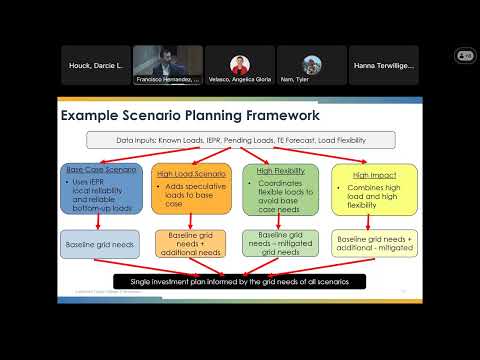
Tyler Nam of CPUC energy division summarized the Commission’s expectations and schedule: utilities must submit a Tier 3 advice letter by June 30 outlining their framework, and the utilities’ scenario proposals must be consistent with, and complementary to, the California Energy Commission’s system‑level IPER demand forecast and other state planning workflows. Nam emphasized transparency and the need for guardrails so that utilities can plan toward a single investment plan informed by multiple scenarios.
What other states reported
Hannah Terwilliger, analyst coordinator with the Minnesota Public Utilities Commission, described Minnesota’s multi‑year Integrated Distribution Plan (IDP) program and how Minnesota uses scenario analysis to inform proactive upgrades. Terwilliger said Xcel Energy—Minnesota’s largest utility—faces substantial distribution congestion: it has about 1.3 million customers and a roughly 9.2 GW peak, with 1.6 GW of interconnected distributed solar and another roughly 1.6 GW pending. She said about 30% of Xcel substations cannot accommodate more DERs and that proactive frameworks and targeted upgrades were being developed to reduce long interconnection waits.
Sean Imada, principal distribution planning engineer at Hawaiian Electric, described that utility’s Integrated Grid Planning (IGP) process, which ran four forecast cases (base, high‑load, low‑load, and fast adoption) across layers of DER, EV, and energy‑efficiency assumptions, produced circuit‑level hosting capacity and location‑based forecasts, and used screening and probabilistic hosting‑capacity tools to narrow which circuits required detailed modeling.
What the large California utilities proposed
Southern California Edison (SCE)
SCE presented a two‑step near‑term implementation and a longer‑term vision. SCE proposed analyzing two scenarios for 2025–26 (a base case and a high case) and using a “foundational scope execution” approach for incremental solutions from the high case. Ann Tran (senior engineer, SCE) explained the decision logic SCE will apply when the high case identifies incremental needs not present in the base case: build consistent solutions that appear in both scenarios; for incremental needs, execute limited foundational work (for example, substation positions, breakers or mainline up to a first switch) that reduces lead time but retains flexibility to repurpose assets if load projections change; and evolve toward probabilistic forecasting and expected‑value optimization in later cycles. SCE said demand flexibility (mitigation) will be considered across scenarios rather than as a separate, stand‑alone scenario.
Pacific Gas & Electric (PG&E)
PG&E described a three‑scenario approach (base, high, low) and emphasized objectives: efficient, defensible spending; timely customer energization; and projects that can adapt (phased design and stage gating). PG&E said the “base” should reflect known loads plus high‑confidence pending loads; a “high” scenario would test greater uptake in particular categories (for instance medium‑ or heavy‑duty electrification or large pending customers); and a “low” scenario would be a conservative view. PG&E stressed that while many solution alternatives are assessed, the utility expects to produce a single, defendable investment plan after analyzing alternatives and tradeoffs.
San Diego Gas & Electric (SDG&E)
SDG&E proposed selecting a base forecast drawn from CEC/IPER elements reconciled with known and pending loads, then using two supplemental assessments: (1) a planning standard variant that flags circuits and buses that reach 90% of thermal capacity within a near horizon (SDG&E proposed screening circuits at 90% for the first three years and buses for the first five years) to identify needs that warrant earlier attention; and (2) an alternative IPER‑element scenario (if a suitable alternative combination is identified) to flag other needs that merit closer review. SDG&E proposed expanding circuit/bus planning horizons to at least 10 years for the 2025–26 cycle, while keeping three‑year line‑segment horizons.
Common themes, uncertainties and guardrails discussed
- Pending loads: utilities and staff discussed how to treat pending, high‑impact requests (category A vs. B in the pending load taxonomy) and whether to cap or include those requests in base forecasts. Presenters agreed pending loads are a central point of debate and that the pending‑loads advice letter and the scenario planning advice letter need to align.
- Lead times and staged work: utilities emphasized that long lead items (land acquisition, permitting, transformers, breakers) make staged or foundational work attractive because some early procurement or substation positioning can cut future energization time without committing to full construction immediately.
- Demand flexibility and non‑wires alternatives: presenters agreed mitigation (demand flexibility, managed charging, storage, NWAs) should be considered, but differed on how to include it. SCE and other utilities said demand flexibility is best modeled as mitigation layered across scenarios rather than a separate standalone scenario; other parties pushed for clearer rules and valuation of flexibility and NWAs. Several presenters noted the CPUC’s Electrification Impact Study (EIS) work and other analyses could inform demand‑flex assumptions.
- Transparency and guardrails: Commissioners and advocates pressed for transparent metrics and guardrails (reporting that ties scenarios to investment decisions, triggers and thresholds for contingent investments, and stage‑gate rules for descoping projects if pending loads withdraw).
Timeline and next steps
CPUC staff reiterated the near‑term schedule: utilities and the CEC will coordinate scenario inputs; joint IOU filings on IPER scenario choices are scheduled in early May; the Distribution Forecast Working Group will meet in mid‑May; utilities must file Tier‑3 advice letters on scenario planning by June 30; and the 2025–26 distribution planning cycle begins later in the summer. Commissioner Hauck indicated the workshop feedback will inform the advice letters and the Commission’s iterative approach to refining scenario planning.
Quotes and sources
Commissioner Hauck: “The goal of transitioning the utility's distribution planning processes from a single forecast planning approach to the use of scenarios is to provide more and varied forecast information to compare and identify distribution needs.”
Tyler Nam, CPUC energy division: “The objective of today's workshop is to discuss barriers and challenges to such implementation, allow for participants to provide input into this significant planning shift, and work through the development of the utility scenario planning proposals.”
Ann Tran, Southern California Edison: “Part of this least‑regret strategy is trying to think about the solutions, and making sure that the ones that we do plan to build… are flexible enough to have other benefits that they can provide if the load forecast ends up being different.”
What the workshop did not decide
No final Commission action or vote occurred at the workshop. Utilities presented proposals and staff outlined requirements; the parties will file formal advice letters and further work will be required to specify scenario inputs, thresholds for contingent investments and reporting rules.
What to watch next
- Joint IOU IPER scenario submissions (May). - Distribution Forecast Working Group (week of May 19). - Tier 3 advice letters on scenario planning (due June 30). - CPUC and Energy Commission coordination on scenario inputs and a continuing rulemaking path for reporting and guardrails.
Ending
The workshop brought utilities, other state commissions and advocates into closer alignment on the practical tradeoffs of scenario planning: the immediate focus is a two‑scenario, guarded implementation for the 2025–26 distribution planning cycle with staged work and reporting protections, while the longer‑term direction is toward probabilistic forecasting and optimization once tools and methodologies mature.