Lifetime Citizen Portal Access — AI Briefings, Alerts & Unlimited Follows
Construction-aggregates industry urges clearer permitting and planning as resources dwindle near markets
Loading...
Summary
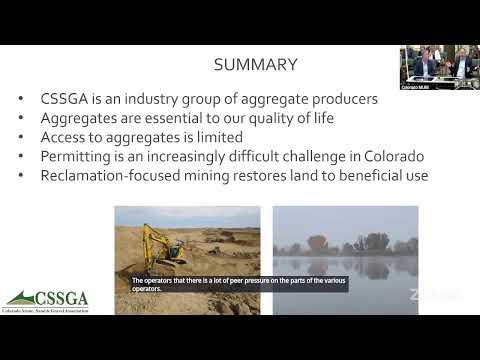
Industry representatives told the Mine Land Reclamation Board that aggregates are locally produced and sold by the ton, permitting has become more complex and expensive, and reclamation frequently creates lined water-storage reservoirs used by communities.
The Colorado Stone, Sand and Gravel Association (CSSGA) presented to the Mine Land Reclamation Board on April 16, describing industry economics, permitting challenges and typical reclamation practices in Colorado.
Todd Ohlheiser, executive director of CSSGA, said aggregates are a place-based commodity; most material is sold by the ton close to where it will be used. David Beaver (adjunct professor, Colorado School of Mines) explained Colorado's geology and markets: the east plains are sand-rich, the mountains provide hard-rock coarse aggregate, and distribution must account for transportation costs and local demand. Beaver said typical trucking economics constrain a truck-served quarry's practical market to roughly a 50-mile radius.
CSSGA's presenters stressed permitting complexity. Paul Kos (consultant, permitting lead) walked trustees through multi-agency reviews (county land use, state environmental permits, federal wetlands and NEPA when federal funding is involved) and noted that permit processes can take many years with overlapping technical studies and iterative agency reviews.
Operators described site-by-site experience. Stephanie Fancher English of Loveland Ready Mix compared a long-established Loveland site (permitted in 1974) with a recently permitted La Porte site: the newer permit required extensive water-quality measures, air modeling that incorporates background concentrations and environmental-justice screening, truck-route restrictions, operating-hour limits and noise studies. Fancher said permitting the smaller La Porte site cost more than $1 million and included lawsuits filed by local opponents after a county land-use decision.
Joel Bolduc of BurnCo described reclamation practices common in Colorado, where many former pits are reclaimed as lined water-storage reservoirs that supply municipal or agricultural water. He noted that the state's topography and prior water-rights system make lined reservoirs an especially common and useful post-mining land use. Reclamation elements discussed included slurry walls, slope grading and engineered spillways that meet modern flood standards.
Industry representatives emphasized two policy points: first, that aggregate resources near urban markets are being depleted or built over, forcing future production farther from customers and increasing truck miles and costs; second, that permitting and land-use pathways to identify and protect future mineral-resource corridors are fragmented and often underutilized by local governments. The presenters pointed to a Utah study assessing critical infrastructure minerals as an example of a method to map likely future resource locations and plan accordingly.
Board members asked about industry consolidation, ownership (locally owned vs. multinational companies), workforce availability and the potential for recycled materials. Presenters said larger, often out-of-state or multinational companies hold a growing share of production, but local firms remain important for nimble decision-making and community ties. Recycled asphalt pavement is widely used in modern asphalt mixes (typical recycled content cited around 25%), while full replacement of rock in high-strength, wearing-course applications is not currently practical at scale.
The board did not take action on the presentation; staff and CSSGA agreed to coordinate future site tours for trustees and staff to view active operations and reclaimed reservoirs.