Lifetime Citizen Portal Access — AI Briefings, Alerts & Unlimited Follows
ODF details Private Forest Accord implementation, state‑forest revenues and invasive‑pest risks
Loading...
Summary
In a March 11 briefing on Senate Bill 5521, ODF division chiefs described implementation of the Private Forest Accord, progress on the habitat conservation plan (HCP) and related funding, declining expected harvest volumes, the role of the Schroeder seed orchard, and concerns about invasive pests including sudden oak death and emerald ash borer.
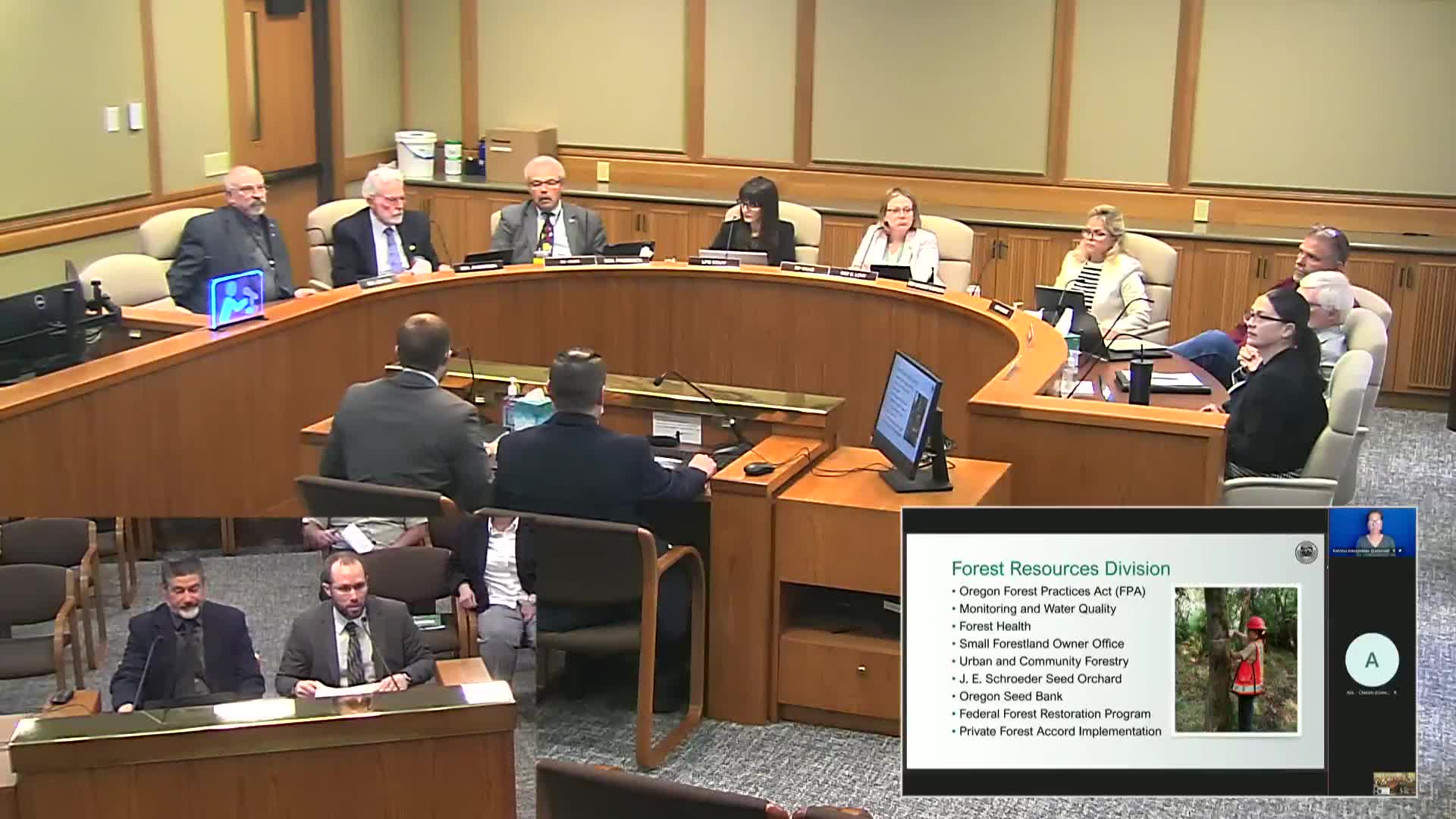
At the March 11 informational hearing on Senate Bill 5521, Josh Bernard, Forest Resources Division Chief, and Michael Wilson, State Forest Division Chief, reviewed program work tied to the Private Forest Accord, state forest revenues, and forest health risks.
Bernard summarized core Division work — compliance with the Oregon Forest Practices Act, monitoring forest health, leveraging federal funds, and expanding urban and community forestry. He said the agency is implementing the Private Forest Accord (passed into law in 2022) including rule changes, adaptive management, and development of a private‑forest Habitat Conservation Plan (HCP).
Michael Wilson told the committee that Board of Forestry lands (roughly 730,000 acres) produce timber revenue used to operate the State Forest Division and that the division expects reduced harvest levels under the planned HCP and revised growth‑and‑yield estimates.
Why this matters
The HCP and updated forest inventory change projected harvest volume and therefore future revenues that support counties, schools and local services. Wilson said that under the planned HCP the division is planning offered harvest in the neighborhood of 185,000,000 board feet, a level lower than historical averages, and that exact revenue will depend heavily on market conditions.
Key points from the hearing
- Private Forest Accord and HCP: Bernard reviewed implementation steps tied to Senate Bill 1501 (referred to in the hearing as SB 15 01) and associated rulemaking. He said adaptive management, incidental‑take permitting (via an HCP) and small forest landowner assistance are central requirements. Bernard said ODF has submitted an administrative draft HCP for federal review and expects to continue working with U.S. Fish and Wildlife Service and other federal partners; the agency is targeting HCP completion near the end of 2027.
- Funding and program timing: Committee members asked whether the governor’s budget included the full funding levels originally discussed for Accord implementation. Bernard and staff said many positions for Accord implementation are funded in current service level but some programs (e.g., an adaptive management program and a small forest landowner assistance program) previously received one‑time funding and the originally discussed ongoing funding levels are larger than what was included in the governor’s budget. The governor’s budget contains a $14,000,000 special purpose appropriation, with $10,000,000 described for grants to small forest landowners once the HCP is finalized.
- State forest revenues and harvest projection: Wilson said the division manages roughly 730,000 acres of Board of Forestry lands and that timber sale revenues are the main funding source for the division (the division keeps a portion of receipts to cover operating costs and returns the remainder to counties and taxing districts). He told lawmakers the division expects lower long‑term harvest levels under the HCP and noted that updated growth‑and‑yield tables reduce standing timber per acre relative to past assumptions, meaning historic harvest levels are not sustainable under current scientific estimates.
- Seed orchard and federal restoration grants: Bernard described the J.E. Schroeder seed orchard and the Oregon Seed Bank as tools for producing and preserving climatically adapted seed stock. He also said the agency leverages federal funds for federal forest restoration and that Policy Option Package 105 increases federal funds limitation to continue that leveraging.
- Invasive pests and forest health: Committee members expressed concern about sudden oak death (SOD) and other pests. Bernard and other staff said SOD containment is ongoing and that the agency receives federal funding and, in prior biennia, one‑time state funding to slow spread. The agency said the pathogen spreads via spores and can move with significant weather events; staff noted the primary objective is to slow spread and protect priority areas such as parts of Coos Bay.
Questions and follow‑up
Senators asked for more detailed briefings from forest health specialists about SOD strains and impacts on species including Douglas fir. Bernard said staff can provide that follow up. Committee members also asked about timing for HCP finalization and whether the federal review is advancing; agency staff said weekly coordination with federal partners is ongoing and targeted completion remains near the end of 2027.
Bottom line
ODF told legislators that Accord implementation and HCP development will reshape how the agency manages forests and generates revenue. The agency said some implementation positions are funded, but several programmatic investments originally discussed in Accord negotiations remain partially funded or were funded as one‑time allocations; draft HCP review and negotiation with federal agencies continue.