Lifetime Citizen Portal Access — AI Briefings, Alerts & Unlimited Follows
Board of Natural Resources approves nine timber sales after hours of public comment
Loading...
Summary
After an hour of public comment split between timber-industry speakers and conservation advocates, the Board of Natural Resources approved nine timber sales totaling about 55.5 million board feet by a voice vote on April 7, 2026. Commenters disputed whether acres listed as "conserved" reflect regulatory protections or discretionary conservation measures.
The Board of Natural Resources on April 7 approved nine timber sales presented by department staff and totaling roughly 55.5 million board feet, after more than an hour of public comment that sharply divided timber purchasers and conservation advocates.
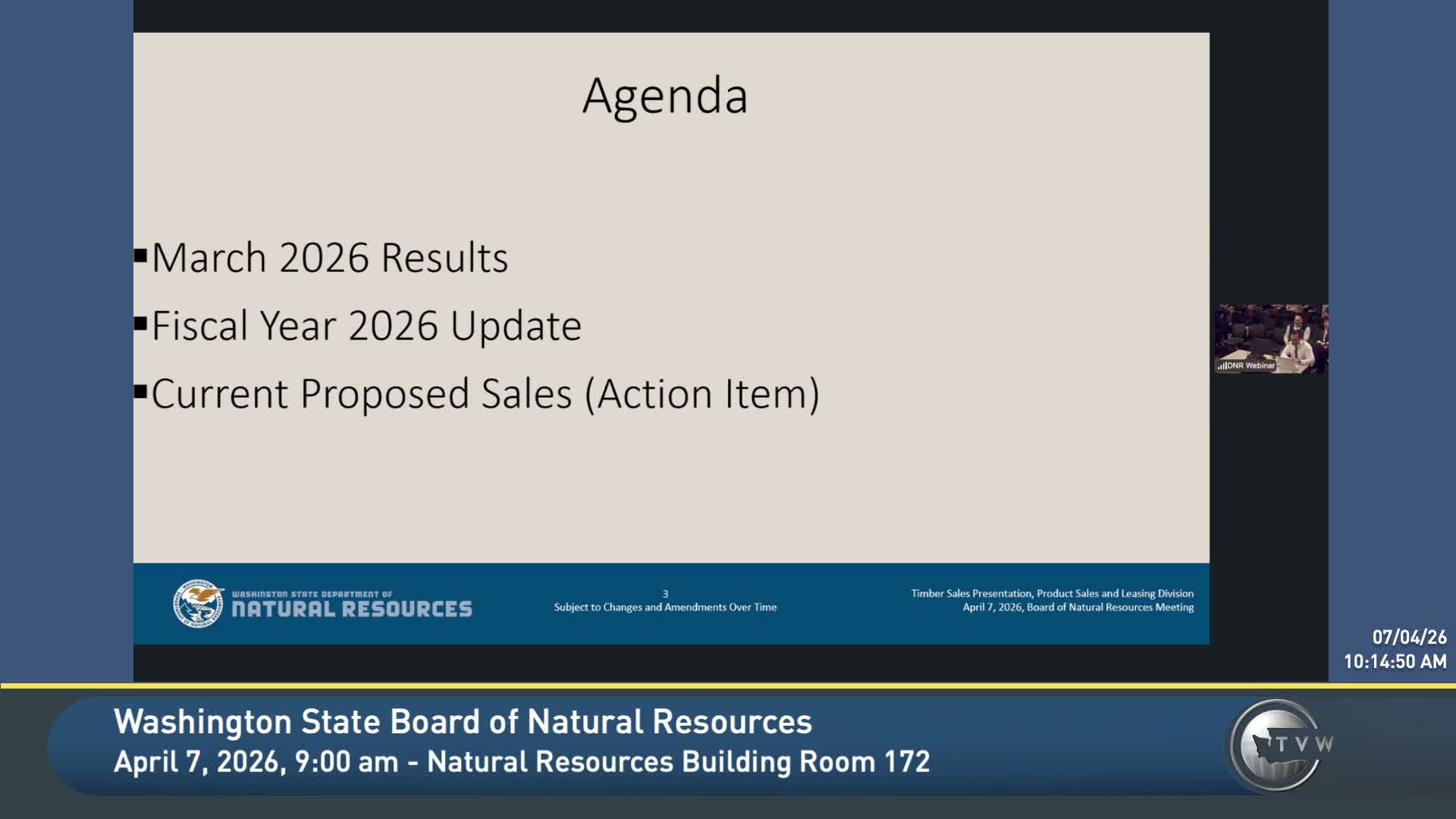
Chair Dave Upthegrove opened the meeting, heard public testimony and then called on Mike Sly, assistant division manager for product sales and leasing, to present auction results and the nine sales before the board. Sly said March auction results included 53.2 million board feet sold and that the proposed sales carry a combined minimum appraised delivery value of about $13.9 million. "The information presented here reflects the accurate application of the department's habitat conservation plan, HCP, and regulatory framework," Sly told the board.
Why it matters: commentors said the sales affect school-trust revenue, local mills and legacy forests, while others argued the department is double-counting "conserved" acres that are already unharvestable under law. The dispute centers on whether the acreage labeled "conserved" on sale fact sheets reflects discretionary conservation added by DNR or baseline regulatory protections required by the Forest Practices Act and the department's HCP.
Speakers on both sides reiterated their stakes. Bill Turner, Oregon and Washington timber procurement manager for Sierra Pacific Industries, warned of immediate fiscal impacts if sales are withheld and urged the board to "do a course correction before it's too late." By contrast, Miguel Perez Gibson, state forest land policy advisor for Washington Conservation Action, said fact sheets risk overstating optional conservation because "these are baseline requirements, not optional conservation measures," citing protections such as riparian buffers and habitat rules that already restrict harvest.
Board members pressed staff on how the department calculated percentages of conserved versus harvestable acres. Sly and other staff explained that initial planning maps are refined during field verification and that the department's percentage figures include areas excluded by the HCP and other regulatory requirements; staff said they could present a clearer breakdown distinguishing regulatory protections from discretionary conservation in a future report.
Staff described particular sales in regional detail. For example, Sly said the Schmidt Creek Sorts sale in the Pacific Cascade region evaluated 143 acres, with about 90 acres identified for harvest and 49 acres counted as conserved (about 34%), and a minimum appraised stumpage of $330 per thousand board feet. Sly also detailed the Echo Explorer blowdown salvage in the Northwest region (600 acres evaluated, 334 acres final harvest, 189 acres conserved) and other sales across Olympic, Southeast and Northeast regions.
After questions and brief discussion, a board member moved approval of the nine timber sales "as presented." The board voted by voice; Chair Upthegrove declared, "The motion carries without objection," and the sales were approved. The board did not record individual tallies in the public record; the motion was carried by unanimous voice vote as reported on the record.
What comes next: Upthegrove announced three upcoming special study sessions on the sustainable harvest calculation (April 21, May 12 and June 11) and the meeting concluded with a notice that an executive session (to consider anticipated litigation and pending legislation) was planned but not taken in public.
Votes at a glance - Approved: Kick in the Pants (Olympic region) — staff reported 234 acres evaluated; ~70 conserved after field verification; low stumpage estimate. - Approved: Rubble (Olympic region) — staff reported 370 acres evaluated; 83 conserved; ~22% conserved reported on the fact sheet. - Approved: Schmidt Creek Sorts (Pacific Cascade) — 143 acres evaluated; ~49 acres conserved (~34%); minimum stumpage ~$330/MBF. - Approved: Baby Rattle (Southeast) — ~136 acres proposed for harvest; few substantive SEPA comments reported. - Approved: Q Atomic (Southeast) — 291 acres evaluated; minimum appraised stumpage ~$120/MBF. - Approved: Only Ferns (Pacific Cascade) — 352 acres evaluated; ~101 acres conserved (~29%); includes road maintenance commitments. - Approved: Kingfisher (Pacific Cascade) — 391 acres evaluated; 149 conserved reported on the fact sheet (discrepancy noted in aggregate percentages). - Approved: Echo Explorer (Northwest) — 600 acres evaluated; 334 final harvest; 189 conserved; salvage of windthrow after the 2024 storm. - Approved: Q Old Douglas Sorts (Northeast) — 199 acres evaluated; notable high-quality western red cedar discoveries.
The board record shows the motion was carried by voice vote with no objections; the transcript did not include a numerical roll-call tally.