Get Full Government Meeting Transcripts, Videos, & Alerts Forever!
Get email alerts on the Alaska Reads Act topic
No spam. Unsubscribe anytime.
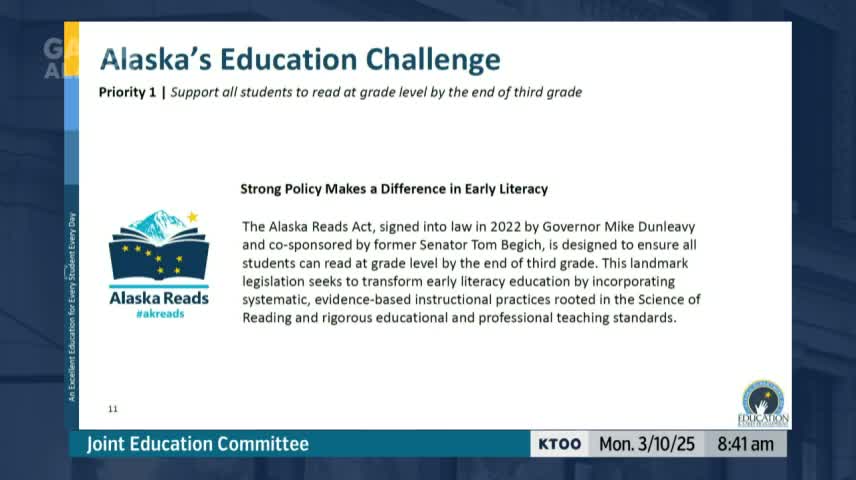
Alaska Reads Act first full year shows early gains in K–1 literacy, department says
Summary
Officials told legislators that first full implementation year of the Alaska Reads Act showed improvements in early-grade literacy, with kindergarten and first-grade benchmark rates rising; department will finalize an annual implementation report and convenings data soon.
Officials from the Alaska State Board of Education and the Department of Education and Early Development told a joint House and Senate education committee on March 10 that early literacy measures showed gains in the first full year after implementation of parts of the Alaska Reads Act.
Commissioner Dina Bishop described the act, signed in 2022, as “designed to transform early literacy education statewide.” The department reported that kindergarten and first-grade benchmark rates improved during the year: kindergarten end-of-year benchmarks reached roughly 60 percent, and first-grade end-of-year benchmark attainment rose to about 61 percent, up from 42 percent at the start of the year, the department said. Officials said Alaska is outpacing the national average in reducing the number of at-risk students in early grades.
Bishop and board materials identified the state’s K–3 literacy screener (DIBELS 8) as a key tool for tracking progress and said the first full implementation school year was 2023–24 for many initiatives. The department also noted the Alyeska Reading Academy and Institute was discontinued as of June 30, 2024 due to lack of funding.
Committee members asked about stakeholder convenings and inclusion of indigenous language experts and early-learning practitioners. Commissioner Bishop said the department will finalize and deliver the annual implementation report “within a few weeks,” and that the first convenings were held with regionally contracted partners; she said contracts are being rebid and the department expects additional convenings and reporting on that input in the updated report. The department highlighted ongoing work to pilot native-language screeners with Alaska Native language staff.
Officials cautioned that some implementation activities remain under development and that the department will provide the committee with additional details requested during the hearing.