Lifetime Citizen Portal Access — AI Briefings, Alerts & Unlimited Follows
Officials say $275–$300 million needed to finish Port McKenzie rail link as port grows barge and military use
Loading...
Summary
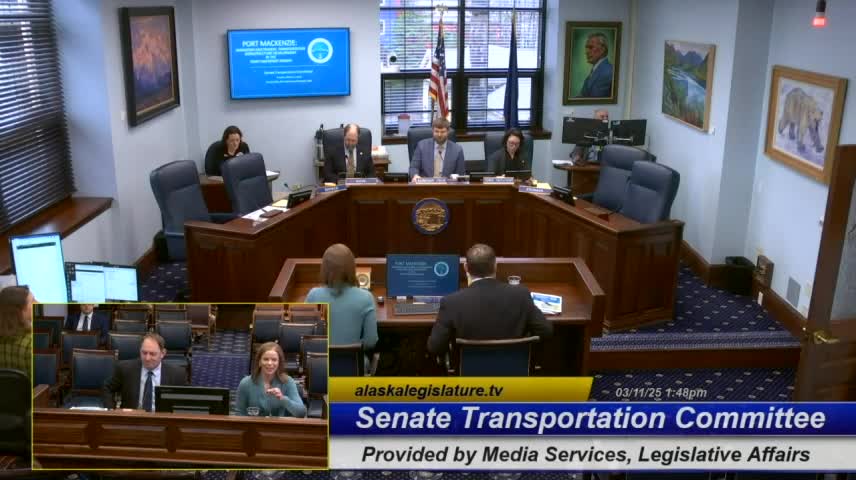
Port McKenzie and Alaska Railroad officials told the Alaska Senate Transportation Committee on March 13 that finishing the 32‑mile rail extension to Port McKenzie will likely cost $275 million to $300 million, require a roughly $60 million local match under a planned Federal Railroad Administration grant, and depend on securing long‑term freight customers.
Juneau — Port McKenzie and Alaska Railroad officials told the Alaska Senate Transportation Committee on March 13 that finishing the 32‑mile rail extension to Port McKenzie will cost an estimated $275 million to $300 million and depends on a mix of federal grants, a local match and long‑term freight customers.
The port and railroad described recent and planned investments at Port McKenzie, rising barge traffic and repeated U.S. military activity at the port. They also outlined a plan to seek a Federal Railroad Administration grant and the need for an “anchor tenant” to support bonding for the local match.
Megan Clemens, external affairs director for the Alaska Railroad Corporation, told the committee the railroad and Matanuska‑Susitna Borough have spent roughly $184 million on the rail extension so far and that 25 of the 32 miles of embankment are complete, with six of seven bridges installed and the right of way acquired. Clemens said the railroad plans to apply for a Federal Railroad Administration competitive grant (an 80/20 program) and estimated the remaining work would require $275 million to $300 million in 2025 dollars, with a 20% local match of about $60 million.
“Based on the assumption of bonding for a $60 million match . . . we are looking for a customer that could provide roughly half a million tons of annual freight cargo, for a 30‑year duration,” Clemens said. She told the committee the railroad has conducted more than two dozen confidential interviews with prospective customers and partners but has not yet secured a firm anchor tenant capable of the volumes needed to support a bonding strategy.
David Griffin, port operations manager for Port McKenzie, gave the committee a technical overview of the port’s facilities and recent activity. He said the port maintains a 1,200‑foot deep‑draft dock with 60 feet of depth at mean low water, a 500‑foot vertical‑face barge dock and about 9,000 acres of uplands zoned for industrial and commercial development. Griffin said Port McKenzie does not require regular dredging because its location and natural channels provide scouring that keeps depth, though the tradeoff is strong currents (about 6 knots on the ebb tide and 3 knots on the flood tide).
Griffin described 2024 activity that included two bulk carrier calls — one importing 32,000 tons of cement and another importing 52,000 tons of bulk salt for the statewide winter road maintenance contract — and increased barge business supporting work in western Alaska and Fire Island wind components. He also said the U.S. Army’s Surface Deployment and Distribution Command ran a proof‑of‑principle operation at the barge dock in October and that the port has hosted about one military visit per month in recent years as the Department of Defense assesses the site for training and possible handling of sensitive cargo in support of Arctic Edge 2025.
“We do not have to dredge at Port McKenzie,” Griffin said, noting the port’s natural scouring channels and annual bathymetric surveys the port performs to monitor sediment movement.
Officials highlighted several projects under way or nearing completion: a $10.5 million pile‑sleeve protection project funded by the Economic Development Administration that wrapped 32 deep‑draft dock piles with heavy‑gauge steel sleeves (expected to extend pile life by roughly 25 years), installation of sacrificial galvanic anodes for cathodic protection, and a barge haul‑out ramp that is at about 95% design and entering permitting; the conceptual ramp would be roughly 300 feet long, 200 feet wide and enable barges to be hauled out for winter storage and repairs.
Clemens told the committee that the project has faced dormancy due to budget constraints over the last decade and that completing the remaining work would likely require $275–$300 million for embankment repairs, track, communications, rolling stock and terminal infrastructure. She said one prior federal grant request in 2021 for an 18‑mile extension to a Titan plant did not succeed and that absent a substantial anchor tenant it is difficult for the Alaska Railroad, as a self‑sustaining state‑owned corporation, to justify bonding the local match.
Committee members asked about potential tenants and local partners. Port officials said they have one existing long‑term lease with Central Alaska Energy for a bulk fuel storage system and described commercially expressed interest from companies exploring sustainable aviation fuel production using biomass, additional cement imports, mining interests in the Ambler district, hydrogen/ammonia drilling, and other conceptual projects. None of those leads had produced a contract that would meet the anchor‑tenant volume requirements at the time of the hearing.
Port and railroad staff said they are coordinating with the Matanuska‑Susitna Borough and the congressional delegation, and Clemens said she had spoken with Representative Begich’s office; the railroad said it will continue outreach and pursue federal grant opportunities. Committee members also raised the prospect of a private short‑line operator completing or operating the extension; Clemens said the existing right of way and constructed embankment would allow conversations with private operators and the railroad was open to evaluating proposals.
Officials provided some tariff examples for port revenue: salt and other bulk commodities are handled at $1.31 per short ton, cement at $3.00 per short ton, and the port’s enterprise‑fund model relies on dockage/wharfage to cover operations and depreciation; a single large bulk ship visit in Griffin’s example yielded roughly $100,000 in revenue for the port.
Committee chair Senator Bjorkman and members asked about coordination with federal partners and military interest; Griffin and Clemens said the port has had repeated military visits and that the Army performed a proof‑of‑principle operation in October. Clemens said the railroad would pursue an FRA grant (an 80/20 program) that would require a 20% local match and that the match strategy is under discussion.
There were no formal committee votes during the presentation. Senators asked for continued updates as the railroad pursues grant applications and customer outreach. The committee adjourned after the presentation.
Ending: Officials said they will continue coordinated outreach with the borough and congressional delegation, pursue FRA grant funding, and work to identify or grow freight customers capable of supporting the local match; no binding federal or state commitments were announced at the hearing.