Get Full Government Meeting Transcripts, Videos, & Alerts Forever!
Get email alerts on the Black Heritage Trail topic
No spam. Unsubscribe anytime.
Dougherty County reviews $190,000 proposal for Black Heritage Trail; commissioners press for funding plan and maintenance safeguards
Summary
A consultant proposed a two-year digital Black Heritage Trail for Dougherty County and Albany; commissioners raised questions about funding, post-launch maintenance and coordination with local partners before sending the agreement for further consideration.
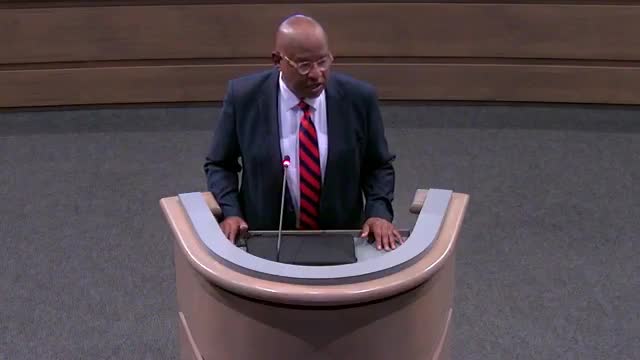
Clinton King, representing Augustine Monica Films, presented a proposal for a digital Black Heritage Trail for Albany and Dougherty County that would catalog maps, archival photos, addresses and narratives tied to local Black history. The county attorney and several commissioners pressed for a clear funding source and written safeguards for post-launch support before moving the item forward.
King told the board the product would be “effectively a website that will house copy, that will house ephemera, that will house photography, of course, the map itself, the stories.” He said the project would center Albany and Dougherty County while linking nearby places such as Camilla and Terrell County that are relevant to the region’s Black history. King noted his recent editorial placements in the Atlanta Journal-Constitution and that a six‑minute film he produced had been accepted to several festivals.
The contract discussed at the work session would cover phase 1 — development of the digital platform — and is written as a roughly two‑year engagement. The agenda lists a proposed payment of $190,000; the transcript shows county staff and the county attorney describing additional phases (plaques, markers and physical infrastructure) as separate and subject to further funding and approval.
Commissioners sought specifics about who would maintain the site after launch and what recurring costs might be. District 4 Commissioner Grace said the contract text itself acknowledges that “client understands that it may incur additional costs outside of the contract price referenced … for expenses associated with post launch support and maintenance,” and warned the county had previously experienced problems when outside vendors controlled web assets. County Attorney Charles Shallow told the board the contract treats the work as a professional service that allows single‑source procurement and said the county would withhold 50% of the contractor’s fee until a successful launch, a mechanism intended to limit risk.
Several commissioners asked that the project be developed collaboratively with existing local partners rather than run solely by the county. District 1 Commissioner Newsome and others asked that the County coordinate with the City of Albany, the Convention and Visitors Bureau (CVB) and the Civil Rights Institute so messaging and promotion are aligned and to avoid duplicate or competing efforts. District 3 Commissioner Johnson and District 6 Vice Chairman Jones urged the county to convene community stakeholders and to keep the Historic Preservation Commission involved for any physical markers.
County Administrator Barry Brooks said contingency funds could cover the initial contract if the board chose that path, but Commissioner Gaines (government affairs chair) reiterated a preference that a funding source be identified before returning the item for a formal vote.
After discussion, the board moved the item for further consideration at the next regular meeting with funding details to be finalized. No final procurement vote was recorded in the work session transcript.
The exchange included repeated references to the contract’s phasing: phase 1 (digital platform), later phases for physical markers and pedestrian infrastructure, and an explicit acknowledgement in the contract that post‑launch maintenance could require separate funding. Commissioners asked staff to pursue written clarifications on ownership, warranties and a durable post‑launch support plan before final approval.
If advanced, the project would be a county‑led initiative to document and promote local Black history digitally first, with possible future investments in plaques, markers and visitor amenities to follow at the board’s discretion.