Get email alerts on the Public Safety Drug Enforcement topic
No spam. Unsubscribe anytime.
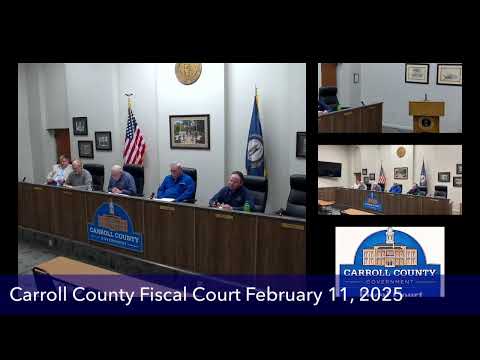
Carroll County court backs intent to join multi-county narcotics task force
Summary
Carroll County Fiscal Court voted to declare its intent to participate in a proposed multi-county narcotics task force that would investigate drug trafficking and overdose deaths; details on the county's financial or staffing contribution will be determined later.
Carroll County Fiscal Court voted Wednesday to declare its intent to participate in a proposed multi-county narcotics task force that would investigate trafficking, narcotics-related crimes and overdose deaths across several neighboring counties.
The court's action, moved by Scott (role/title not specified in transcript) and seconded by Denji (role/title not specified in transcript), passed on a voice vote after an extended presentation and discussion of how the task force would be staffed, governed and funded.
The proposed unit would be a full‑time narcotics task force with a board of directors responsible for hiring a unit commander or director, approving the budget and adopting bylaws and policies. Court presenters said the board would include commonwealth and county attorneys, judge executives and a chief law enforcement officer from each participating county. A director and unit commander would supervise day‑to‑day operations, manage evidence and asset forfeiture accounts, and prepare regular reports to the board.
Court presenters described the task force's mission as investigating trafficking and other drug offenses, preparing investigative reports for prosecutors and handling overdose death investigations within the task force's jurisdiction. Presenters and attendees emphasized that overdose scenes and coroner coordination would remain a joint process among affected counties and the medical examiner, and that local officers assigned to the task force would remain employees of their home agencies while operating under the task force's policies when assigned.
Court members discussed funding options presented in the packet: statewide grant awards declined from about $2,100,000 in fiscal year 23‑24 to about $1,750,000 in 24‑25, leaving roughly $300,000–$400,000 less in that cycle. Presenters identified potential future funding sources including asset forfeiture proceeds (described in the packet as splitting roughly 85% to investigating agencies and 15% to prosecutors), RMJAC grants, JAG grants and other federal or state grants. Presenters also said opioid‑abatement funds may be an allowable source and that some grant programs require the task force to be operating for a year before an application can be submitted.
Several operational questions were raised during discussion: whether Carroll County would contribute money or personnel (or both), how assigned deputies would be supervised and whether they would wear uniforms or drive marked vehicles during certain operations, how search warrants and coordinated raids would be handled, and how coroners in different counties would coordinate overdose investigations. Presenters said those details would be set in the task force's operating agreement and policies and that county attorneys and other stakeholders were still finalizing the written agreement.
The court recorded the motion to declare intent and voted in favor by voice; no opposing votes were recorded in the transcript. The court did not adopt a final operating agreement or set Carroll County's specific fiscal or personnel commitment at the meeting.
Next steps described by presenters included finalizing the operating agreement language (being worked on by county and commonwealth attorneys), selecting a board and interim director, and preparing the task force to meet grant program eligibility windows later in the year. The packet and discussion noted an upcoming meeting where staff overseeing opioid‑abatement audits would be available to answer questions about permissible uses of those funds.
AI generated
The text on this page is AI generated. Summaries, highlights, analysis, and video transcripts are all produced from the original source material.
AI can make mistakes, so if you spot one, and we will fix it for everyone.
Note: the source content is unaltered by us. Any content source we link to, be it a video, an audio recording, or a document, is presented exactly as its publisher released it. That publisher is usually a government body, sometimes an individual official or another organisation.