Get Full Government Meeting Transcripts, Videos, & Alerts Forever!
Get email alerts on the State Budget topic
No spam. Unsubscribe anytime.
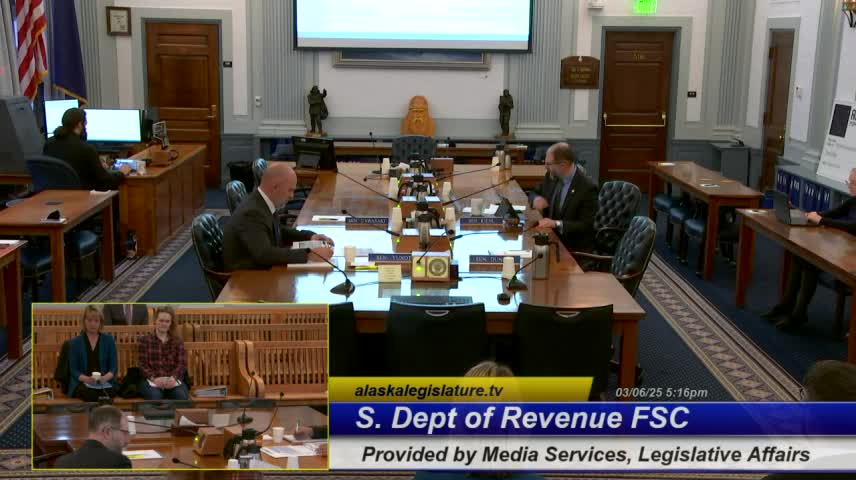
Senate subcommittee reviews Department of Revenue budget, presses for audit data and staffing details
Summary
At a roughly 44-minute hearing, the Senate Finance Subcommittee heard Department of Revenue officials outline the agency’s FY‑26 budget and divisions’ needs, pressed for detailed audit records on oil-and-gas production tax work, and requested administrative-cost and vacancy data for the Permanent Fund dividend and child-support operations.
The Senate Finance Subcommittee on the Department of Revenue’s budget met for its first hearing of the year, beginning at 5:16 p.m. and adjourning at 6:00 p.m., to review the department’s proposed fiscal 2026 operating budget and to question department officials about staffing, audits and federal funding.
Adam Crum, commissioner for the Department of Revenue, opened the presentation with an overview of the agency’s mission and divisions and said the department’s charge is "to collect, distribute and invest funds for public purposes." Janelle Earls, Administrative Services Director, described the department’s operating budget as "mainly comprised of other state funds," including retirement-system funds and receipts tied to state corporations and authorities.
Why it matters: The Department of Revenue administers high-profile, dollar-value programs — including the Permanent Fund dividend (PFD), retirement investments and shared tax distributions — and oversees state corporations such as the Alaska Permanent Fund Corporation (APFC) and the Alaska Housing Finance Corporation (AHFC). Committee members pressed the department for information that affects the Legislature’s ability to audit and forecast state revenue.
Major presentation points and committee questions
- Staffing and vacancies: The Permanent Fund Dividend Division’s vacancy rate has fallen from about 25% in April 2022 to an average of roughly 4% in 2025, and the division requested increased personal-services authority to pay for positions filled. Department staff said the department reduced the PFD division’s vacancy rate in part by opening six positions to in-state telework and by implementing classification/pay changes earlier this year. The Child Support Enforcement Division also reported progress in filling positions: vacancies decreased by 16% and turnover by 14.1% over the past year, and the division’s vacancy rate moved from nearly 30% in 2022 to about 15% in 2025.
- Administrative costs and postage: Senator Dunbar asked for a three‑year breakdown of administrative costs versus funds distributed for the PFD. The department agreed to provide that information: "Through the chair to senator Dunbar, yes. We can provide those, costs," said a department speaker. Committee members also heard that the federal postage increase in July 2024 raised the cost of first-class mail by about 5 cents per letter, and staff agreed to provide counts of PFD checks sent by mail.
- Audit hours and tax-audit capacity: Committee members noted tax-division audit hours dipped (a referenced figure showed "negative 6,000" audit hours), and department staff attributed the decline to a tax-revenue management system upgrade and to three vacant auditor positions that are being recruited. The department said audit hours should recover in FY‑25 as the system work completes and vacancies are filled.
- Fraud investigations: The subcommittee was told the department has seven investigators who handle PFD-related fraud cases; staff said fraud accounts for a small percentage of applications but agreed to provide more detailed information on investigations and referrals to the attorney general for prosecution.
- Treasury/retirement and data services: The Alaska Retirement Management Board (ARM board) component shows increases to pay for interagency salary changes and to maintain investment-data subscriptions such as Bloomberg, Moody's Analytics and S&P Global Market Intelligence. The department said those services support investment due diligence and retirement-fund management.
- Alaska Housing Finance Corporation and Alaska Sustainable Energy Corporation: AHFC requested additional authority for service contracts, insurance and security services. The AHFC presentation also noted the newly created Alaska Sustainable Energy Corporation (established by HB 273) and included a multi-year federal authority request of $20 million to support energy-infrastructure investments. AHFC staff said the timing and amount of federal funds are uncertain given broader federal appropriations developments.
- Alaska Permanent Fund Corporation: The APFC budget request includes increases for incentive compensation, services and travel reimbursements and additional investment‑management fees to support data analytics and investment due diligence. The subcommittee chair said at least one future meeting will focus directly on APFC; that meeting was scheduled for Thursday the 13th at 5:15 p.m.
Legislative audit access and historical context
Senator Kawasaki asked about a December letter from the Legislative Budget and Audit Committee to the commissioner, attorney general and governor seeking cooperation in providing information for an oil-and-gas production-tax audit. Department officials said the department has provided information and has a timeline of interactions for the Division of Legislative Audit but that past disputes over formatting and legal-review constraints required involvement from the Department of Law. Commissioner Crum said the department has been working with the audit office and that "the information is there," but that some details require further offline conversations with Department of Law and auditors.
Committee directions and next steps
Committee members asked the department to supply several follow-up items: a three‑year breakdown of PFD administrative costs versus amounts distributed; counts of mailed PFD checks; more detail on audit staffing and audit-hour history for the tax division; specific data on fraud referrals and prosecutions; and a list of possible budget cuts the department could consider. Chair Keel asked staff to distribute requested materials to the entire subcommittee.
No formal votes or budget decisions were taken at the hearing. The subcommittee scheduled a follow-up meeting to focus on the Alaska Permanent Fund Corporation.
Ending
Chair Keel closed the hearing by encouraging subcommittee members to submit topics or data requests to his office and noted that the Legislative Finance Division is available to members. The subcommittee adjourned at 6:00 p.m.