Get Full Government Meeting Transcripts, Videos, & Alerts Forever!
Get email alerts on the Building Codes Legislation topic
No spam. Unsubscribe anytime.
Legislative committee hears update on embodied-carbon bill, wildland-urban interface code and other building-code items
Summary
Tom Handy, committee chair for the Legislative Committee of the State Building Code Council, called the committee to order Feb. 27 and heard a legislative update from staff about several bills affecting building codes.
Tom Handy, committee chair for the Legislative Committee of the State Building Code Council, called the committee to order Feb. 27 and opened the meeting with routine business before turning to a legislative update.
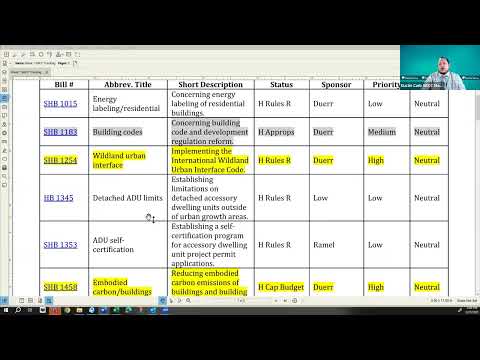
Dustin (staff member) summarized the council’s tracking sheet, saying the Legislature has passed the first house cutoff and that “the dead bills are on page 3.” He reported limited movement on several measures of interest to the council, including a wildland‑urban interface (WUI) code proposal and bills addressing embodied carbon. “We don’t have any major movement on the wildland urban interface code bill,” Dustin said. He also noted a provision related to kit homes and an exemption proposal for affordable housing that were not moving forward.
The committee discussed whether tribal nations should be engaged in WUI code work. Tom Handy said he believed tribal adoption of state building codes is optional and that tribes “have to follow federal, but the state stuff is optional.” Dustin added that the decision to adopt state building codes remains at the tribal nation’s discretion: “If they decide to adopt the codes, then, yes, they would be subject to it. But they’re not beholden to adopt the codes.” Joel (council member) said he had further questions about intent and goals for tribal engagement.
Members also noted recent changes to an embodied‑carbon bill identified in the committee’s materials as HP 1458 (also referred to during the meeting as 1458). Roger Haringo, council member and VFRW committee chair, said the bill was revised to reference the council’s own tag language and that the project‑size threshold has been raised from 50,000 square feet to 100,000 square feet. Justin (staff member) said he had received the updated language only recently and had not finished a detailed review.
No formal legislative actions (motions on specific bills) were taken by the committee during the meeting. The committee did, by voice vote, approve the meeting agenda and the minutes for Feb. 13 and Feb. 20 and later adjourned. The agenda motion was moved by Jay Arnold (council vice chair) and seconded by Roger Haringo; the minutes motion was moved by Jay Arnold and seconded by Roger Haringo; a motion to adjourn was made and seconded and carried by voice.
Why it matters: changes to state bills or to the council’s tag references can affect which model codes or modifications apply to large projects, affordable‑housing exemptions, and the council’s workload. Committee members identified open questions about the scope of tribal engagement and signaled they will monitor bill language as it evolves.
The committee adjourned after the legislative update and brief discussion.