Get Full Government Meeting Transcripts, Videos, & Alerts Forever!
Get email alerts on the Senate Floor Legislation 2025 02 26 topic
No spam. Unsubscribe anytime.
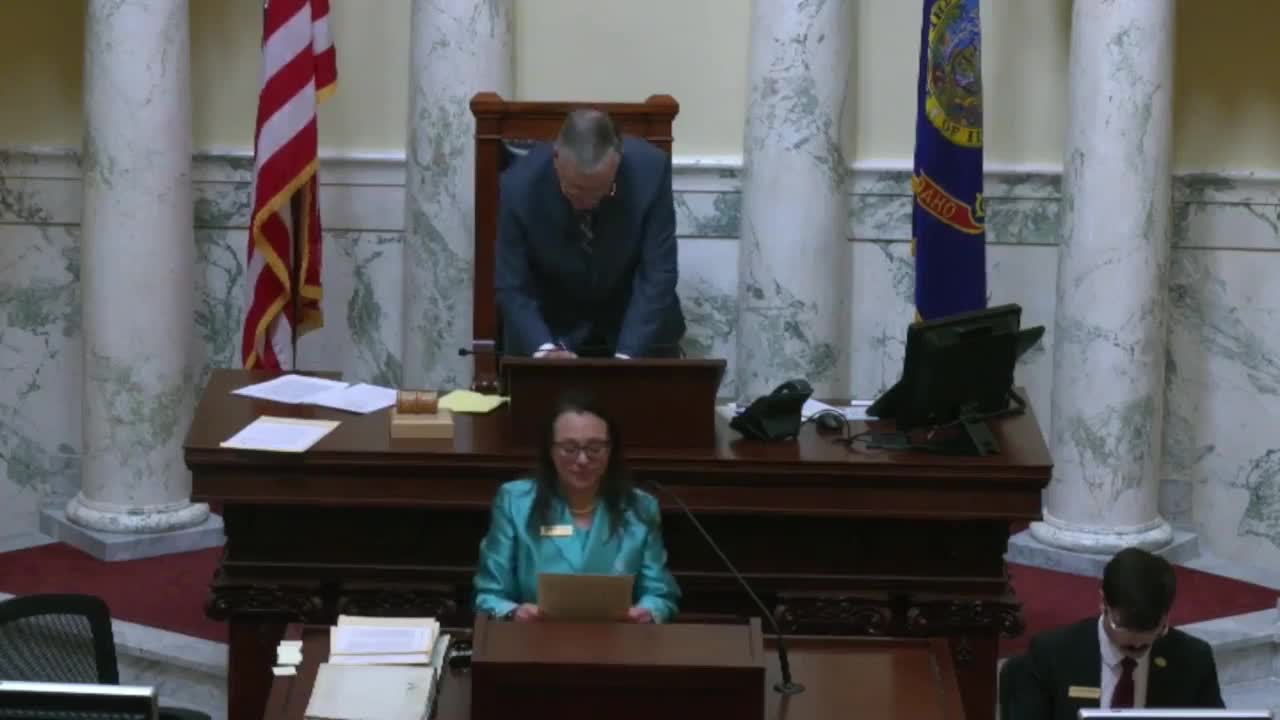
Idaho Senate passes coroners reform, safe-haven placement rules and medical-freedom bill; dozens of other measures advance
Summary
The Idaho Senate on Feb. 26 approved reforms to coroner duties, accelerated placement rules for infants surrendered in safe‑haven boxes, changes to foster‑home safety training, and a broadly written medical‑freedom bill while advancing appropriations and several education items to the House.
The Idaho Senate on Feb. 26 voted on a series of bills touching public safety, child welfare, health policy and education funding, approving major measures including a coroners’ reform bill, a bill setting rapid placement rules for infants surrendered in safe-haven boxes, and a broadly written "medical freedom" act while advancing appropriations and education measures to the House.
The Senate passed Senate Bill 11‑01, a package of changes to county coroner duties and training designed by coroners and local authorities and developed following a Joint Legislative Oversight Committee (JLOC) review. “Before you today is a bill that is a long time coming,” said Senator Tanner Wintrow, one of the bill sponsors, citing a multi-year effort and an Office of Performance Evaluation report that found low autopsy rates in Idaho. The bill narrows and clarifies coroner responsibilities and emphasizes training; supporters said it will increase consistency in death investigations across counties. Opponents raised concerns that some rural counties could struggle to meet new expectations, in particular language describing use of forensic pathologists. The Senate approved the bill 25 in favor, 10 against; the measure will be transmitted to the House.
The Senate also approved the judicial branch maintenance appropriation, Senate Bill 11‑06. "This is fiscal year 2026 maintenance appropriation for the judicial branch," said Senator Sarah Carlson in opening remarks, which listed line items including court operations and judicial council expenses. The bill presented FY2026 appropriation figures in the debate packet (the floor discussion cited prior-year and base figures and adjustments) and the Senate passed the measure (vote count reported on the floor: 33 in favor, 2 absent excused). The bill will be sent to the House for its consideration.
On child-welfare and adoption policy the Senate approved two measures. Senate Bill 10‑58, the Safe Haven bill, requires the Department of Health & Welfare to maintain a vetted list of licensed adoption agencies so infants surrendered in safe-haven boxes can be placed with waiting adoptive families quickly; custody transfer to an adoption agency is required within 24 hours unless medical care or other circumstances delay placement. Sponsor Senator Lori Nichols said the bill is intended to place babies with "vetted, ready, and waiting adoptive families rather than entering the foster care system." The Senate vote was 32 in favor, 3 against. Senator Nichols also carried Senate Bill 11‑04 to add counseling and notice requirements for birth mothers in adoption medical-cost provisions; that bill passed 28‑7.
Foster-home rules were changed in Senate Bill 10‑34. Sponsor Senator Eric Shippey told the Senate he and the Department of Health & Welfare moved existing administrative rules into statute and removed one specific rule-language requirement that firearms and ammunition be stored "separately, locked, and unloaded," replacing it with a statutory direction that the department provide ongoing training that includes gun-safety instruction. Shippey said the change was intended to reduce what some potential foster parents described as a barrier to licensure while still requiring training and safeguards. The Senate passed SB10‑34 (vote count reported: 30 in favor, 4 against, 1 absent).
A broadly worded measure reworking the state's earlier Coronavirus Stop Act into what sponsors called the "Idaho Medical Freedom Act" (Senate Bill 10‑23) also passed after an extended floor debate. Sponsor Senator Trey Forman urged the measure was drafted to protect individual choice and clarified it does not change statutory school vaccine opt-out provisions; other senators raised concerns about inserting the Legislature into private-sector employment decisions and about the bill's wide definition of "medical intervention." The Senate approved SB10‑23 on a recorded vote (19 in favor, 14 against; 2 absent).
Other debated measures that passed on Feb. 26 included: - Senate Bill 10‑52 (Health & Welfare): changes to the appointment process for bureau chiefs in the Department of Health & Welfare to align bureau chief hiring/firing with division standards; passed 35‑0. - Senate Bill 10‑70 (Education): requires school districts to make available free online parent education about school-issued internet devices; passed 24‑11. - Senate Bill 10‑95 (Education): updates to the teacher career ladder amounts to reflect prior budget intent; passed 31‑4. - Senate Bill 10‑31 (as amended, Public Health districts): limits or clarifies public health district powers and establishes accountability measures; passed 31 in favor, 4 absent. - Senate Bill 10‑87 (Medical records): provides one free copy of medical records needed for Social Security disability claims with narrow small‑provider exemptions; passed 19‑16. - Senate Bill 10‑34 (Foster home health and safety): moved multiple foster‑care rules into statute and required department training including gun safety; passed 30‑4‑1. - Senate Bill 10‑93 (Adult alternative instructional diploma pilot): this outcomes‑based pilot to provide accredited diplomas for adults was rejected by the Senate (vote 14 in favor, 21 against). - Senate Bill 10‑94 (School levies): allows certain supplemental levies to run up to six years and removes the perpetual levy provision; passed 35‑0.
What was debated, what was decided - Coroners reform (SB11‑01): supporters argued the bill addresses public-safety gaps revealed by the Office of Performance Evaluation; opponents warned rural counties could lack access to forensic pathologists. Outcome: passed 25‑10. - Foster-home firearms requirement (SB10‑34): sponsors replaced a strict storage mandate with required department training and guidance; sponsors said safety will be delivered by education rather than a single prescriptive storage rule. Outcome: passed 30‑4‑1. - Safe‑haven placements (SB10‑58): sponsors argued the bill speeds placement into vetted adoptive homes and includes Indian Child Welfare Act notification within 10 days when tribal status is suspected. Outcome: passed 32‑3. - Medical freedom (SB10‑23): tension on the floor centered on private-sector flexibility and the bill's broad definition of "medical intervention." Outcome: passed 19‑14 (2 absent).
Votes at a glance (selected measures passed or considered on Feb. 26) - SB 11‑06 (Judicial Branch FY2026 appropriation): passed (33 in favor; 2 absent excused). - SB 11‑01 (Coroners; duties and training): passed (25 in favor; 10 against). - SB 11‑04 (Adoption: counseling/notice for birth mothers): passed (28 in favor; 7 against). - SB 10‑58 (Safe‑haven placement and adoption coordination): passed (32 in favor; 3 against). - SB 10‑31 (Public health district powers; limits/definition): passed (31 in favor; 4 absent). - SB 10‑52 (Health & Welfare bureau chiefs alignment): passed (35 in favor; 0 against). - SB 10‑70 (Parent education for school devices): passed (24 in favor; 11 against). - SB 10‑95 (Teacher career ladder code update): passed (31 in favor; 4 against). - SB 10‑87 (Medical-records copy for SSDI claims): passed (19 in favor; 16 against). - SB 10‑34 (Foster home health & safety; training requirement): passed (30 in favor; 4 against; 1 absent). - SB 10‑93 (Adult alternative diploma pilot): failed (14 in favor; 21 against). - SB 10‑94 (School levies changes): passed (35 in favor; 0 against).
What happens next Most of the bills approved on the Senate floor were transmitted to the House for further action. Several measures that drew floor debate flagged follow-up needs: the coroners' bill sponsors and JLOC said they will pursue further needs assessments of county-specific gaps; the safe‑haven bill contains ICWA notice steps that will require coordination with tribal authorities; and the foster‑care change tasks the Department of Health & Welfare with producing recurring training materials and guidance for caregivers.
Key quotes from the floor - "Before you today is a bill that is a long time coming," Senator Tanner Wintrow said of coroners' reform, citing decades of attempted changes and an OPE report. - "This is fiscal year 2026 maintenance appropriation for the judicial branch," Senator Sarah Carlson said while opening debate on the judicial appropriation bill. - "This bill will ensure birth mothers are fully informed," Senator Lori Nichols said in support of counseling and notice requirements for adoption. - "Would that be a deterrent? Would that be burdensome to you?" Senator Eric Shippey asked rhetorically on whether a prior rule on separate locked storage for guns and ammunition deterred would‑be foster parents.
Reporting notes This summary is based on the Feb. 26, 2025 Senate floor transcript and roll calls announced on the floor. Where the transcript recorded specific vote counts those counts are reported above. The Senate published titles and committee referrals earlier in the day; bills transmitted to the House will be available in the enrolled bills list at the Idaho Legislature website.
Ending The Senate recessed at the end of the day's business after a motion to adjourn; the calendar will continue when both chambers reconvene and the House takes up the bills transmitted from the Senate.