Get Full Government Meeting Transcripts, Videos, & Alerts Forever!
Get email alerts on the School Health Athletic Trainers topic
No spam. Unsubscribe anytime.
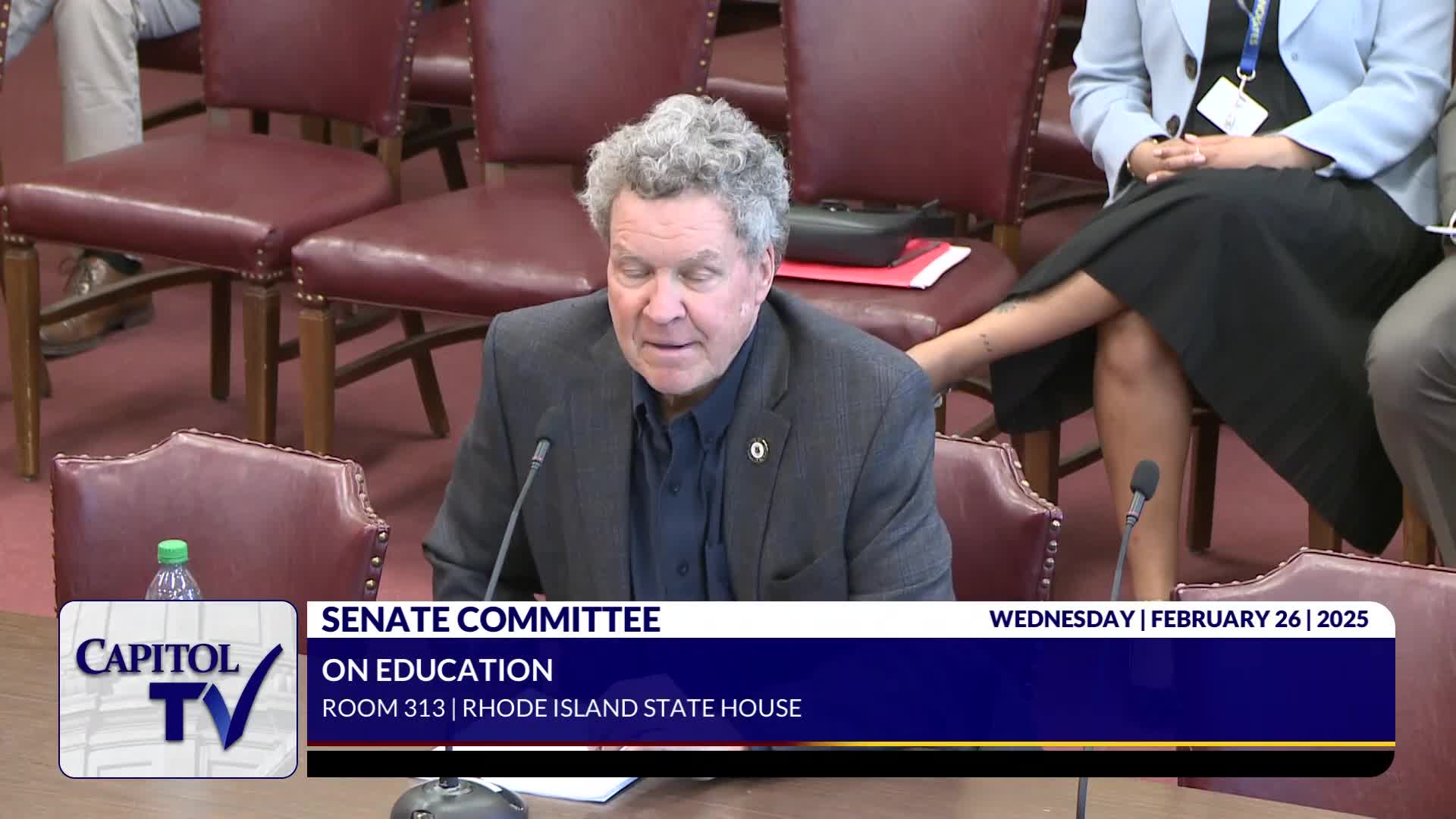
Senate education hearing holds three bills on athletic trainers, concussion protocols and EpiPens for further study
Summary
The Rhode Island Senate Education Committee held for further study three related bills addressing concussion return-to-play rules, the presence of athletic trainers in schools and availability of EpiPens at school athletic events.
The Rhode Island Senate Education Committee held for further study three related bills addressing concussion return-to-play rules, the presence of athletic trainers in schools and availability of EpiPens at school athletic events.
Proponents said the measures—referred to in testimony as bill 3 19, bill 3 20 and bill 3 21—seek to reduce risk to student athletes by clarifying who may sign students back into play after a concussion, expanding access to athletic trainers at secondary schools, and equipping athletic trainers with EpiPens and related training.
The bills’ sponsor and witnesses described the three measures in sequence. Mark DeSisto, a testifying athletic trainer, described bill 3 19 as a “return to learn” measure that would expand the personnel who may clear a student to return to practice or play to include physician assistants and athletic trainers. “This would . . . ensure that a student athlete suffering a concussion goes through proper protocols, with the ability to return to the classroom,” DeSisto said. He also urged passage of bill 3 20, which proponents framed as a requirement that school districts designate an athletic trainer for each secondary school within the district, and bill 3 21, which would require athletic trainers to be trained in—and encouraged to carry—EpiPens.
Supporters recounted incidents and benefits. DeSisto said having athletic trainers on-site at his high school prevented worse outcomes in past injuries and would have helped him personally after concussions. He also said athletic trainers regularly make venue-specific emergency plans and respond not only for athletes but for officials and spectators as well. Another witness described a televised case where use of an AED saved a college athlete’s life, cited as context for the bills’ public-safety rationale.
Opponents and school representatives urged caution on scope, cost and liability. Tim Duffy, representing the Rhode Island Association of School Committees, said current law allows only a licensed physician to sign a student back into play and raised questions about who would bear liability if athletic trainers or physician assistants assume that role. “Right now, only a licensed physician can sign off on a student's return to practicing or to playing on the field. This would include physician assistants and it would also include athletic trainers,” Duffy said, adding uncertainty about indemnity and whether interlocal insurance trusts would cover nonphysician evaluators. Duffy also said a strict reading of the language could be interpreted to require trainers at each secondary school (he cited about 45 high schools and 55 middle schools in Rhode Island Interscholastic League membership), and he offered a rough cost estimate: at a modest salary of $70,000–$80,000 with benefits, providing trainers at every secondary school could cost roughly $7–8 million annually if applied per school.
Committee members pressed witnesses on workforce capacity and funding. Witnesses told senators that 61% of secondary schools in the state lacked a full-time athletic trainer and that schools use a range of models—shared trainers, per‑diem coverage, partnerships with physical‑therapy companies or grant funds such as a KSI grant—to secure coverage. Witnesses said nationwide the shortage is concentrated in the secondary‑school setting and that COVID‑era workforce changes reduced the available pool. Senators asked whether districts could designate a single trainer to serve multiple high schools in a district; witnesses said the bill’s language allows districts to evaluate program size and may permit a designated trainer to serve multiple schools where feasible, but that simultaneous events at multiple schools would make a single trainer inadequate.
On the EpiPen proposal (bill 3 21), witnesses said local practice varies: families generally provide EpiPens for their children, school nurses often maintain stock EpiPens and school physicians can write standing prescriptions for district use. Proponents said athletic trainers are trained to administer epinephrine and that carrying an EpiPen on the sideline could save time in emergencies.
After roughly four decades of questions and testimony, committee members moved to “hold for further study” each bill. The committee recorded voice votes—“Aye”—to hold senate bills 3 19, 3 20 and 3 21 for further consideration.
Why it matters: If enacted, the bills would change school health practice across Rhode Island by broadening who may clear students after concussion, altering district staffing expectations for athletic coverage and encouraging or requiring availability of EpiPens at athletic events. Witnesses and senators agreed on the safety rationale but differed on funding, legal liability, workforce availability and the precise scope of any mandate.
Next steps: The committee voted to hold all three bills for additional study and follow-up information; senators requested additional data on workforce availability, district costs and indemnity arrangements before advancing legislation.