Lifetime Citizen Portal Access — AI Briefings, Alerts & Unlimited Follows
EGLE holds public hearing on Eagle Mine paste-backfill project; air permit draft and mining-permit amendment open for comment
Loading...
Summary
An informational session and public hearing March 5 convened by the Michigan Department of Environment, Great Lakes, and Energy (EGLE) covered Eagle Mine’s request to add a paste backfill process, construct an enclosed tailings storage addition to the mine’s core storage area (COSA), install a cement silo and a borehole to deliver paste underground, and to increase the facility’s allowed annual ore-truck count from 17,140 to 17,703.
An informational session and public hearing March 5 convened by the Michigan Department of Environment, Great Lakes, and Energy (EGLE) covered Eagle Mine’s request to add a paste backfill process, construct an enclosed tailings storage addition to the mine’s core storage area (COSA), install a cement silo and a borehole to deliver paste underground, and to increase the facility’s allowed annual ore-truck count from 17,140 to 17,703.
Why it matters: EGLE’s Air Quality Division (AQD) is the decision maker on the draft air permit to install the paste backfill equipment; EGLE’s Geologic Resources Management Division (GRMD) is separately considering an amendment to the mine’s nonferrous metallic mining permit. Both reviews evaluate potential air and geochemical impacts and set conditions that the mine must follow if permits are approved. Public comments submitted during the stated comment periods will be reviewed before EGLE issues any final decisions.
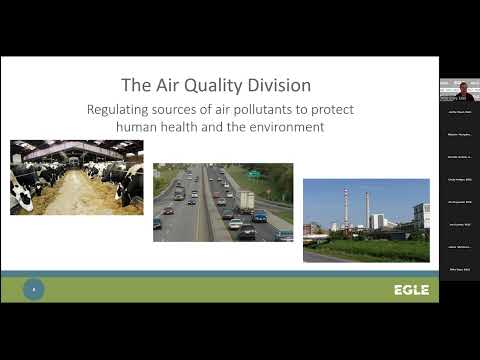
AQD overview and draft permit details Andy Drury, lead air quality permit engineer for the Eagle Mine application, described AQD’s regulatory role, the technical review steps and the draft permit conditions. AQD evaluated emissions from the entire facility (including onsite truck traffic and fugitives) and performed dispersion modeling for criteria pollutants (including PM10 and PM2.5) and toxic air contaminants. Drury said the modeling shows the facility’s projected emissions would meet National Ambient Air Quality Standards and EGLE health-based screening levels for toxic air contaminants under the scenarios modeled.
Drury summarized the main elements of the proposed air-permit changes: operation of a paste backfill process (mixing dewatered tailings from the Humboldt Mill with cement in a screen and mixer, then pumping paste underground via a new borehole and pipe), an enclosed addition to the COSA to store dewatered tailings, a new cement silo with a bin-vent filter, and visible-emission and fugitive-dust controls for the new equipment and onsite roads. AQD’s draft permit would keep most existing permit conditions unchanged and requires implementation and maintenance of a fugitive dust plan, paved roads on most site routes, and a truck wash for vehicles leaving ore-contact areas.
AQD will permit and model emissions from truck activity on the facility’s property; emissions from trucks on public roads fall outside AQD’s authority and are not included in the air-permit modeling, Drury said. The draft permit increases the annual ore-truck limit from 17,140 to 17,703 (about a 3% increase) and retains a visible-emission limit for on-site truck traffic.
Inspection, monitoring and testing Joe Scanlon, AQD inspector for the Marquette district, explained that district staff perform periodic on-site inspections, review company records and visible-emission checks, and may request monitoring data and operating parameters to verify compliance. Scanlon said AQD reserves the right to require stack testing for particulate matter, nickel and copper if staff determine a test is necessary; he noted the main ventilation air raise (the MVAR) was last stack tested on Sept. 17, 2014.
Mining-permit amendment and geochemical controls Melanie Humphrey, mining specialist in GRMD, described the mining-permit amendment application, received Dec. 12 and declared administratively complete Jan. 28. GRMD determined the changes are “significant” under the nonferrous metallic mineral mining law (Part 632 of Michigan’s Natural Resources and Environmental Protection Act). Written comments on the mining-permit amendment will be accepted through March 25 (28 days following the meeting), and GRMD expects a final decision by April 8 or, if a proposed decision is issued, a proposed decision by April 22 followed by another opportunity for public comment.
Humphrey said the amendment would authorize the mill’s dewatered tailings to be brought to the Eagle Mine and processed into paste backfill for use in specified underground workings (Upper Eagle East and Eagle East). Cement rock fill (CRF) produced from development rock would continue to be used in other portions of the mine. The amendment application includes an Underground Injection Control (UIC) inventory form submitted to U.S. EPA because paste backfill would be transported through a borehole; GRMD said EPA’s UIC program is a separate federal review and EGLE does not issue those approvals.
GRMD also provided information on geochemical characterization: Part 632 requires testing of geologic materials to determine whether they are potentially reactive (acid-generating or metal-leaching). GRMD said development rock stored temporarily at the TDRSA was previously characterized as potentially reactive, a limestone-addition condition (20 tons limestone per 1,000 tons of development rock) remains in the permit but the mine requested an adaptive management modification that would allow EGLE-approved adjustments based on monitored site water chemistry. GRMD requires adherence to a Quality Assurance Project Plan (QAPP) for groundwater and surface-water sampling; the mine proposes a process to request modernization of the QAPP with departmental approval.
Public comment, hearing and stakeholder concerns AQD opened a public hearing on the draft air permit; the air permit public comment period remains open through midnight March 17, 2025. GRMD’s comment period on the mining-permit amendment runs through March 25, 2025. Drury and Humphrey emphasized that EGLE can only use information within its statutory authority when making permit decisions (for AQD, that includes emissions, modeling, monitoring, and enforceable permit conditions; zoning, noise and truck traffic on public roads are outside AQD’s legal authority).
A public comment from Kathleen Heideman of the Upper Peninsula Environmental Coalition flagged additional community concerns that were not evaluated in the air-permit draft: escalating light pollution from mine operations and truck traffic, the potential for future pit mining or tailings reprocessing that could expose legacy contaminants (Heideman cited cyanide as a community worry), and a request that EGLE require stack testing to confirm compliance for copper and nickel emissions. Heideman also noted she did not receive direct notice from GRMD and asked that GRMD consider better public notice practices; GRMD staff responded that mining documents are posted on the nonferrous metallic mining web pages and that the UIC submission to EPA is included in the amendment application appendices.
Next steps and how to comment AQD reiterated that the draft air permit remains open for change and that written and verbal comments received by March 17 will be reviewed before a final decision. GRMD will accept written comments on the mining-permit amendment through March 25 and will decide on whether to issue a final decision or a proposed decision (which would trigger an additional hearing) based on public interest and the review. EGLE staff provided directions for submitting comments by mail, email (egle-mining-comments@michigan.gov for mining permit comments), voicemail to AQD’s public comment line, or by using the myEnviro portal for air-permit submissions. A recording of the meeting will be posted on the Eagle Air public notice page and material cited in the presentations (technical fact sheet, draft permit conditions, and the mining amendment application) is available on EGLE’s project pages for Eagle Mine.
Publicly stated deadlines and commitments from the meeting AQD air-permit comment period closes: March 17, 2025 (midnight). GRMD mining-permit written comment period closes: March 25, 2025. GRMD tentative decision timelines: final decision by April 8, 2025, or proposed decision by April 22, 2025 (if a proposed decision is issued an additional hearing would be scheduled). AQD stated it may require stack testing if staff determine it necessary; the last MVAR stack test occurred Sept. 17, 2014.
The record of this hearing and all submitted comments will be reviewed by the decision maker(s) before a permit determination is issued.