County warns environmental-crimes bill could criminalize routine wastewater permit exceedances
Summary
County public-works staff and commissioners expressed concern about a bill that would add felony or gross-misdemeanor penalties and individual liability for violations of discharge limits under MPDES permits, saying routine permit exceedances could expose municipal operators to criminal penalties and worsen staffing shortages.
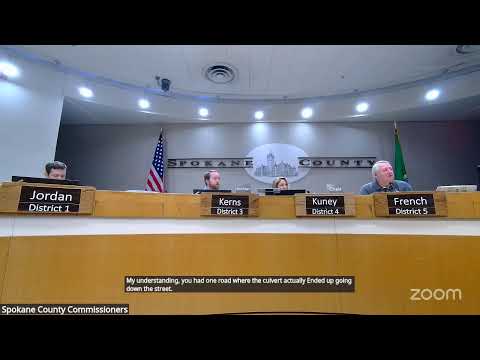
Kyle, a public-works staff member, briefed the Spokane County Board of Commissioners on a proposed state environmental-crimes bill that would increase penalties for discharge violations and could expose individuals operating wastewater facilities to criminal liability.
Kyle said the bill would add civil penalties and raise some violations to class C felonies or gross misdemeanors and would “bring liability down to the individual,” a change he described as “particularly concerning when you talk about operating a municipal or county owned wastewater treatment facility.” He explained that wastewater operators regularly conduct testing and at times can foresee a permit exceedance before it happens; many MPDES permits contain narrow numerical limits that are monitored and reported to the Department of Ecology.
“A class c felony or a gross misdemeanor is a pretty steep penalty for a [permit] exceedance,” Kyle said, and he warned the bill could “scare off wastewater operators out of our state,” aggravating an existing shortage of qualified operators. He noted Ecology already has authority to assess civil penalties (for example, up to $10,000 per event per day) and that Ecology typically reviews reported exceedances.
Commissioners raised questions about the bill’s intent and scope; one asked whether the legislature was likely targeting commercial actors rather than public utilities. County staff observed the bill language does not distinguish between scale or harm — a major corporate discharge and a minor exceedance in pH could be treated equally by the bill’s tiering. Commissioners and staff said they would coordinate with WASAC (the water/wastewater association), public-employee unions and regional partners, and that staff would draft suggested language and engage the Spokane delegation if the bill progresses.
No formal board action was taken during the briefing; staff recommended preparing concerns and potential clarifying language for legislative outreach.
AI generated
The text on this page is AI generated. Summaries, highlights, analysis, and video transcripts are all produced from the original source material.
AI can make mistakes, so if you spot one, and we will fix it for everyone.
Note: the source content is unaltered by us. Any content source we link to, be it a video, an audio recording, or a document, is presented exactly as its publisher released it. That publisher is usually a government body, sometimes an individual official or another organisation.