Get AI Briefings, Transcripts & Alerts on Local & National Government Meetings — Forever.
Arizona committee hears bill to exempt remedial PFAS pumping from AMA caps
Loading...
Summary
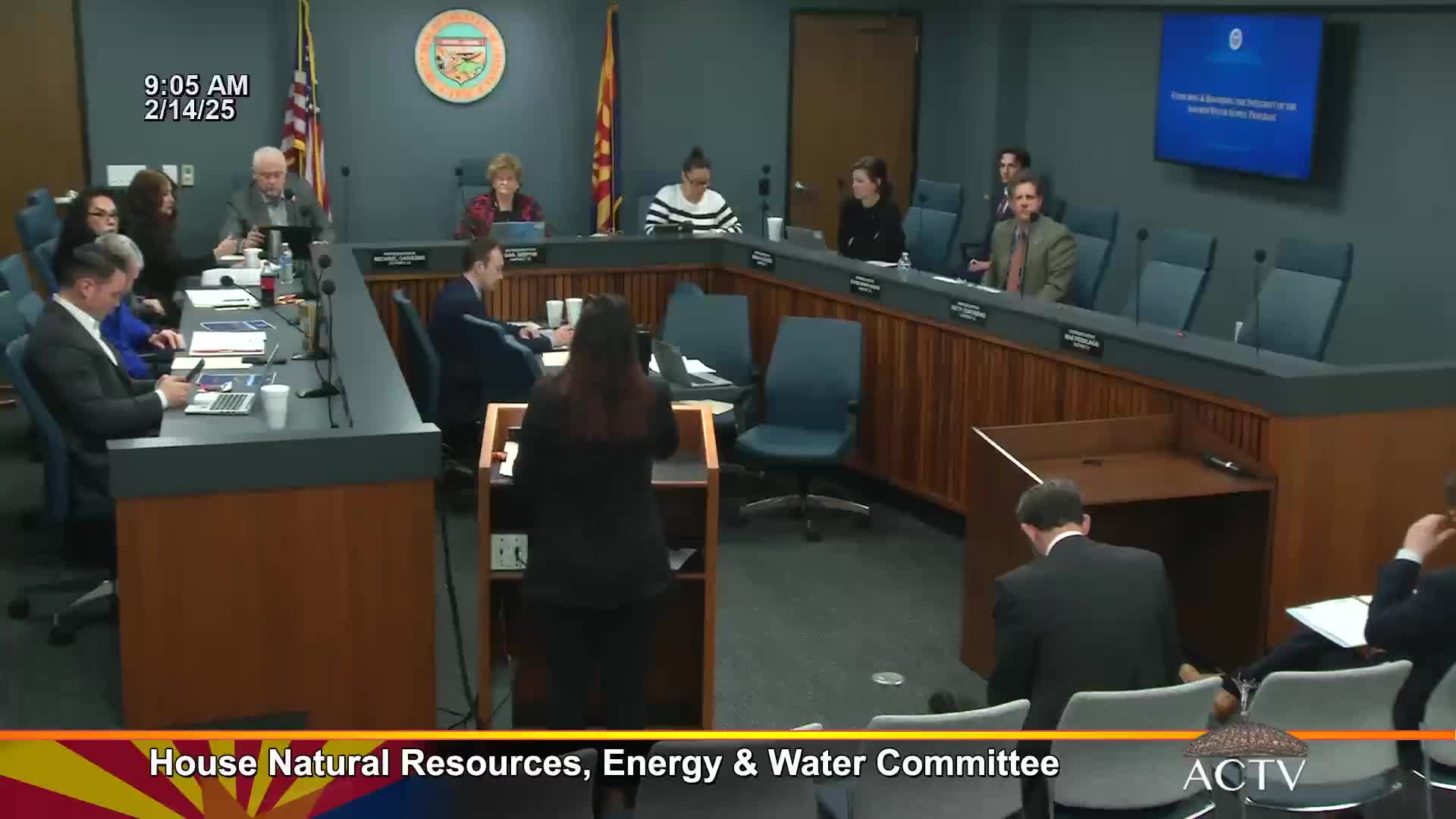
A state House committee on Feb. 14 considered House Bill 24-14, which would allow groundwater pumped to remove PFAS and other specified contaminants during an approved remedial action project to be excluded from a provider's withdrawal cap in an active management area (AMA).
A state House committee on Feb. 14 considered House Bill 24-14, which would allow groundwater pumped to remove PFAS and other specified contaminants during an approved remedial action project to be excluded from a provider's withdrawal cap in an active management area (AMA).
The bill's sponsor said the measure is narrowly focused on incentivizing cleaning up “forever chemicals” whether the current U.S. Environmental Protection Agency mandate remains in place. Representative Culloden said the change would let water providers withdraw water expressly for treatment without counting that withdrawn volume against AMA limits, allowing cleanup without impairing service to existing customers.
The Arizona Department of Environmental Quality (ADEQ) said it is neutral but flagged potential conflicts and ambiguities. Krista Osterberg, ADEQ chief legislative liaison, warned the bill’s definitions could allow pumping without a demonstrated release of a hazardous substance and could expand the state’s hazardous-substance definition beyond current federal designations. She also said the bill could cause entire aquifers to be classified as hazardous if applied as written and could expand Aquifer Protection Program permitting obligations by removing some current exemptions.
The Arizona Department of Water Resources (ADWR) representative, Trent Womberg, said ADWR is neutral and noted a key practical concern: commingled accounting. Womberg told the committee all pumped water still counts as groundwater in aquifer accounting; allowing exemptions could permit more pumping without replenishment if broadly applied because PFAS contamination is widespread.
The Arizona Municipal Water Users Association, represented by Barry Aarons, testified in respectful opposition. He said the existing temporary incentive enacted in 1997 has been used by only four providers (Scottsdale, Goodyear, Tucson and the Metropolitan Domestic Water Improvement District) and that permanently opening the exemption to all AMAs and allowing PFAS-contaminated water that exceeds EPA maximum contaminant levels (MCLs) to qualify could enable up to 65,000 acre-feet per year of pumping without replenishment.
Aarons and ADEQ both urged careful drafting to avoid expanding the hazardous-substance definition and to address WARF (the Water Assurance Revolving Fund) funding and scope. ADEQ noted WARF’s limited appropriation (historically cited in testimony as between $15 million and $18 million per year) and the difficulty of identifying responsible parties for PFAS contamination.
Sponsor Culloden said the bill is intended to create a market incentive for voluntary cleanup when federal mandates are uncertain and asked to work with ADEQ and ADWR on statutory language. The committee held the bill for follow-up and additional meetings with staff and agency representatives.
Ending: The committee did not take a vote on HB2414; the sponsor agreed to meet with ADEQ and ADWR staff to refine definitions and address funding and program interactions before advancing the measure.
Quotes
"This bill is pretty tightly focused on the issue of cleaning up Arizona's forever chemicals," Representative Culloden said.
"The bill as introduced could allow for pumping of remedial groundwater without replenishment even in scenarios where actual release of a hazardous substance has not yet occurred," Krista Osterberg said for ADEQ.
"Extending this exemption permanently could effectively permit the allowance of groundwater pumping without replenishment if they can demonstrate some sort of link to a PFAS site or plume," Trent Womberg said for ADWR.
Ending note
The committee paused action to allow sponsors and agencies to resolve definitional and program-funding concerns. No formal motion or roll-call vote was made on HB2414 during the hearing.