Lifetime Citizen Portal Access — AI Briefings, Alerts & Unlimited Follows
Senators and witnesses stress urgency for direct air capture, but note energy and scale hurdles
Loading...
Summary
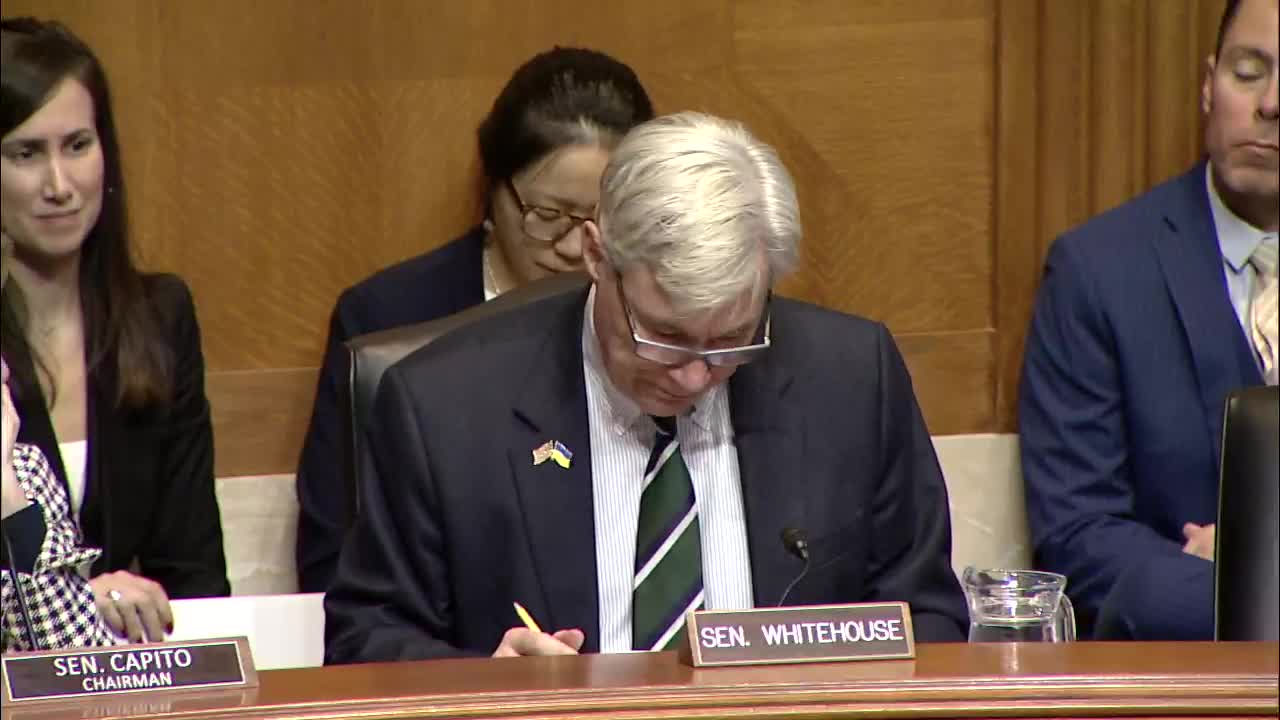
Ranking Member Sheldon Whitehouse and witnesses emphasized the need to scale carbon dioxide removal, including direct air capture (DAC), to meet climate scenarios, while testifying that DAC’s costs and power needs make rapid scale‑up contingent on cheap, abundant energy and clearer permitting.
WASHINGTON — Senators and expert witnesses at a Senate EPW Committee hearing said direct air capture and other carbon removal technologies are necessary to reach aggressive climate pathways, but warned that scale, economics and permitting remain significant obstacles.
Ranking Member Sheldon Whitehouse, Democrat of Rhode Island, opened with a review of climate modeling and argued that carbon dioxide removal (CDR) will be necessary if the U.S. and world are to avoid the worst outcomes of climate change. "Carbon dioxide removal will be necessary to achieve net negative CO2 emissions," Whitehouse said, citing peer‑reviewed scenario work on 1.5‑degree pathways.
Jack Kavanaugh, manager for carbon management at Breakthrough Energy and a member of a White House task force, told the committee the United States must scale to gigaton‑level removal. "A single blue whale weighs around 46 metric tons, which means 6,000,000 blue whales constitute a single gigaton and we need multiple gigatons of both CCS and CDR from here on out," Kavanaugh said to illustrate scale. He said U.S. policy mechanisms — the USE IT Act, the DAC hubs program in the IIJA, and the Section 45Q tax credit — have created early market signals but that more federal permitting clarity and funding are required.
Witnesses and senators discussed DAC’s technical and economic needs. Kavanaugh and Kevin Connors agreed that direct air capture is energy‑intensive and that lowering costs will require cheap, abundant power and access to transmission. Connors said most DAC projects will not individually justify a Class 6 well because economics currently favor capture volumes on the order of 1 million metric tons per year for a project to justify that permitting step; he noted one conditional Class 6 permit tied to an Occidental Petroleum facility in West Texas.
Committee members said DAC’s energy footprint and the permitting of pipelines, transmission and storage must be addressed in parallel. Kavanaugh added that DAC can be sited near storage to reduce pipeline needs and that hubs combining point‑source capture and DAC were already being planned. Senators sought written follow‑up on how federal agencies can coordinate to speed permitting for pipelines and storage, and how federal funding pauses or loan cancellations might affect private investment in DAC and other projects.
Ending: The committee asked witnesses for additional written recommendations on coordinating federal permitting and on financing mechanisms to scale DAC and other CDR approaches.