Get Full Government Meeting Transcripts, Videos, & Alerts Forever!
Get email alerts on the Outdoor Recreation Trails topic
No spam. Unsubscribe anytime.
Alaska Long Trail update: feasibility study, funding and local concerns discussed
Summary
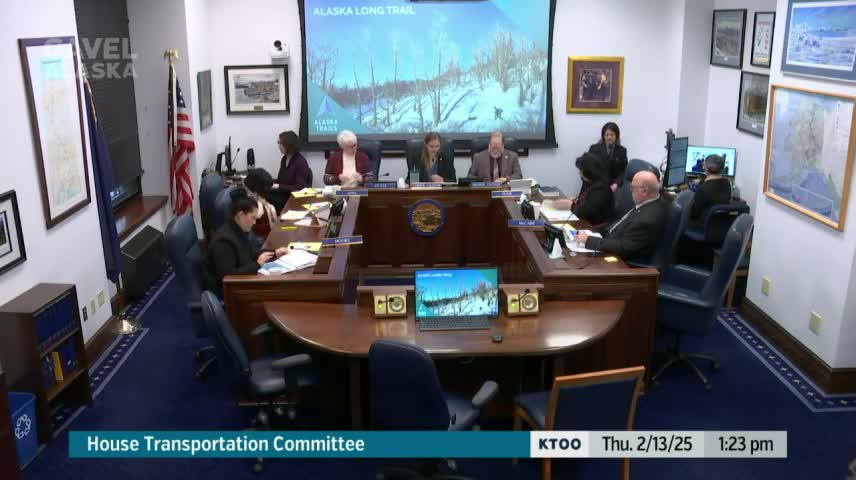
Haley Johnston, deputy director of Alaska Trails, updated the House Transportation Committee on Feb. 13, 2025 on the Alaska Long Trail project, including funding to date, a BLM feasibility study timeline and ongoing local concerns about a potential National Scenic Trail designation.
Haley Johnston, deputy director of the nonprofit Alaska Trails, briefed the House Transportation Committee on Feb. 13, 2025 about the status of the Alaska Long Trail project, a proposed roughly 500‑mile corridor connecting Seward to Fairbanks.
Johnston said the trail project began as an economic development idea and noted national and state outdoor recreation statistics (a $640 billion national outdoor recreation economy and a $3.14 billion figure for Alaska in 2023, cited from the Bureau of Economic Analysis). She told the committee the vision is to connect coastal and interior communities, build on existing trail networks in places such as the Chugach National Forest and Chugach State Park, and fill gaps “where the costs are fairly manageable.”
Johnston outlined funding so far: roughly $12 million in federal funding directed to projects associated with the corridor, about $6.7 million in state funding over three fiscal years for 14 state projects, and nearly $2 million from private and foundation donors since 2021 for Alaska Long Trail–related work. She described specific projects funded by the state and partners: $1.5 million in FY23 for Crow Pass Trail work, state support for Eklutna Lakeside Trail reconstruction and Indian Valley Trail improvements, federally supported bridge work along the Iditarod National Historic Trail corridor, and other localized construction and maintenance projects.
Johnston reviewed the federal feasibility study process: an appropriations allocation in late 2022 directed $1 million for a BLM feasibility study, the BLM hired a contractor in late 2023, the contractor completed public engagement in 2024 (in‑person meetings, virtual meetings and outreach to landowners), and a draft feasibility report was scheduled for release in spring 2025 with a subsequent public comment period. Johnston said the draft will not itself contain a designation recommendation but will inform next steps that may go to Congress.
Committee members pressed on key concerns. Representative McCabe and others cited Section 7(c) of the National Trails System Act and asked whether a National Scenic Trail designation would limit motorized uses; Johnston said language for each trail’s congressional designation is written case‑by‑case and noted examples (such as parts of the Continental Divide Trail) where motorized use is permitted on road segments. Several members and local stakeholder groups, Johnston acknowledged, have written that they do not oppose the trail concept itself but oppose a federal National Scenic Trail designation if it would relinquish local control or restrict existing motorized uses. Johnston also noted that some boroughs passed resolutions expressing conditional support for the concept while opposing federal overreach on borough‑owned lands.
Members sought economic justification and a return‑on‑investment analysis. Johnston cited a Headwaters Economics study (Mat‑Su) saying public open space investments in that study generated a $5.30 return per dollar invested, and she said more comprehensive statewide economic analysis is not yet available; she offered to provide BEA data and other materials to the committee. She added that Chugach State Park receipts for parking and access have in recent years exceeded the park’s appropriations, and that federal grants and private matches have been used to leverage state spending for trail maintenance and construction.
Johnston emphasized that land managers decide permitted uses on their lands, and that the Alaska Long Trail effort has worked with federal, state and municipal land managers who will determine whether sections are motorized, non‑motorized, equestrian or multi‑use. She said some sections are already in place and in use year‑round; other sections remain in planning and will require additional funding and coordination.
Ending: Johnston told the committee Alaska Trails will share letters of support, the BEA data she referenced, and other materials; she urged public engagement on the upcoming BLM draft feasibility study. Committee members thanked the presenter and requested additional economic and technical details as the feasibility process continues.