Lifetime Citizen Portal Access — AI Briefings, Alerts & Unlimited Follows
House committee sends House File 8 to workforce panel after debate over ombudsman, tribal consultation and expedited fees
Loading...
Summary
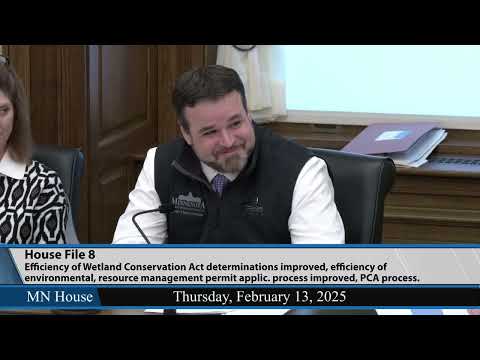
The committee voted to re-refer House File 8 as amended to the Labor and Workforce Development Committee after extended questioning about county jurisdiction, an ombudsman funded through DEED, tribal consultation and an optional expedited-fee process.
A Minnesota House committee voted to re‑refer House File 8, as amended, to the Labor and Workforce Development Committee after extended debate about how the bill would define jurisdiction, fund an ombudsman and whether tribal nations were consulted.
The motion to re‑refer passed on a roll call, 7‑5. Committee members' questions before the vote focused on whether the bill's geographic reach — written to apply in the county where a project exists and adjoining counties — would adequately capture watershed or cross‑boundary impacts; on whether the Department of Employment and Economic Development (DEED) would fund an ombudsman; and on whether an optional expedited fee would advantage larger companies over small and medium operations.
Supporters, including the bill's author, said the measure is intended to provide assistance for smaller and mid‑sized operators who face long permitting timelines. Opponents pressed for more named stakeholder engagement, in particular consultation with Minnesota’s tribal nations, and asked for a clearer fiscal note before the bill advances.
Representative Hansen told the committee that changes in agriculture and industry consolidation have concentrated impacts in some counties and raised the risk of local intimidation when a dominant employer is present. He asked how the bill would protect residents in a county where a single vertically integrated employer could exert pressure on local decision‑making.
Chair Heintzeman (committee chair) replied that the bill covers the county where a project exists and adjoining counties, not a single county, and stressed that the bill does not lower environmental standards. He also said the committee could discuss using modernized technology for more timely public notice and reporting.
Representative Purcell asked whether the bill's drafters had modeled provisions on other states, including Michigan, where permitting reforms involved higher staffing and system modernization. The bill's author said the language incorporated provisions used in several other states and that conversations had occurred with a number of stakeholders, including the Minnesota Chamber of Commerce.
Several members raised concerns about the bill's expedited review option, which would allow applicants to pay for prioritized processing. Representative Purcell said that if the bill is intended to help small and mid‑sized operators, a paid expedited lane could privilege large corporations that can afford the fee.
Testimony from Aaron Clemens of the Minnesota Center for Environmental Advocacy questioned the Chamber's examples that purportedly showed companies leaving the state because of permitting timelines. Clemens described three cases cited by the Chamber — Epitome Energy, Huber Engineered Woods and Talon Metals — and said each had distinct facts, including subsidies, litigation and revised applications, that complicated any single explanation for why a project moved out of state.
Members also pressed the author on tribal consultation. Representative Jordan asked directly whether Minnesota’s 11 sovereign tribal nations had been consulted; the author said he welcomed conversations with anyone who wished to engage but did not name any tribal nations as having been specifically consulted on the bill in committee discussion.
During debate, Representative Fisher moved to lay the bill on the table; that motion failed on a roll call, 5‑7. The committee then voted to re‑refer House File 8, as amended, to the Labor and Workforce Development Committee by roll call, 7‑5.
The committee did not complete a fiscal analysis during the hearing; several members said a fiscal note and more stakeholder outreach, especially to tribal nations, should be developed before further advancement. The bill will proceed to the Labor and Workforce Development Committee for additional consideration.