Spokane County holds workshop on comprehensive plan update, emphasizes placemaking and climate resilience
Summary
Spokane County Planning staff and consultants held a public workshop in Otis Orchards to gather resident input on the county's 2026 comprehensive plan update, emphasizing placemaking, a new climate element and the technical process for revising urban growth-area boundaries.
Spokane County Planning staff and outside consultants held a public workshop in Otis Orchards where they walked residents through the county's comprehensive-plan update process, described a new required climate element and tested local preferences for neighborhood design.
County planning staff framed the meeting around shaping future urban growth areas (UGAs) and improving "how you build a sense of community," asking participants to weigh in on design choices and priorities through live polling and map exercises.
The workshop matters because Spokane County must update its comprehensive plan under the state Growth Management Act; the plan sets land-use policy, future UGA boundaries and implementing zoning that will guide development for the next planning cycle. County staff said the work will feed into a steering committee of elected officials and ultimately to the county board for adoption.
"How do you make a neighborhood instead of a subdivision?" asked the county planner leading the session, emphasizing placemaking as a central goal of the update. He described UGAs as areas intended to be served by infrastructure such as water and sewer and said the county and cities will run a capacity analysis to determine where growth can be accommodated before any boundary changes are considered.
On Otis Orchards specifically, county planning staff said growth pressures and existing infrastructure patterns make the area an unlikely candidate for urban expansion in the near term. "In our professional opinion, Otis Orchards is not in the path of development in a generation," the planner said, adding that there are "no guarantees" but that the absence of sewer and urban roads weighs against UGA expansion there.
Consultants described two parallel streams of the project: a placemaking/design work led by Maker's Architecture and Urban Design and a climate/resiliency analysis led by Cascadia Consulting. Magda of Cascadia Consulting explained the new climate element required by recent state changes: "Resiliency is the ability to withstand, adapt to, and recover from impacts from climate change," she said, and the county will use local data and university projections to evaluate risks such as wildfire smoke, summer drought and changing streamflows.
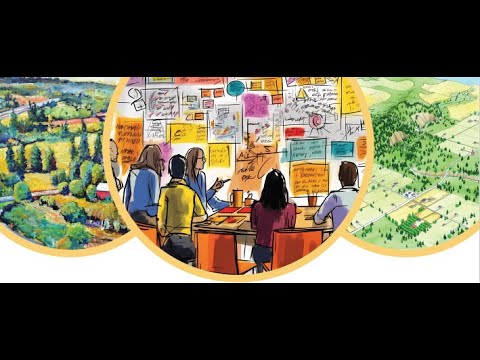
Presenters ran a visual-preference survey and several development-pattern examples (grid/neighborhood, cul-de-sac subdivisions, mixed-use main streets) through a live polling tool (Polleverywhere/Pollev) and asked attendees to mark map locations where they live and to rank "must-haves," "nice-to-haves" and outcomes to avoid. Common priorities the group entered included trails, green space, parks and transit; concerns included loss of rural character and industrial uses near housing.
Staff stressed the legal and procedural limits on how UGAs change: the county will allocate projected growth through a technical capacity analysis in consultation with cities and a steering committee; any expansion of a UGA must be justified in the plan and can be subject to challenge at the state hearings board. The county planner said the update has been underway since earlier technical work and that final recommendations will go to the county board in mid-2026 with adoption scheduled before the end of 2026.
Participants raised local concerns about specific road projects, right-of-way acquisitions and neighborhood trees; staff asked those residents to leave written comments or contact public works separately so staff can follow up. Presenters also noted the county will post the slide deck and a video recording on the county website and add attendees who left contact information to the notification list.
The meeting continued the county's outreach series for the comprehensive plan and sought community input on design standards, connectivity and climate-related priorities that will be translated into policies and implementation strategies for the comp plan.
AI generated
The text on this page is AI generated. Summaries, highlights, analysis, and video transcripts are all produced from the original source material.
AI can make mistakes, so if you spot one, and we will fix it for everyone.
Note: the source content is unaltered by us. Any content source we link to, be it a video, an audio recording, or a document, is presented exactly as its publisher released it. That publisher is usually a government body, sometimes an individual official or another organisation.